How to Tell Real Agarwood: Grain, Scent, Weight, Surface and the Seller, and What Each Check Can’t Prove
No single test proves you have real agarwood. However, five checks together catch most fakes. The five checks are grain in side light, scent cold and warm, weight and density, the surface finish, and how open the seller is. Each check works only when you know the limits of the check. This guide walks through all five, and the common treatments the checks catch.

Written by
Founder & Chief Sourcing Officer, AgarwoodTown
Wang Jianyu is the founder of AgarwoodTown, the agarwood business behind Oudbracelet, trading since 2014. 15+ years grading plantation agarwood and advising buyers on grade selection and CITES paperwork. These guides draw on the same bead geometry our wrist fitter uses and on the questions buyers ask before they approve a weighing video.
In this article
- How do you tell real agarwood?
- Five checks for real agarwood, at a glance
- Where should you start checking for real agarwood?
- Part 1 — What must a fake copy from real agarwood?
- Part 2 — What does the grain of real agarwood look like?
- Part 3 — Real agarwood scent: smell it cold, then warm
- Real agarwood or added scent and colour?
- Part 4 — How do weight and density point to real agarwood?
- What do five possible weights mean for one strand of real agarwood?
- Part 5 — Which surface treatments hide real agarwood?
- What are four treatments that imitate real agarwood resin?
- Part 6 — How do you check a seller of real agarwood before buying?
- What is a four-step check for real agarwood at home?
- What can a close-up show you?
- Part 7 — How do you check real agarwood again after it arrives?
- Why does checking take patience, not a trick?
- Frequently asked questions
 Strand A
 Strand B
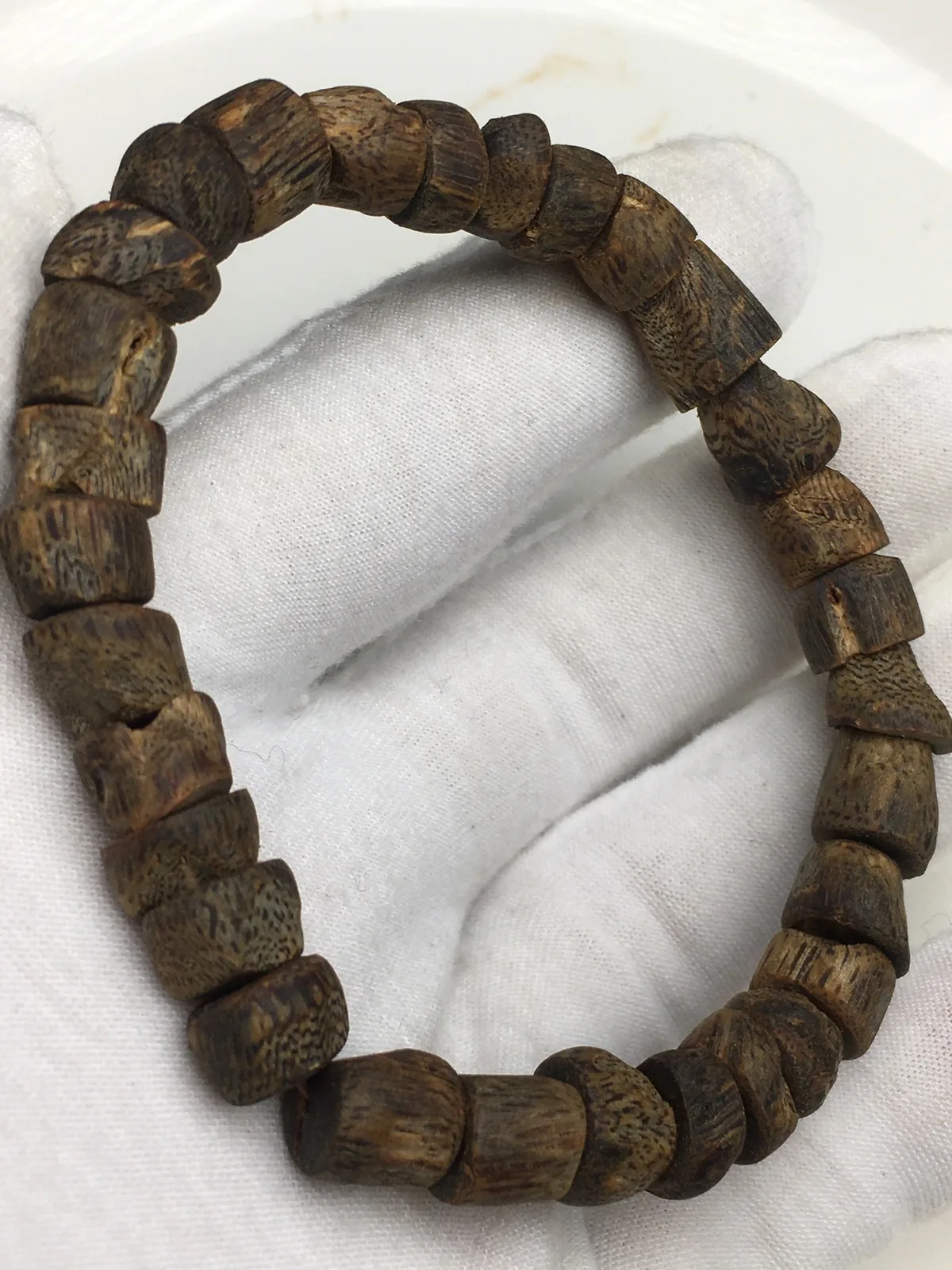
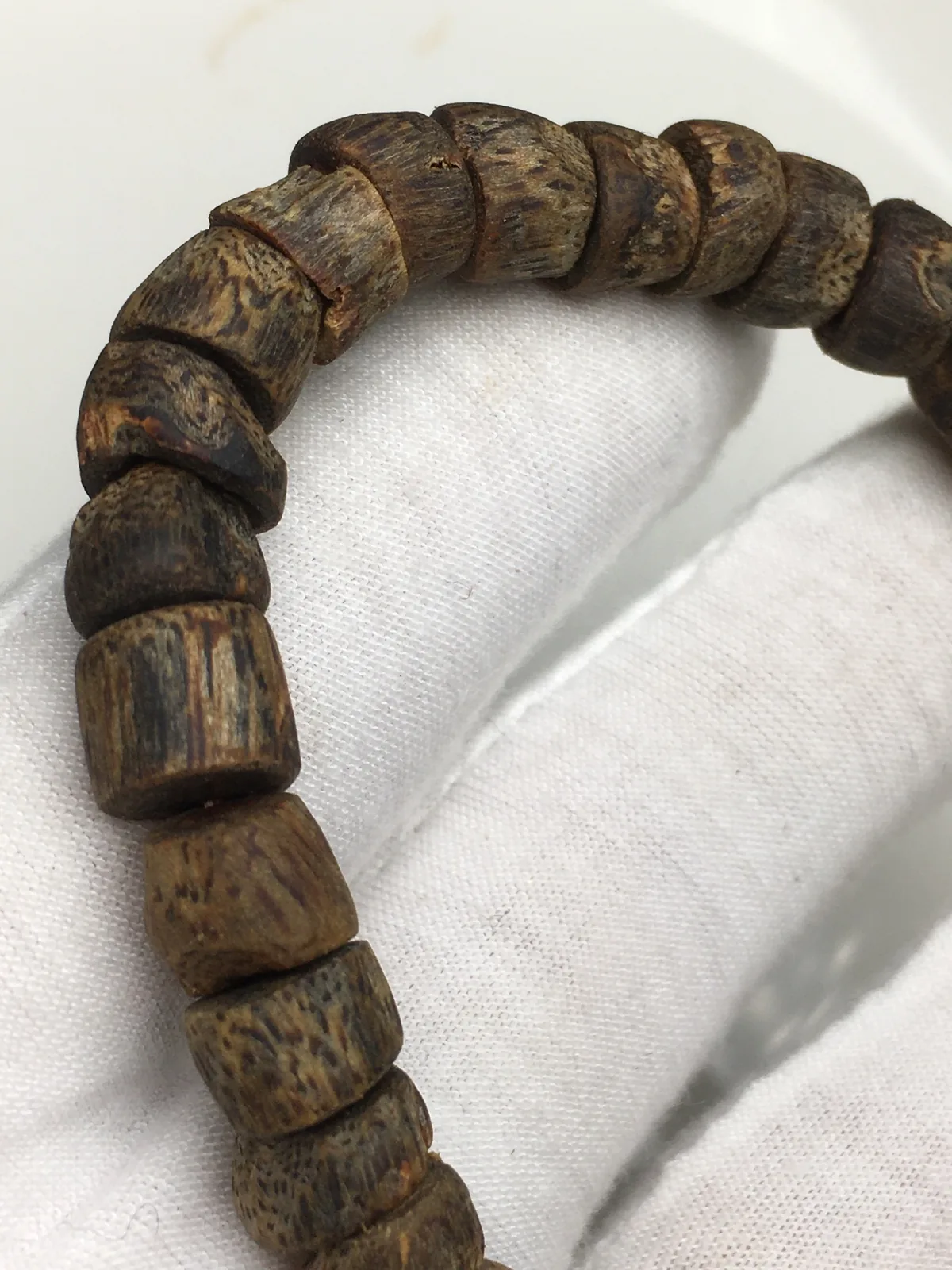
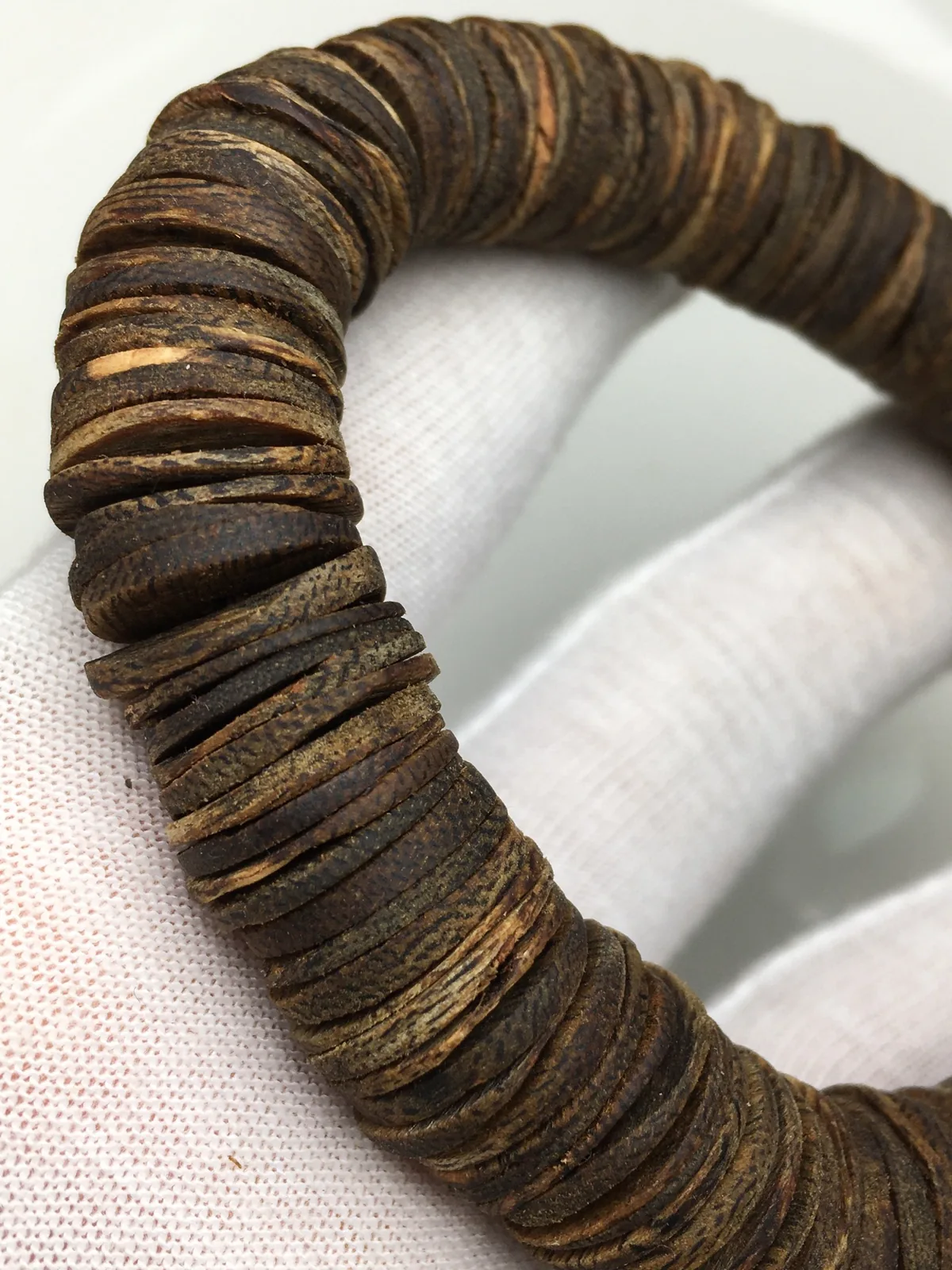
Two strands from our stock: one dark and heavily streaked, one paler with scattered lines. Which one is real agarwood? Both are. So what would a fake get wrong, and how would you notice?
How do you tell real agarwood?
Real agarwood is the resin-filled wood that forms inside Aquilaria trees, and no single test proves a bead is real. Real agarwood varies widely: pale or almost black, faint or strongly scented, floating or sinking. So no one look, smell or number separates real agarwood from a good imitation. What you can do is gather evidence, then see whether the evidence agrees with itself and with the seller’s description.
Oudbracelet is the retail side of AgarwoodTown, which has traded agarwood since 2014. We weigh and film real agarwood from plantations every day. Copying colour, scent and weight all at once is hard, so a fake that passes one check often stumbles on another.
The guide works through five checks: grain, scent cold and warm, weight and density, surface finish, and the seller’s openness. Real agarwood owes the scent to a wide range of compounds formed in the resin, according to Naef in 2011.(Naef 2011) First, the scent is warm and faint, never sharp or perfumed. Then the resin shows as uneven dark lines. Finally, check scent, grain and weight together, not any single test.
Five checks for real agarwood, at a glance
This table is a 5-row summary. First read the check column, then compare the how much it tells you, easy at home?, can suggest, cannot prove, needs across each row. For example, the first row covers “Grain”.
| Check | How much it tells you | Easy at home? | Can suggest | Cannot prove | Needs |
|---|---|---|---|---|---|
| Grain | ★★★★★ | ★★★★★ | Resin is present and uneven, as it should be | How much resin is inside; surface staining | One lamp from the side |
| Scent, cold → warm | ★★★★★ | ★★★★★ | Natural aromatics rather than added perfume | Quality or resin content | Two minutes in a warm hand |
| Weight and density | ★★★★★ | ★★★★★ | Whether the weight fits the size and the claim | Authenticity on its own | A 0.1 g scale, bead size and count |
| Surface and finish | ★★★★★ | ★★★★★ | Coatings, fillers, pressed material | What lies under the surface | Good light; a magnifier helps |
| Seller transparency | ★★★★★ | ★★★★★ | Whether the seller expects to be checked | Anything about one particular strand | A few direct questions |
The star ratings are our own judgement, for comparison only. No check here is a laboratory test. Together they catch most fakes, but alone none of them is conclusive.
Where should you start checking for real agarwood?
This chooser is a 2-question guide with 8 possible answers. First answer “Where are you in the purchase?”, then pick the option that fits, such as “Browsing listings”.
The chooser matches the check to the moment. First, pick where you are in the purchase. For example, a buyer browsing listings needs the buying guide, while a buyer holding a strand can run the density check at once. Second, pick what made you doubt the strand: colour too even, scent too loud, a weight that seems wrong, or a quote that looks too good. Each answer leads to the part of the guide, or the page, that tests the doubt. In practice, a single doubt is a reason to run all five checks, not to give up on the strand.
Part 1 — What must a fake copy from real agarwood?
Agarwood is not a species of tree. Instead, real agarwood is the dark, resin-filled wood that forms inside Aquilaria trees after a wound or infection. The tree slowly deposits resin around the damage as a defence, over years, as a 2019 review by Tan and colleagues describes.(Tan 2019) Plantation agarwood forms the same way, except that growers make the wound on purpose.
The scent comes from a large family of aromatic compounds in the resin, and chemists have catalogued a long list, according to Naef.(Naef 2011) So real agarwood has three traits that matter to a buyer.
First, resin is uneven, so resin shows as streaks and patches through paler wood. Second, resin is heavy, so resin raises the density of the wood. Third, resin is aromatic in a way that responds to warmth. A fake has to copy all three traits of real agarwood at once, and copying all three is where a fake tends to slip.
Part 2 — What does the grain of real agarwood look like?
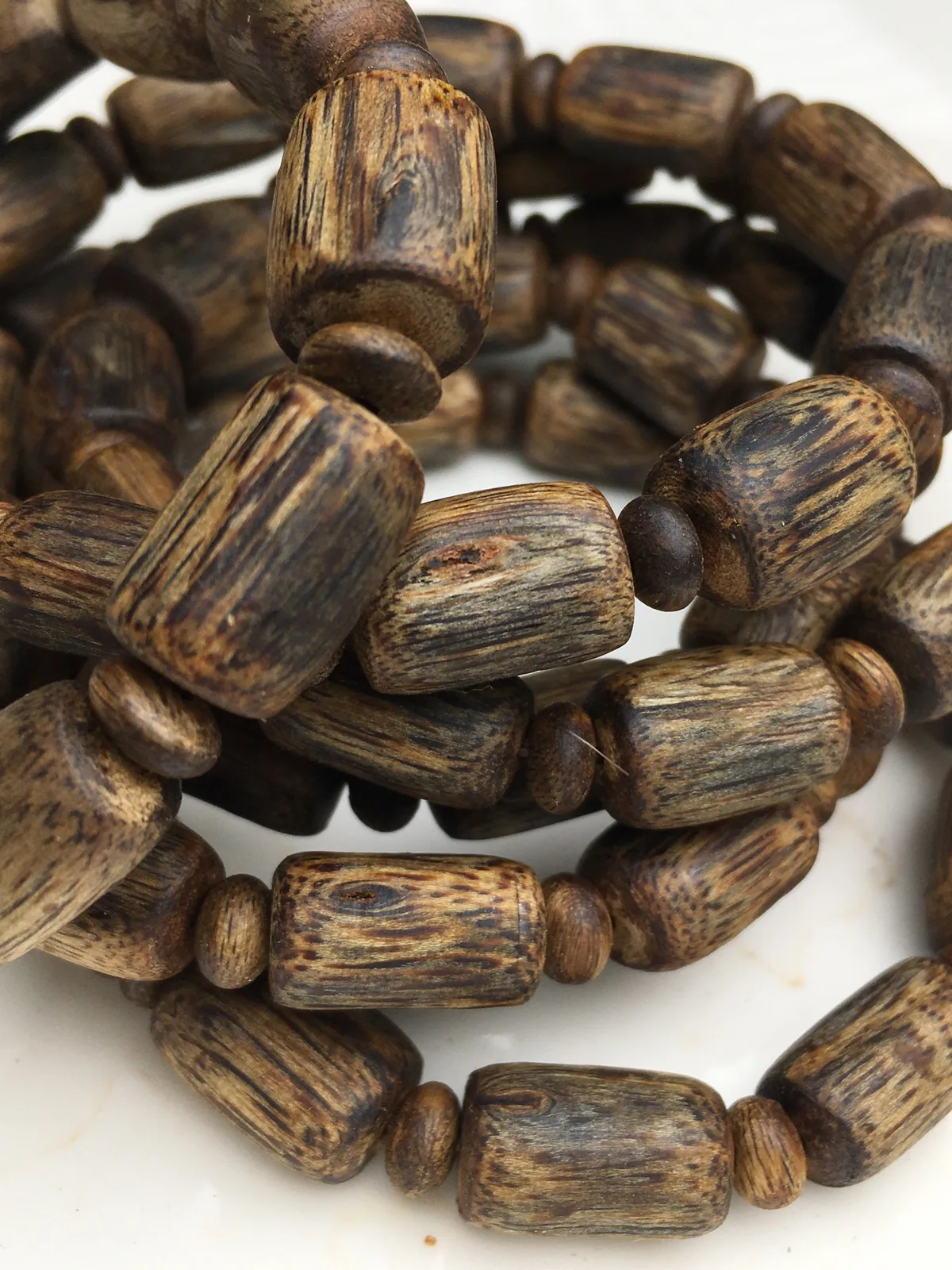
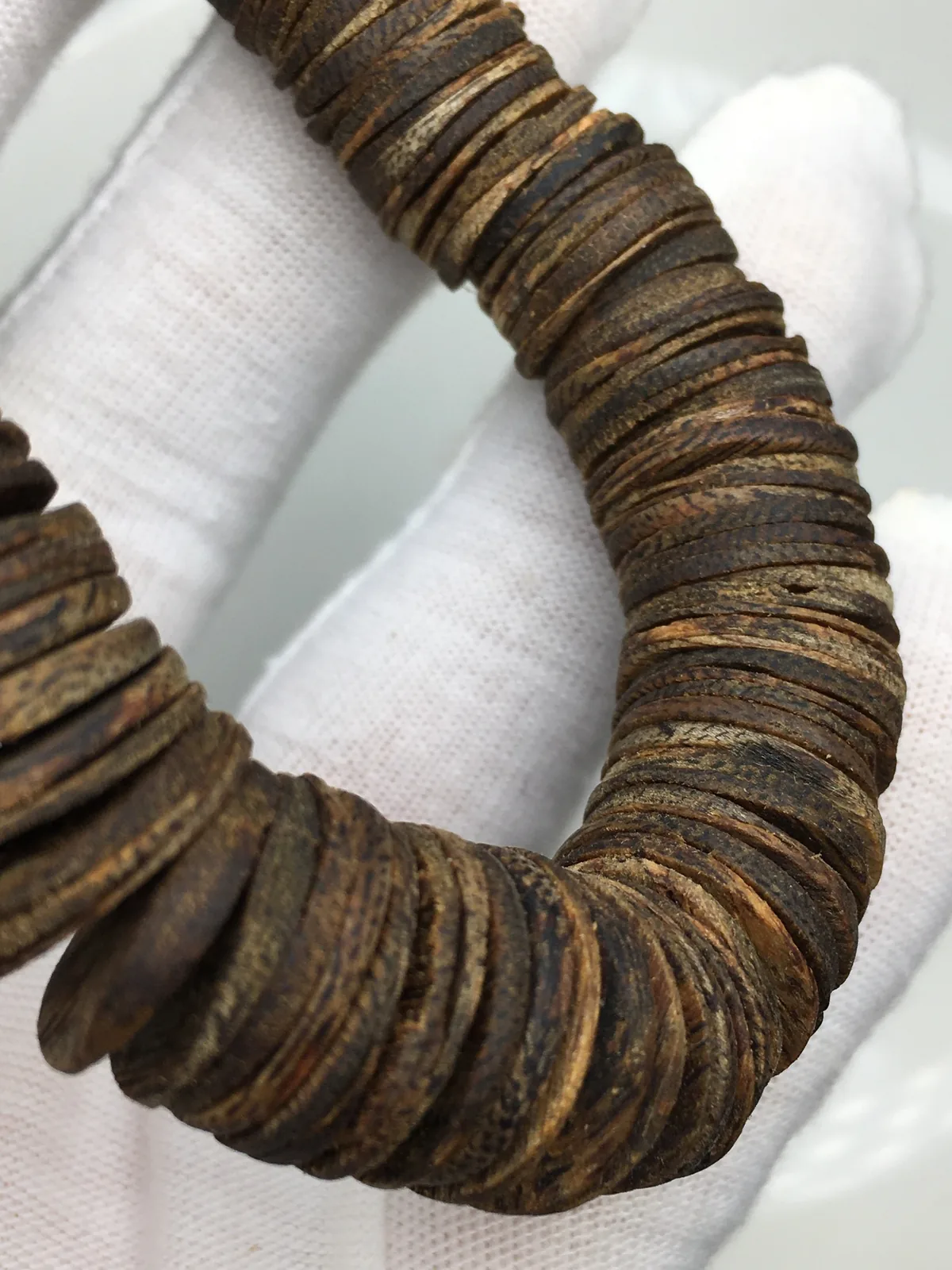
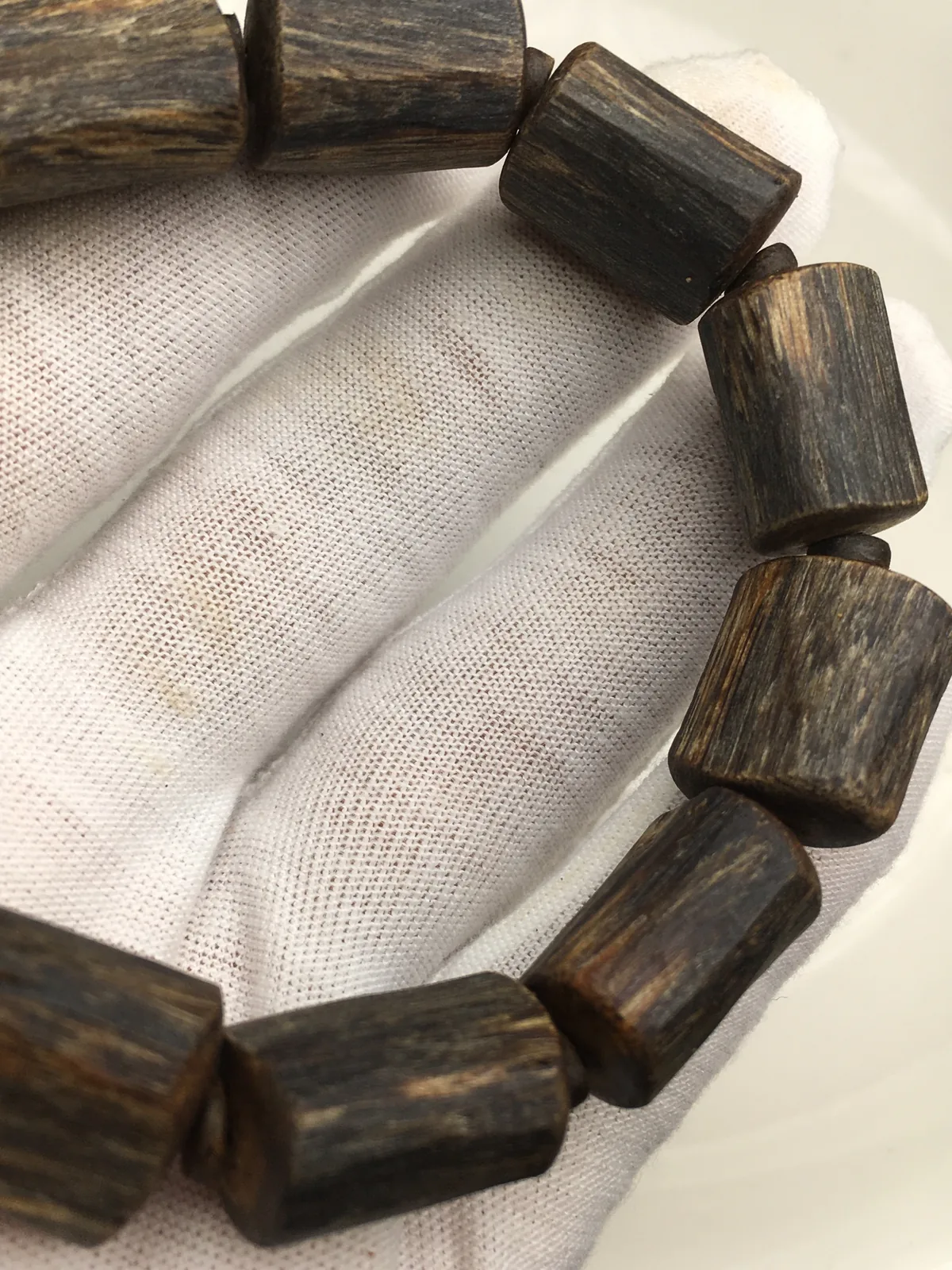
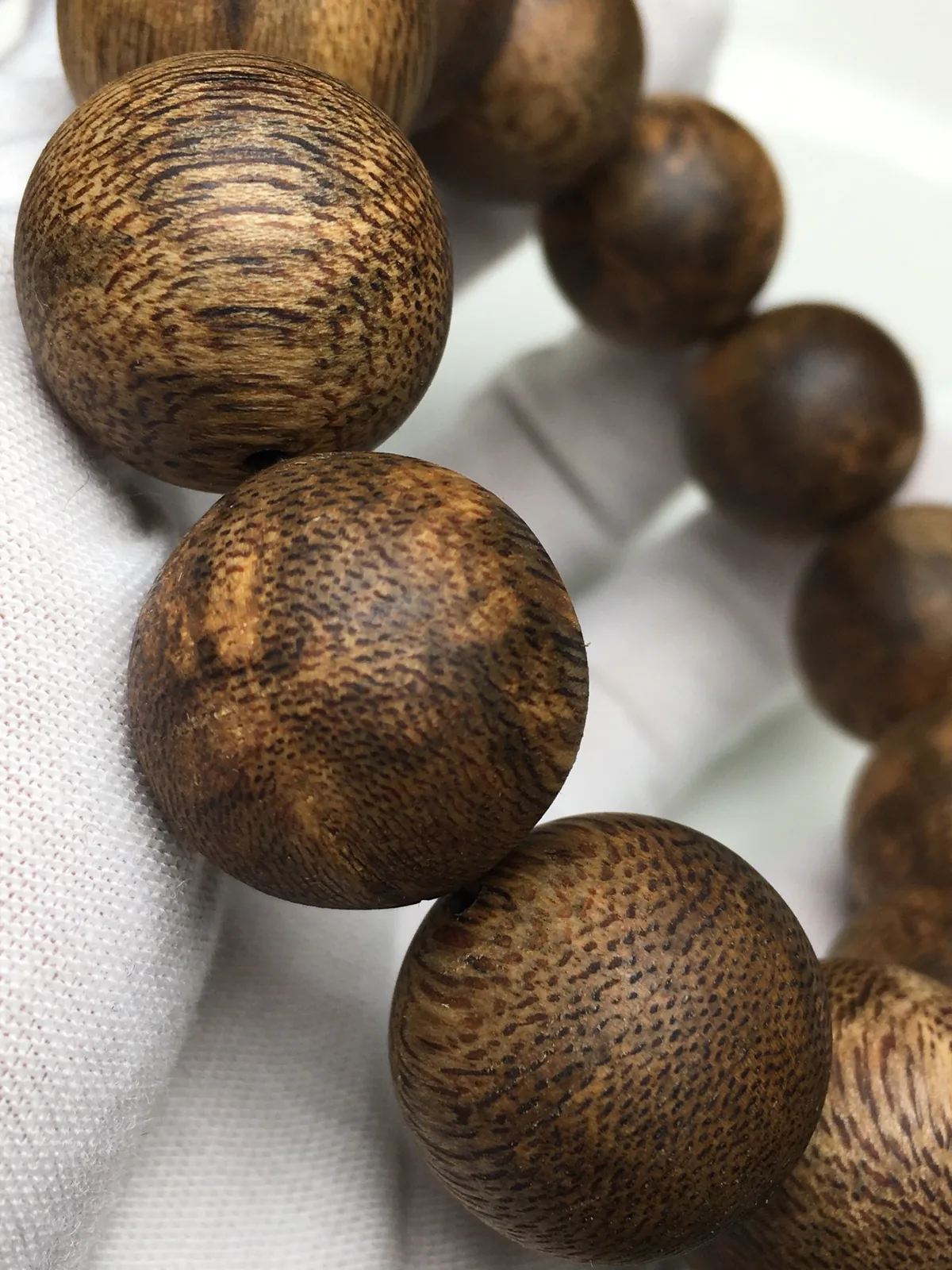
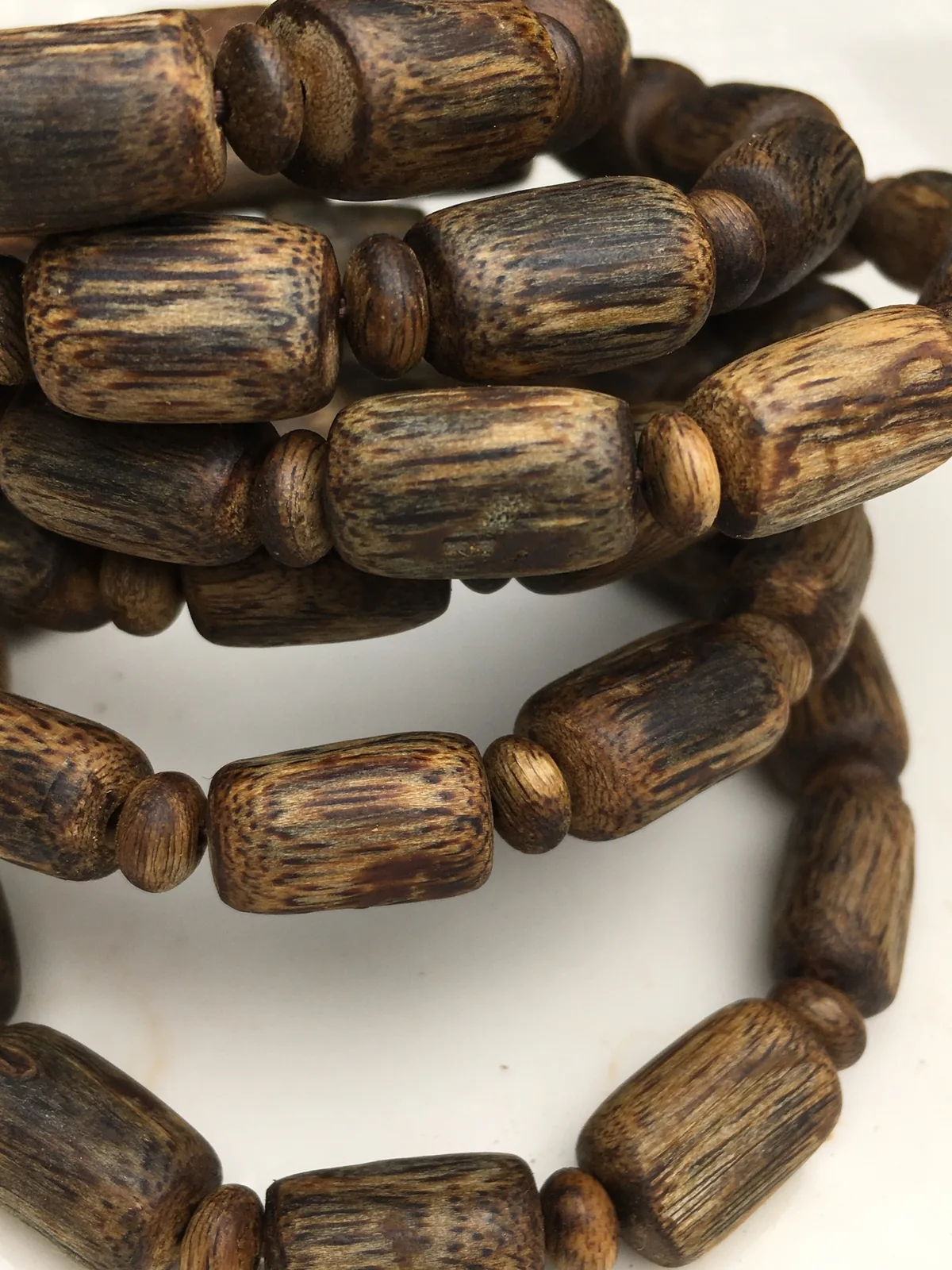
Grain is the first check for real agarwood, because resin is visible: darker resin runs through lighter wood. The pattern should also differ from bead to bead. Round beads show resin as moving rings and flecks, while flat cube faces show long, clear lines.
Good signs: streaks of varying width, and beads that do not match each other perfectly. Warning signs: every bead the same flat, even brown, or colour that sits on top of the wood rather than in the wood. For example, a strand where every bead looks identical deserves a closer look under side light.
However, grain has limits. First, grain cannot tell you how much resin is inside a bead. Second, grain cannot show whether someone stained a pale strand of real agarwood to look richer. Resin forms unevenly after a wound, as a 2019 review by Tan and colleagues describes,(Tan 2019) so irregular lines are exactly what genuine wood shows.
 Along the grain
 Across the grain
Same kind of wood, two cuts. Neither pattern is regular, and no two beads repeat. Irregular, unrepeated patterns are what you want to see in real agarwood.
Part 3 — Real agarwood scent: smell it cold, then warm
The aromatic compounds in real agarwood release more readily when the wood is warm.(Naef 2011) So a genuine strand usually smells faint at room temperature, and noticeably fuller after a minute or two in a closed hand. That change is the thing to look for, more than the strength.
Wood soaked in fragrance oil tends to do the opposite. It gives a strong, sweet smell straight out of the packet, much the same warm or cold. Also, that smell may fade within weeks.
However, scent tells you little about quality. Real agarwood from plantations with modest resin can stay quiet even when warm. Scent also softens with age and storage, and a skilled blend of oils can fool a newcomer. So if you can, smell a strand of real agarwood you trust first. Our guide on whether agarwood beads smell goes further.
Real agarwood or added scent and colour?
This comparison is a 5-point check of Resin-bearing agarwood against Treated or imitation. For example, the first row compares colour. Finally, pick the column that matches what you need.
| Feature | Resin-bearing agarwood | Treated or imitation |
|---|---|---|
| Colour | Dark streaks through paler wood; varies bead to bead | Even, uniform brown; beads match too well |
| Scent, cold | Faint and woody; sometimes barely there | Strong and sweet from the moment the packet opens |
| Scent, warm | Grows and deepens in a warm hand | Stays much the same, or turns sharp |
| Surface | Wood texture and pores visible under the polish | Glassy film, oily feel, or no grain direction at all |
| Over months | Darkens and softens slowly with wear | Added scent fades; coatings can wear in patches |
The comparison sums up the guide in five rows. Resin-bearing agarwood is irregular in colour, quiet in scent when cold, and fuller in scent when warm. Treated or imitation beads, by contrast, look too uniform, smell loud from the start, and hide the wood under a film. For example, a strand smelling strongly sweet straight from the packet and stays the same in a warm hand fails two rows at once. Additionally, time helps: added scent fades over months, while worn real agarwood darkens and softens slowly.
Part 4 — How do weight and density point to real agarwood?
Density is weight divided by volume, and density is the third check because resin makes wood heavier. Most woods are lighter than water, according to Forest Products Laboratory data.(USDA 2010) However, as resin fills real agarwood, the density climbs, and the most resinous pieces sink. The name chénxiāng, “sinking fragrance”, comes from the sinking pieces.
For round beads, the volume is plain geometry: a sphere with a 2 mm hole through the middle. For example, a strand of 17 beads of 12 mm holds about 14.74 cm³ of wood. The table below shows what different weights would mean for the same strand. Additionally, a scale that reads to 0.1 g is enough for the arithmetic.
What do five possible weights mean for one strand of real agarwood?
This table is a 5-row summary. First read the weight on the scale column, then compare the wood volume, density, our working band, sinks? across each row. For example, the first row covers “8 g”.
| Weight on the scale | Wood volume | Density | Our working band | Sinks? |
|---|---|---|---|---|
| 8 g | 14.74 cm³ | 0.54 g/cm³ | Lighter than our working bands — ask why | No |
| 10 g | 14.74 cm³ | 0.68 g/cm³ | Light wood, little resin | No |
| 12 g | 14.74 cm³ | 0.81 g/cm³ | Mid resin | No |
| 14 g | 14.74 cm³ | 0.95 g/cm³ | Resin-rich | No |
| 16 g | 14.74 cm³ | 1.09 g/cm³ | Denser than water — would sink | Yes |
Worked out, not measured: 17 round beads of 12 mm, each with a 2 mm hole. For example, a 12 g strand works out at about 0.81 g/cm³, in the mid band. The bands are the working tiers from our guide to <a href="/blog/how-to-buy-an-agarwood-bracelet/">buy an agarwood bracelet</a>, not an industry standard. Real strands vary, so our <a href="/contact/#density">density check</a> runs the same arithmetic for any size and count.
Part 5 — Which surface treatments hide real agarwood?
The surface is the fourth check, and polished real agarwood should still look like wood under good light. You should see pores and the direction of the grain beneath the shine.
However, a few things are reasons to look harder. First, a thick, glassy film. Second, a tacky or oily feel. Third, colour collecting in the drill hole or in small cracks. Finally, a surface with no grain direction at all.
The cards below describe the treatments buyers most often ask about, in general terms. Methods vary, and we cannot say how common each treatment is. Some treated beads are outright fakes. Others are real agarwood with little resin, dressed up to look like more. For example, stained pale wood can pass at a glance but fails under raking light. Either way, look, scent and weight should agree.
What are four treatments that imitate real agarwood resin?
This section is a set of 4 short notes, from “Stained or dyed wood” to “Pressed from powder”. First scan the 4 titles under “What are four treatments that imitate real agarwood resin?”, then read the note that matches your case.
Stained or dyed wood
Pale wood, sometimes pale real agarwood, coloured to look resin-rich. Stained wood gives itself away through colour too even, sitting on the surface. For example, raking light and a look inside the drill hole help.
Soaked in fragrance oil
Wood soaked in perfume or oil to smell of “agarwood”. The tells are a loud scent unchanged by warmth, an oily feel, and a smell fading noticeably over weeks.
Weighted or injected
Material forced into the wood to raise its weight, so a light strand passes as resin-rich. So check whether the weight agrees with the grain. In real agarwood, dark, heavy resin should be visible, not only implied by the scale.
Pressed from powder
Beads moulded from sawdust or agarwood powder with a binder. Pressed beads can smell of agarwood and weigh what the maker wants. However, look for a grainless, speckled texture, identical on every bead.
Part 6 — How do you check a seller of real agarwood before buying?
Seller transparency is the fifth check, and the only check you can run on a listing photo. Before buying, look at how the seller behaves. A seller of real agarwood has no reason to hide the weight, the bead size or the bead count. A good seller should also happily show the actual strand rather than a catalogue picture.
Two things deserve caution. The first is “wild agarwood” at a low fixed price, in any size. Wild wood is scarce and regulated, since every Aquilaria species sits in CITES Appendix II,(CITES) so the numbers do not add up. The second is a certificate with no named laboratory, or a promise about what a bead will do for you. Neither tells you anything about whether a strand is real agarwood. For example, ask for the exact weight, the bead count and a video of the actual strand, and judge the answers.
What is a four-step check for real agarwood at home?
This process is a 4-step sequence, from “Side light” to “Compare”. First follow step 1, then work down the 4 steps of “What is a four-step check for real agarwood at home?” in order.
- 1
Step 1: Side light
Lay the strand on a plain surface under one low lamp. Then turn each bead, and look for irregular dark lines through lighter wood and for any glassy film.
- 2
Step 2: Cold, then warm
Smell the beads at room temperature, and note the strength. Then hold the strand in a closed hand for two minutes and smell again. The scent should grow, not stay flat and perfumed.
- 3
Step 3: Weigh and measure
Weigh the strand on a scale that reads to 0.1 g. Also count the beads, and measure one bead across with a ruler or calliper.
- 4
Step 4: Compare
Run the numbers through the density check. Then set all four results side by side with what the seller told you, because agreement matters more than any single result.
We sell real agarwood from plantations only, and our process follows the same checks. First you choose. Then we weigh and film the strand, with the weight on the display. Next, you approve or ask for another, and we send a PayPal invoice and ship.
Sales are final after you approve and we ship, so the video comes first. Still, transit damage, or a piece that differs from your video, is on us: we replace the piece (final sale policy). We also quote sinking-grade wood separately, on request.
What can a close-up show you?
Part 7 — How do you check real agarwood again after it arrives?
This timeline is a 5-stage sequence, from “Compare with the video” to “Let the wood age”. First read “Part 7 — How do you check real agarwood again after it arrives?” from top to bottom, since each stage follows the one before.
- On arrivalCompare with the videoCheck the bead count and size. Then match a few distinctive beads against the video.
- Same dayWeigh the strandA small difference between scales is normal. However, raise a large one with the seller at once.
- First weekCold and warm scentSmell the beads cold and warm on a few different days. Does the scent grow with warmth, as real agarwood does, or stay loud and flat?
- First weeksWatch for residueAfter a dry wipe, look for colour on a white cloth or an oily film on your skin. Genuine polished beads leave neither.
- Over monthsLet the wood ageWorn real agarwood usually darkens and softens slowly. Added scent, however, tends to fade, and coatings can wear through in patches.
Why does checking take patience, not a trick?
Telling real agarwood from a fake is a matter of patience, not a trick. First, look at the grain in side light. Second, smell the beads cold and warm. Third, do the arithmetic on the weight and examine the surface. Finally, listen to how the seller answers your questions. When all five checks agree, you can be reasonably confident. When one check jars, however, ask again before you pay.
Also, be fair to pale, quiet strands. Plenty of honest, real agarwood is light, floats, and smells faint until warm. For example, a 17-bead strand of 12 mm beads that weighs 10 g sits in the light band of the table above, yet the wood can be entirely genuine. The goal is a strand that matches the seller’s description exactly.
Frequently asked questions
This FAQ is a set of 8 short answers about how to tell real agarwood. First find your question below. For example, many facts in these answers about how to tell real agarwood come from the 5 published sources in References, which we checked in September 2026.
Is there one test that proves agarwood is real?
No. Grain, scent, density, surface and the seller’s answers each give you a piece of evidence, and each can be fooled on its own. Taken together, however, they catch most fakes. Laboratory analysis is the rigorous method, but it is rarely practical for one bracelet. So look for agreement between checks of real agarwood.
Why does my real agarwood bracelet barely smell?
Real agarwood usually smells faint at room temperature and fuller when warm, for example after a minute or two in a closed hand. Plantation strands with modest resin can stay quiet even when warm, and scent softens with time and storage. So a faint scent is normal, while a loud, sweet perfume that never changes is the warning sign.
Should I burn a bead to test it?
We do not recommend it. Burning damages or destroys the bead. The smoke is also hard to judge unless you already know real agarwood well, and scented fakes can smell pleasant too. So the gentle checks in this guide tell you more, without harming a strand you may want to keep.
Can dyed wood look like real agarwood?
Yes. Stained or dyed wood can copy the colour, but it usually looks too uniform: every bead the same flat brown, with no lighter wood showing. Real resin, however, runs in irregular streaks. So raking side light, and a look inside the drill hole, make the difference much easier to see.
What are pressed agarwood beads?
They are beads moulded from sawdust or agarwood powder mixed with a binder, instead of cut from solid wood. They can smell of agarwood and weigh whatever the maker wants. However, under a magnifier they tend to show a speckled, grainless texture that looks the same on every bead, with no direction to the pattern.
If my beads float, are they fake?
No. Only wood denser than water sinks, and most real agarwood, especially from plantations, floats. Equally, sinking does not prove a bead is genuine, because sellers can weight wood and press dense beads. So treat floating or sinking as one piece of evidence among several.
Is plantation agarwood real agarwood?
Yes. It forms the same way, as resin an Aquilaria tree lays down in response to a wound. The only difference is that growers make the wound on purpose in cultivated trees. Resin content still varies from tree to tree. We sell plantation wood only, and we say so on every page.
What should I ask a seller before I buy?
Ask for the exact weight of the strand you will receive, the bead size and count, and whether it is plantation or wild. Also ask to see a video of that piece rather than a catalogue photo. For international orders, ask what paperwork applies. A seller of real agarwood should answer all of these plainly.
References
This reference list is the source record for “How to Tell Real Agarwood: Grain, Scent, Weight, Surface and the Seller, and What Each Check Can’t Prove”, with 5 published sources. According to the citations in “How to Tell Real Agarwood: Grain, Scent, Weight, Surface and the Seller, and What Each Check Can’t Prove”, such as (Tan 2019), each one links to one entry below. Finally, we checked all 5 links behind “How to Tell Real Agarwood: Grain, Scent, Weight, Surface and the Seller, and What Each Check Can’t Prove” in September 2026.
- 1Tan C.S., Isa N.M., Ismail I., Zainal Z.. Agarwood induction: current developments and future perspectives. Frontiers in Plant Science 10: 122, 2019.doi:10.3389/fpls.2019.00122
- 2Naef R.. The volatile and semi-volatile constituents of agarwood, the infected heartwood of Aquilaria species: a review. Flavour and Fragrance Journal 26(2): 73–87, 2011.doi:10.1002/ffj.2034
- 3Forest Products Laboratory. Wood Handbook — Wood as an Engineering Material (General Technical Report FPL-GTR-190). USDA Forest Service, 2010.View source
- 4Wang Y., Hussain M., Jiang Z., et al.. Aquilaria species (Thymelaeaceae) distribution, volatile and non-volatile phytochemicals, pharmacological uses, agarwood grading system, and induction methods. Molecules 26(24): 7708, 2021.doi:10.3390/molecules26247708
- 5CITES Secretariat. Appendices I, II and III. Convention on International Trade in Endangered Species of Wild Fauna and Flora, current.View source
References are listed for transparency. We summarise them for general reading; nothing here is medical advice, and no health effect is claimed.
In this article
Styles mentioned
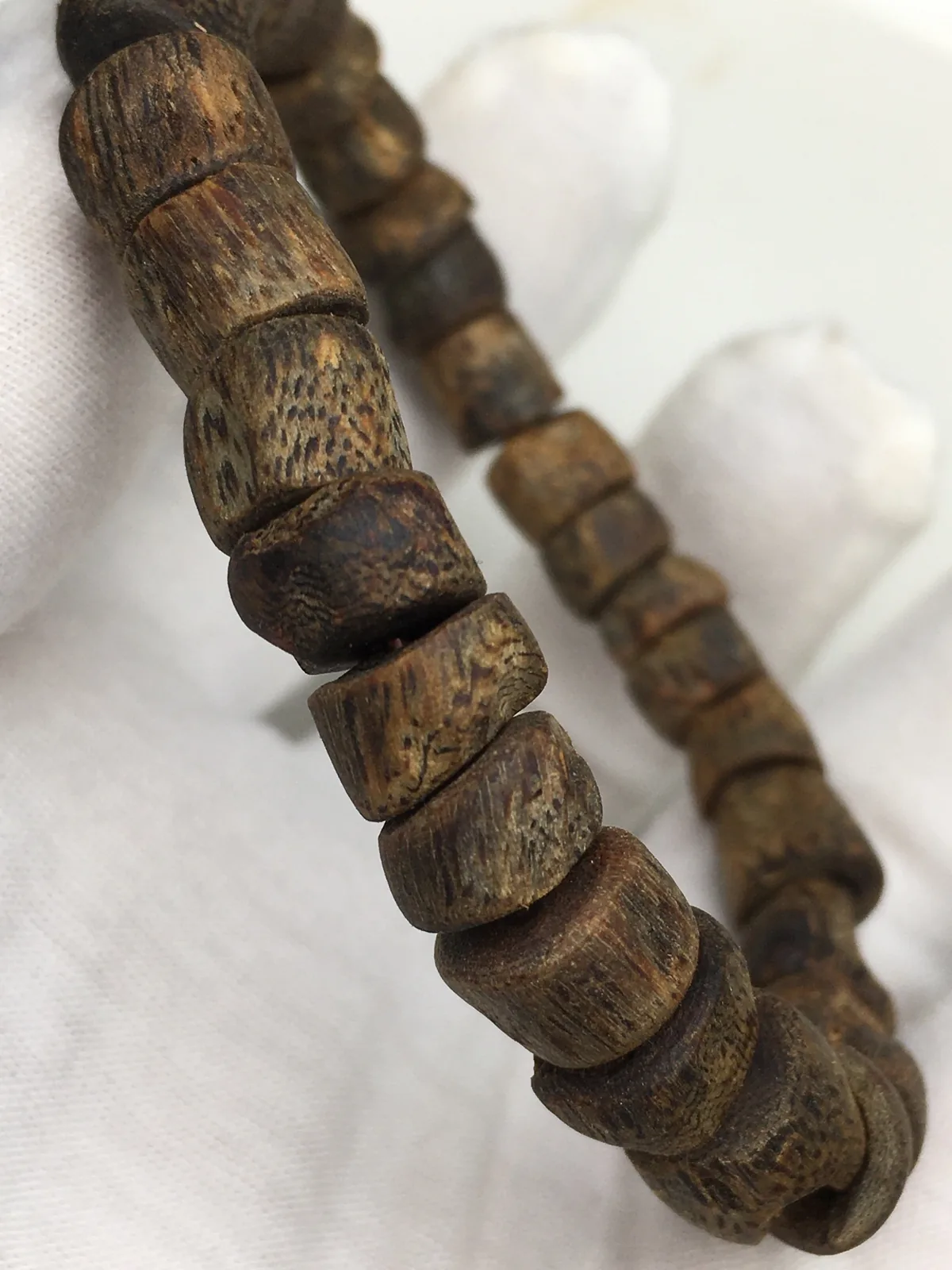



Browse more: Agarwood Bracelets
Related articles
Weighed before you pay
Choose a style, get your strand weighed
Pick a bead and size, send your request, and we reply with a video of your piece on the scale — its exact weight and price. Nothing is charged until you approve.