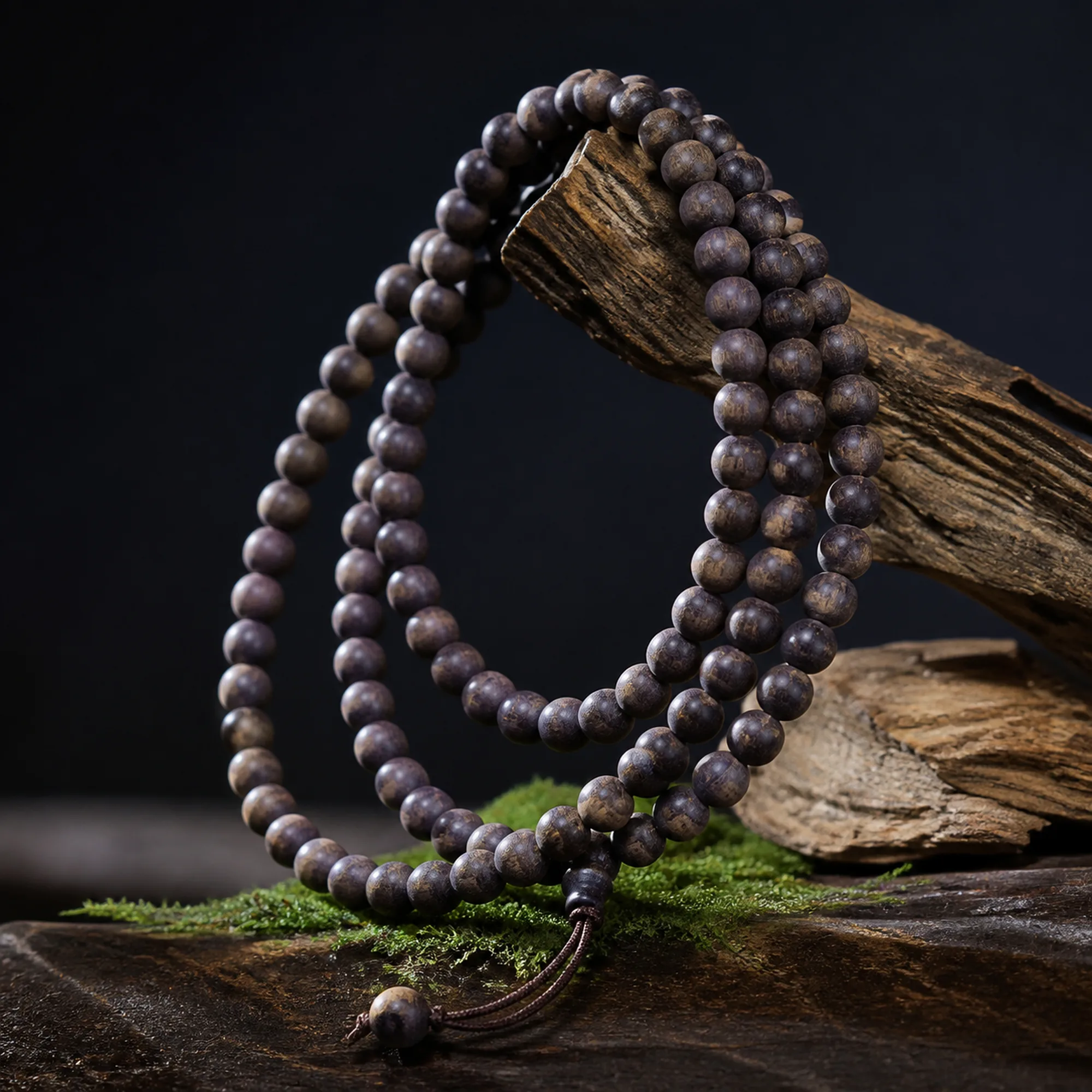
Agarwood and Sandalwood Compared, with Ebony, Rudraksha and Stone Beads
Agarwood and sandalwood are the only two bead woods with a real scent, so this guide starts there. Then it compares both with rosewood, ebony and karungali, bodhi seed, rudraksha, lava stone, obsidian and onyx, tiger’s eye, jade and amber, on scent, weight, hardness and care. It also says plainly where another material is the better buy.

Written by
Founder & Chief Sourcing Officer, AgarwoodTown
Wang Jianyu is the founder of AgarwoodTown, the agarwood business behind Oudbracelet, trading since 2014. 15+ years grading plantation agarwood and advising buyers on grade selection and CITES paperwork. These guides draw on the same bead geometry our wrist fitter uses and on the questions buyers ask before they approve a weighing video.
In this article
- How do agarwood and sandalwood differ?
- Agarwood and sandalwood beside other bead materials, at a glance
- Agarwood and sandalwood or something else? Two questions
- Part 1 — Three questions that separate agarwood and sandalwood from other beads
- The one number we can calculate: agarwood strand weight
- Part 2 — Why are agarwood and sandalwood the two scented woods?
- Which of agarwood and sandalwood will suit you?
- Agarwood and sandalwood, side by side
- Part 3 — How do ebony and rosewood compare with agarwood and sandalwood?
- Is rosewood a better buy than agarwood?
- Part 4 — Why are bodhi seed and rudraksha lighter than agarwood and sandalwood?
- Are seed beads better than agarwood and sandalwood for counting?
- Part 5 — How do stone, glass and fossil resin compare with agarwood and sandalwood?
- Where do tiger’s eye, jade and amber fit?
- Part 6 — When should you skip agarwood and sandalwood?
- If you choose agarwood over sandalwood: how buying from us works
- What agarwood grain looks like moving
- Part 7 — How do you care for agarwood and sandalwood, and the rest?
- Finally: agarwood and sandalwood, or neither?
- Frequently asked questions
 Strand A
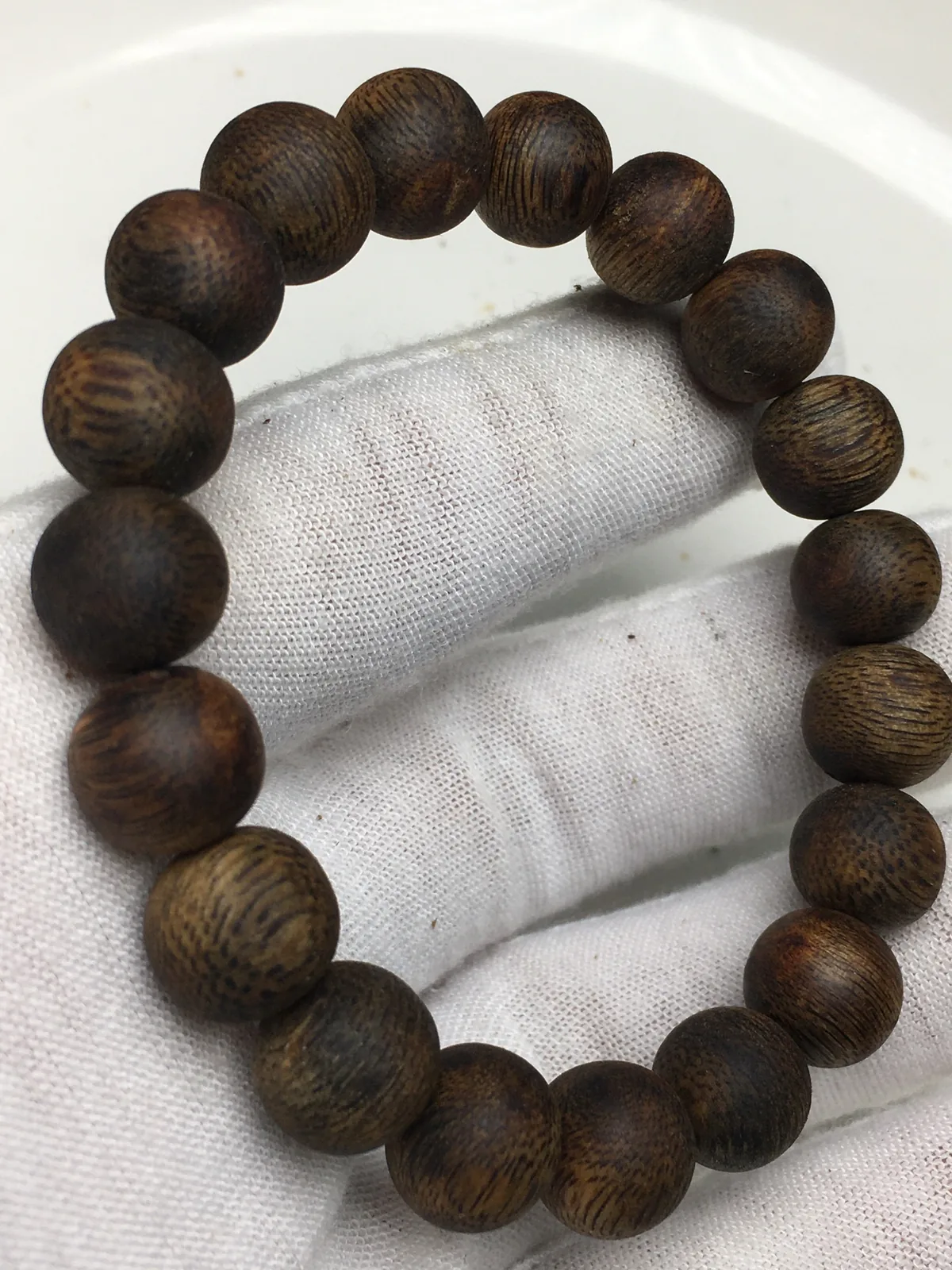 Strand B
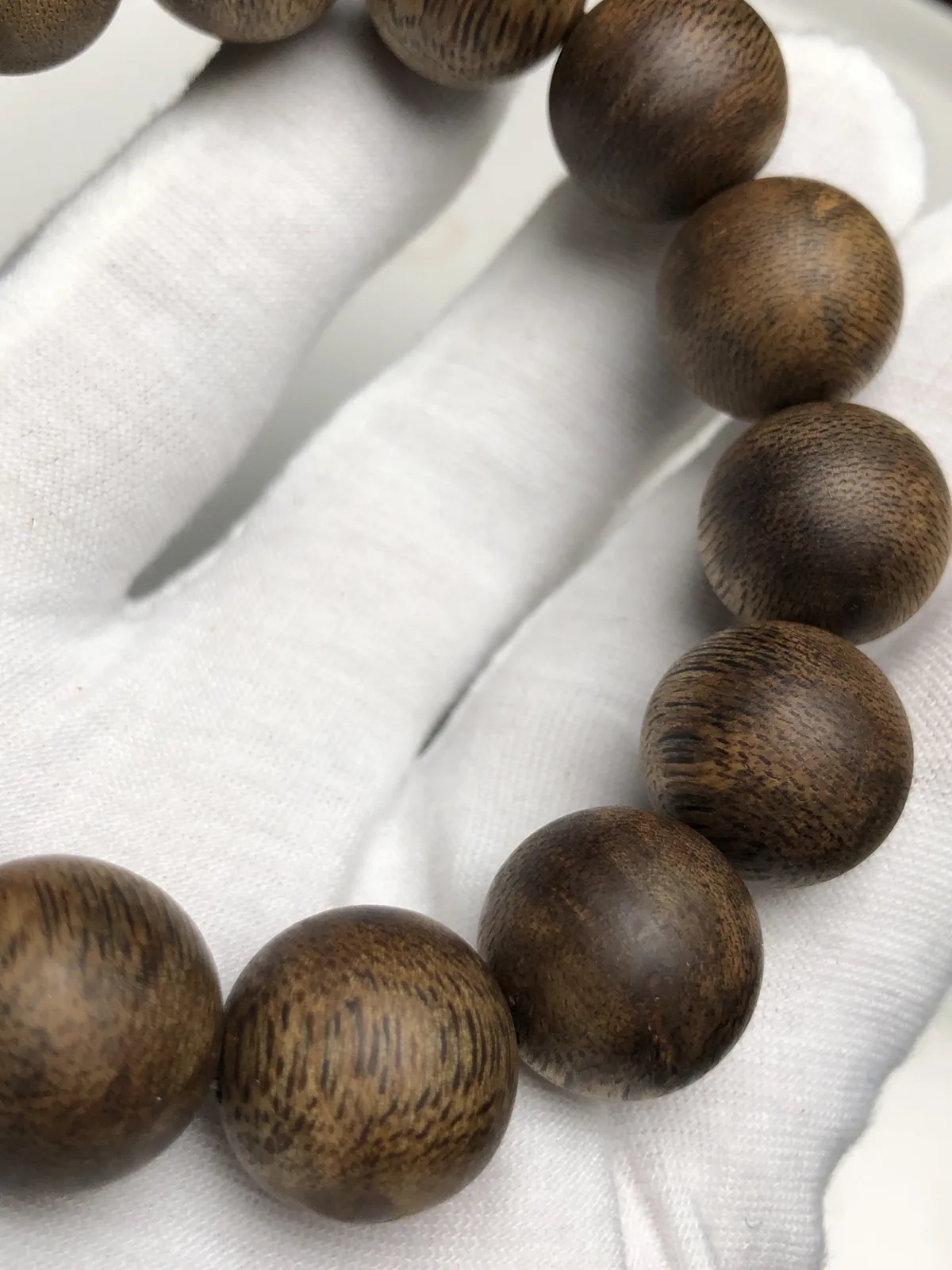
Both of these are agarwood. In a photo, though, a dark bead could be ebony, stained rosewood, pressed sawdust or dyed anything. Colour tells you least about what a bead is made of. Yet it is the only thing a photo shows well.
How do agarwood and sandalwood differ?
Nobody chooses between agarwood and nothing; the real choice is often agarwood and sandalwood. Instead, they choose between agarwood and sandalwood, rosewood, ebony, a seed bead and half a dozen stones. Listings, however, rarely explain how those differ on a wrist.
So this guide uses agarwood and sandalwood, the two scented woods, as the benchmark. Then it compares every other material against them. As for us, Oudbracelet is the consumer shop of AgarwoodTown, an agarwood trader since 2014. We sell one material. So treat what follows about the others as what an interested neighbour would tell you: checkable facts only. Where another material is the better buy, we say so.
Agarwood, unlike sandalwood, is the odd one out. It is not a species but a resin that forms inside wounded Aquilaria trees over years.(Tan 2019) That is why no two pieces weigh the same, and why people call it the most expensive wood in the world. Between agarwood and sandalwood, only agarwood sells by weight. Everything else here, sandalwood included, sells by the piece.
According to Naef (2011), the scent of agarwood comes from a wide range of volatile compounds formed in its resin.(Naef 2011) First, sandalwood carries its scent evenly in the heartwood. Then agarwood carries it unevenly, only where resin formed. Finally, that is why agarwood and sandalwood beads look, smell and weigh so differently.
Agarwood and sandalwood beside other bead materials, at a glance
This table is a 11-row summary. First read the material column, then compare the scent, weight, same bead size, hardness and wear, in plain words, care it needs across each row. For example, the first row covers “Agarwood”.
| Material | Scent | Weight, same bead size | Hardness and wear, in plain words | Care it needs |
|---|---|---|---|---|
| Agarwood | ★★★★★ quiet cold, clearer warm; lasts | Light to medium; the more resin, the heavier | Soft as woods go; dents and scuffs, does not chip | Dry only. No water, perfume or oil |
| Sandalwood | ★★★★★ sweet, milky, there without warming | Light, and even from bead to bead | Moderately hard for a wood; wears smooth | Dry, cool, out of the sun; scent fades over years |
| Rosewood (Dalbergia) | ★★★★★ faintly sweet when cut, gone once polished | Heavier than agarwood or sandalwood | Hard, oily, takes a glassy polish | Very little; a dry wipe. Keep off radiators |
| Ebony, karungali (Diospyros) | ★★★★★ none | The heaviest of the woods; some sinks in water | Hardest of these woods; can crack, rarely dents | Dry wipe; traditionally given a light oiling |
| Bodhi seed | ★★★★★ faint, nutty at most | Very light — the lightest thing here | Hard shell, but it can split if it dries fast | Handle often; avoid dry heat and sudden soaking |
| Rudraksha | ★★★★★ faint, woody-earthy | Light; a big strand still feels like nothing | Tough fruit stone; ridges trap dirt and wear shiny | Keep dry, clean the grooves, traditional light oiling |
| Lava stone (basalt) | ★★★★★ none of its own | Light for a stone; heavier than any wood here | Hard but porous and brittle at the edges | Rinse and dry; it soaks up oil, soap and scent |
| Obsidian, black onyx | ★★★★★ none | Several times an agarwood bead | Glass-hard surface; obsidian chips, onyx is tougher | Wipe clean; keep knocks off hard floors |
| Tiger’s eye | ★★★★★ none | Several times an agarwood bead | A quartz — hard, scratch-resistant, everyday-proof | Almost none; soap and water is fine |
| Jade: jadeite, nephrite | ★★★★★ none | Several times an agarwood bead; the heaviest here | Hard and unusually tough; resists breaking | Mild soap and water; avoid sudden heat |
| Amber | ★★★★★ faint pine-resin smell when rubbed | Light for a stone — closer to wood than to rock | Soft; scratches, scuffs and dulls with hard wear | The fussiest: no alcohol, perfume, solvent or heat |
This is our working summary, not an industry standard. Scent stars show how strongly a finished, unheated bead smells on the wrist, which differs from the raw material. We compare weight at the same bead size and cut. Also, we describe hardness in plain words on purpose, because mineral hardness scales say little about how a bead survives a kitchen floor.
Agarwood and sandalwood or something else? Two questions
This chooser is a 2-question guide with 8 possible answers. First answer “What do you actually want from it?”, then pick the option that fits, such as “Scent”.
The first question is the one most buyers skip. Scent points to agarwood and sandalwood, since no other material here smells once finished. Colour points to stone, and warmth points to amber. The second question then narrows the form. For example, a buyer who wants scent and counts prayers ends up with a wooden mala. In practice, two honest answers rule out most of the table above.
Part 1 — Three questions that separate agarwood and sandalwood from other beads
Strip away the marketing, and bead materials differ in three ways you can test yourself. First, does it smell? Almost nothing does. Of everything here, only agarwood and sandalwood give off real scent once finished, plus amber faintly when rubbed. Rosewood and ebony beads are essentially scentless, and stone has no scent of its own.
Second, what does it weigh? Wood is mostly air. Most woods are less dense than water,(USDA 2010) so a wooden strand disappears on the wrist and a stone one announces itself. Ebony is the exception among woods, dense enough that some pieces sink. Between agarwood and sandalwood, agarwood is the exception for a different reason. Resin fills the wood, so one bead can far outweigh its neighbour.
Third, how hard is it? Every stone here is far harder than every wood, and that cuts both ways. Hard materials shrug off the scrapes that mark agarwood and sandalwood. However, they chip on a tiled floor where a wooden bead bounces. So softness is not a defect. It is why agarwood and sandalwood slowly take on the shine of whoever wears them.
The one number we can calculate: agarwood strand weight
This table is a 5-row summary. First read the bead size column, then compare the beads (16 cm wrist), wood in the strand, typical weight, would sink above across each row. For example, the first row covers “8 mm”.
| Bead size | Beads (16 cm wrist) | Wood in the strand | Typical weight | Would sink above |
|---|---|---|---|---|
| 8 mm | 24 | 5.8 cm³ | 3.5–5.5 g | more than 5.8 g |
| 10 mm | 20 | 9.8 cm³ | 5.9–9.4 g | more than 9.8 g |
| 12 mm | 17 | 14.7 cm³ | 8.8–14 g | more than 15 g |
| 14 mm | 15 | 20.9 cm³ | 13–20 g | more than 21 g |
| 16 mm | 14 | 29.3 cm³ | 18–28 g | more than 29 g |
Calculated, not measured: round beads with a 2 mm hole, a standard fit of about 1 cm of room, and our density band of 0.6–0.95 g/cm³, with the same geometry as our wrist fitter. We give no figures for sandalwood or the other materials, because we do not weigh them and will not invent numbers. So compare by hand instead.
Part 2 — Why are agarwood and sandalwood the two scented woods?
Agarwood and sandalwood are the two bead woods that truly smell good. However, the two woods carry scent differently. Sandalwood (Santalum album and its relatives) carries its scent through the heartwood as an oil. The oil is sweet, milky and simply there from the moment you open the packet, and strongest when the beads are new.
Agarwood, by contrast, is quiet when cold. Its aromatic compounds are a large family that chemists are still cataloguing.(Naef 2011) The compounds sit in the resin and read best with body heat. So agarwood and sandalwood reward different habits: sandalwood rewards opening the box, and agarwood rewards wearing the strand. For example, a cold agarwood bead may smell of almost nothing until a few minutes on the wrist.
Which of agarwood and sandalwood will suit you?
The answer depends on whether you want scent now or scent that lasts. Sandalwood is the more immediately rewarding scented bracelet, and much cheaper than agarwood. Sandalwood is also the wood that fades, so a strand worn daily for years smells of far less than when new. Agarwood, however, starts quieter and keeps going, because the resin is the material itself, not a treatment. The trade-off is that resin varies strand to strand, so we weigh every agarwood strand on camera.
There are also two honest warnings. First, much of what sells as sandalwood is cheap pale wood dosed with fragrance oil: overwhelming at first, then gone within months. Second, red sandalwood (Pterocarpus santalinus) is a different tree with essentially no scent. Finally, when you compare agarwood and sandalwood, make sure the sandalwood is real Santalum.
Agarwood and sandalwood, side by side
This comparison is a 6-point check of Agarwood against Sandalwood. For example, the first row compares scent, cold. Finally, pick the column that matches what you need.
| Feature | Agarwood | Sandalwood |
|---|---|---|
| Scent, cold | Faint; you have to look for it | Clearly there as soon as you open the box |
| Scent, warm | Opens up on the wrist and after handling | Warmer, but not much different |
| Over years | Persists; the resin is the wood | Fades; a light sanding is the traditional remedy |
| Consistency | Varies strand to strand, which is why we weigh it | Predictable from bead to bead |
| Look | Dark streaks over paler ground; the grain is the point | Even, pale gold to tan; plain and calm |
| Budget | The expensive option, honestly | Far easier on a budget at any bead size |
The table comes down to one trade. Sandalwood is the predictable choice: even colour, even scent and an even price per bead. Agarwood is the variable choice, because resin decides scent, colour and weight bead by bead. According to Naef, agarwood scent comes from a large family of compounds in that resin. In practice, buy sandalwood for scent today and agarwood for grain and scent that last.
Part 3 — How do ebony and rosewood compare with agarwood and sandalwood?
Ebony and rosewood are the two dark hardwoods you will meet most often in bead bracelets. Ebony, the genus Diospyros, sells in South India under the Tamil name karungali. Among woods in common bead use, ebony is the densest, far heavier than agarwood and sandalwood. Most woods are less dense than water, according to the USDA Wood Handbook, yet some ebony sinks.(USDA 2010) Real ebony heartwood is close to black, and the wood takes a polish that reads almost as stone.
Unlike agarwood and sandalwood, ebony has no scent whatever. Ebony is also brittle for a wood. So an ebony bead resists dents but can crack, especially after drying out fast. For example, a strand left on a radiator is more at risk than a strand worn daily.
Is rosewood a better buy than agarwood?
Rosewood is a trade name for many Dalbergia species, in colours from pale orange-brown to purple-black. Rosewoods are hard, oily woods that polish beautifully and cost a fraction of agarwood. Fresh-cut rosewood has a faint sweetness, hence the name. However, a finished bead smells of nothing you will notice, unlike agarwood and sandalwood. Additionally, CITES lists the whole Dalbergia genus, mostly in Appendix II.(CITES)
The honest comparison follows. If you want a dark, hard-wearing wooden bracelet that needs almost no care, ebony or rosewood does it better than agarwood, and for far less. Agarwood wins only if the resin matters to you: the scent, the streaked grain, the weight. Otherwise, you pay for resin you will never use.
 Cube cut
 Barrel cut
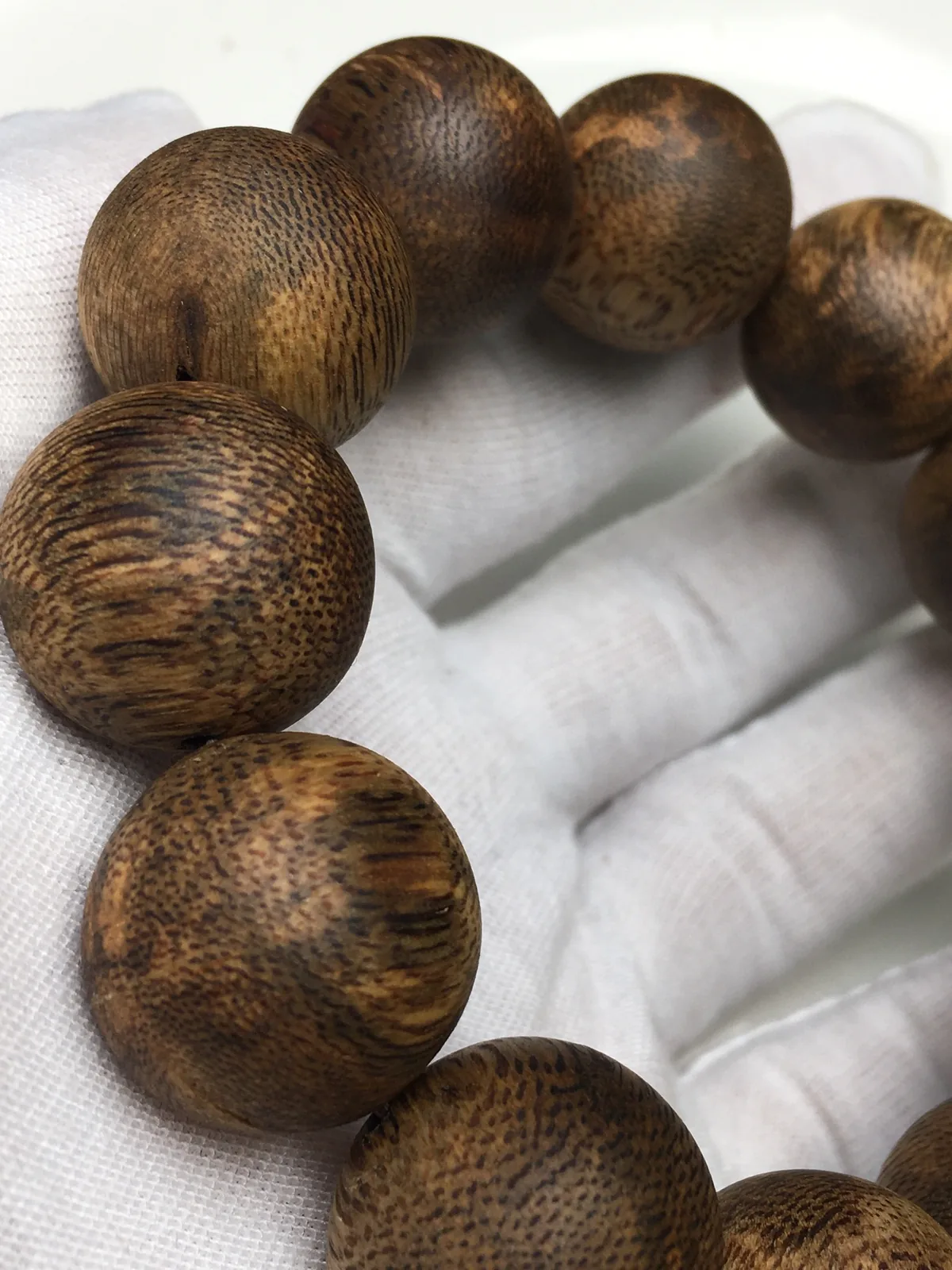
This is what agarwood has that the other dark woods lack: streaks of resin through paler wood, different on every bead. Ebony, however, is evenly black, and rosewood is evenly figured. So if you like a disciplined look, that argues for them, not for us.
Part 4 — Why are bodhi seed and rudraksha lighter than agarwood and sandalwood?
Bodhi seed and rudraksha are lighter because neither is wood at all. A bodhi seed bracelet uses seeds and nuts. Also, “bodhi seed” is a trade name covering a startling range of seeds, many from plants with no link to the bodhi tree. Most share a few traits: hard, very light and usually pale when new. Then handling darkens and polishes the beads over months into a deep honey colour. The patina is the appeal, much as with agarwood and sandalwood.
A rudraksha bracelet uses the dried stone of the Elaeocarpus ganitrus fruit. Each bead is deeply grooved, and people count the mukhi, the natural facets from end to end. Five-faced beads are by far the most common. Shaiva practice has used rudraksha for prayer beads for centuries. We describe the custom as the tradition it is, and we make no other claims.
Are seed beads better than agarwood and sandalwood for counting?
Seed beads are the better counting tool for most people. First, seeds weigh almost nothing, so a 108-bead mala does not drag. Second, seed strands are cheap enough that losing one is no disaster. Third, seed beads improve with heavy handling. For example, a new pale strand can turn honey-brown within months of daily counting.
The weakness is moisture, however. Seeds and fruit stones move with humidity. A strand usually dies when a bead splits after a soaking and a fast dry on a radiator. Finally, agarwood and sandalwood still win on scent, so many people keep a seed mala for counting and a wooden strand for wearing.
Part 5 — How do stone, glass and fossil resin compare with agarwood and sandalwood?
Stone and glass beads are heavier, harder and colder than agarwood and sandalwood. Lava stone is basalt full of frozen gas bubbles. So a lava stone bracelet is light for a stone, though heavier than any wood here, and matte black rather than shiny. The pores also explain why sellers offer lava for holding a drop of scented oil. However, the same pores hold soap, sunscreen and sweat, so the beads discolour and resist cleaning. Much of the very even black on the market is dyed or coated.
Obsidian is volcanic glass with no crystal structure. Obsidian is glossy, sometimes with a sheen, and breaks with the curved fracture that once made the glass useful for blades. So obsidian chips. Black onyx, by contrast, is a banded variety of chalcedony, a form of quartz. Most solid-black onyx beads are dyed, a normal, long-established practice and not a fraud. Additionally, onyx takes everyday knocks better than obsidian.
Where do tiger’s eye, jade and amber fit?
A tiger eye bracelet is quartz shot through with fibres, which produce a moving band of light called chatoyancy. As a quartz, tiger’s eye is truly hard-wearing. So of everything here, tiger’s eye asks the least of you, far less than agarwood and sandalwood. A jade bead bracelet, meanwhile, may be either of two minerals that share the English word: jadeite or nephrite. Both are far harder than any wood, and nephrite is unusually tough.
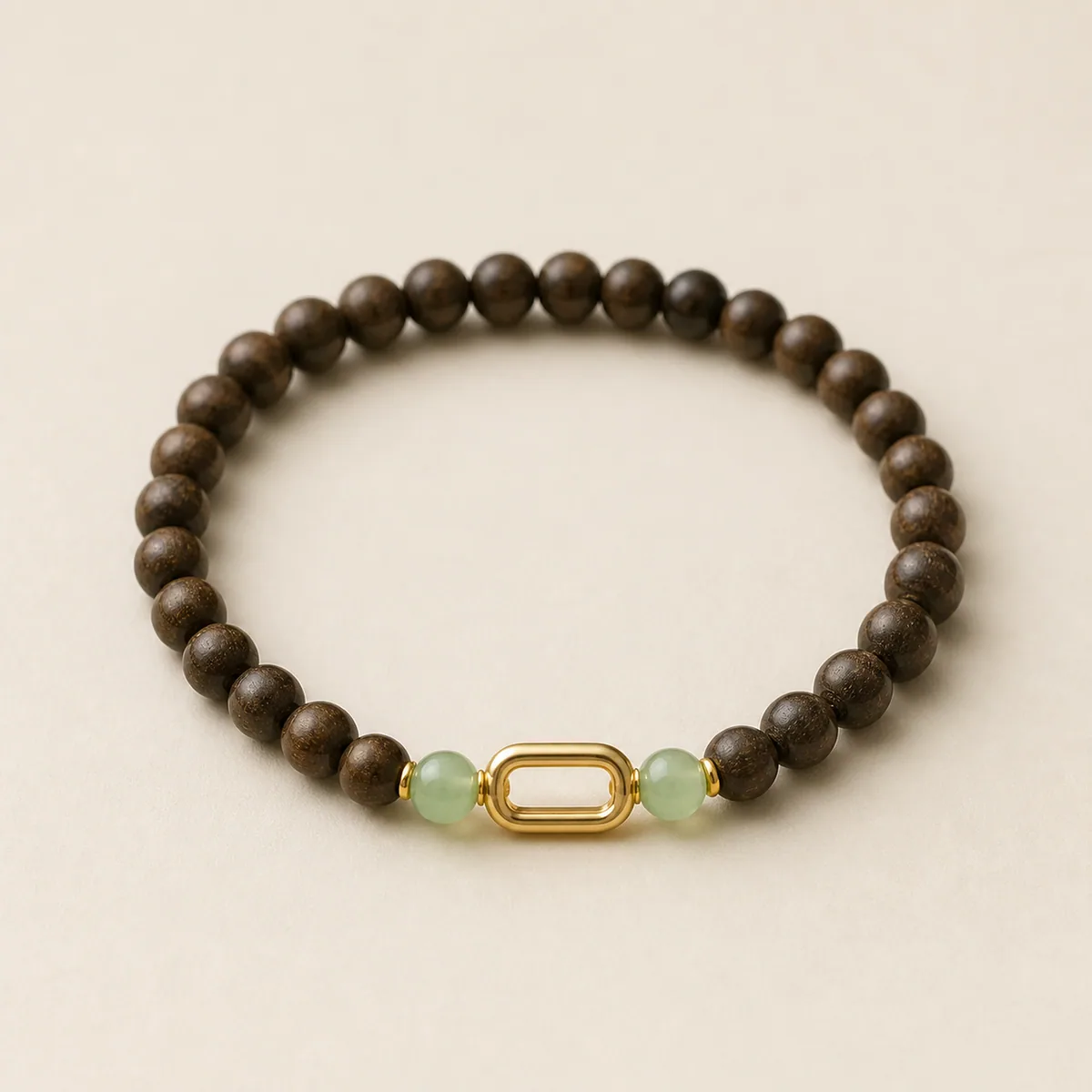
Amber is the odd one out, because amber is not a stone. An amber bead is fossil tree resin, tens of millions of years old in the Baltic material. Amber is light, barely denser than water, so a bead sits closer to agarwood and sandalwood than to rock in the hand. Amber also feels warm rather than cold. However, amber is soft, and a splash of perfume or alcohol can damage the surface. Our agarwood jade bracelet guide shows how these stones sit beside wood on one strand.
Part 6 — When should you skip agarwood and sandalwood?
We sell agarwood, and we would still rather you bought the right thing. In four situations, another material is plainly the better answer than agarwood, and sometimes better than sandalwood too.
This section is a set of 4 short notes, from “On a tight budget” to “As a gift for someone unknown”. First scan the 4 titles under “On a tight budget”, then read the note that matches your case.
On a tight budget
Buy sandalwood or a seed strand instead of agarwood. We price agarwood by weight, unlike sandalwood, because resin is what you pay for. So a cheap agarwood bracelet is usually a light one, with very little resin. On a low budget, a good sandalwood strand will please you more.
For rough, wet, daily wear
Buy tiger’s eye, onyx or jade. If the bracelet stays on through washing up, the gym and the shower, wood is the wrong material. For example, tiger’s eye and onyx shrug all of that off, but agarwood and sandalwood do not, as our agarwood bracelet care guide explains.
If you want colour
As a gift for someone unknown
Buy something forgiving. Agarwood rewards an owner who keeps it dry, off the shower rail and away from perfume. For an unknown recipient, a stone strand or a seed mala is kinder to give, and much easier to size.
If you choose agarwood over sandalwood: how buying from us works
This process is a 4-step sequence, from “Choose” to “Pay and receive”. First follow step 1, then work down the 4 steps of “If you choose agarwood over sandalwood: how buying from us works” in order.
- 1
Step 1: Choose
Select the style, bead size and wrist size on a product page, and it drafts your request.
- 2
Step 2: We weigh and film
Next, a strand goes on our scale, and we film it up close with the reading in view.
- 3
Step 3: Approve or swap
The video arrives with the weight and price. Nothing is due yet, so ask for another strand if this one is not right.
- 4
Step 4: Pay and receive
Approve it and a PayPal invoice follows; the filmed strand ships after payment. Sinking-grade wood is quoted separately.
What agarwood grain looks like moving
Part 7 — How do you care for agarwood and sandalwood, and the rest?
This timeline is a 7-stage sequence, from “Dry cloth, closed pouch” to “Check the cord”. First read “Part 7 — How do you care for agarwood and sandalwood, and the rest?” from top to bottom, since each stage follows the one before.
- AgarwoodDry cloth, closed pouchSkip water, oil and polish. Put the strand on after perfume and cream, and take the strand off for showers and hard exercise. A wet strand should air-dry slowly.
- SandalwoodKeep it out of the sunHeat and light drive off the scent faster than wear does, so store sandalwood closed. The traditional way to refresh a faded strand is a very light sanding.
- Ebony, rosewoodAlmost nothingA dry wipe is enough. The real risk is dry heat, because dense woods crack after losing moisture quickly. So keep dark woods off radiators and out of hot cars.
- Seed beadsWear them, do not wash themHandling builds the patina. For example, a bodhi strand darkens to honey within months. However, avoid soaking, and never dry a wet strand fast, because fast drying splits seeds and fruit stones.
- Hard stoneSoap and waterTiger’s eye, onyx and jade take ordinary cleaning. Still, keep them off tiled floors, where a dropped strand chips rather than bounces.
- Amber, lavaThe fussy twoAmber hates alcohol, solvent, perfume and heat, and scratches easily. Lava is porous, so rinse and dry lava beads, and expect oils and soap to darken the stone.
- Any strandCheck the cordWhatever the beads, the cord is the part that fails first. So if gaps open up or the cord looks thin, restring the strand before the cord breaks.
Finally: agarwood and sandalwood, or neither?
There is no best bead material, only a best fit. First, for something light that improves with handling and costs little, buy seeds. Second, for colour, hardness and an easy life, buy stone. Third, for a plain wooden bracelet that lasts and asks nothing, buy ebony or rosewood.
For a wood you can smell, however, the shortlist is two names long: agarwood and sandalwood. Between the two, sandalwood gives you more scent today, and agarwood gives you more in ten years.
Finally, compare agarwood and sandalwood honestly: same bead size, same cut, and a clear look at what is in the bead. Agarwood has more room than most materials for a listing to say one thing and a scale another. So we weigh every strand on camera. Whatever you buy, ask for the same kind of evidence.
Frequently asked questions
This FAQ is a set of 9 short answers about agarwood and sandalwood compared, with ebony, rudraksha and stone beads. First find your question below. For example, many facts in these answers about agarwood and sandalwood compared, with ebony, rudraksha and stone beads come from the 4 published sources in References, which we checked in September 2026.
Agarwood vs sandalwood: which actually smells stronger?
Sandalwood, on the day it arrives. Its scent sits in the heartwood as an oil, so it is simply there, sweet and milky, without any warming. Agarwood, however, is quiet when cold and opens with body heat and handling. Over years the order reverses, because sandalwood fades and agarwood keeps going.
What is the difference between oud and sandalwood?
Oud is another name for agarwood, so oud vs sandalwood is the same comparison. In short, sandalwood vs agarwood comes down to three points. First, sandalwood smells at once, while agarwood needs warmth. Second, sandalwood is even from bead to bead, while agarwood varies with its resin. Finally, agarwood usually costs more, because you pay for the resin.
What is karungali, and is it the same as ebony?
Karungali is the Tamil name in South India for ebony beads, from the genus Diospyros, and a karungali malai is a strand of them. So it is the same material by a different name. Genuine ebony heartwood is near black, unusually dense for a wood, and completely scentless, unlike agarwood and sandalwood. Also, much cheap black ebony is dyed hardwood.
Which wood that smells good is best for daily wear?
Only agarwood and sandalwood have a real scent as finished beads. For daily wear, sandalwood is the easier choice: cheaper, more even from bead to bead, and fragrant at once. Agarwood, however, suits someone who wants the scent to last for years and will keep the strand dry and away from perfume.
Are rudraksha and bodhi seed beads the same thing?
No. Rudraksha is the dried stone of the Elaeocarpus ganitrus fruit, deeply grooved and counted by its mukhi, or natural facets. Bodhi seed, by contrast, is a trade name for many different seeds and nuts. Both are far lighter than agarwood and sandalwood, both darken with handling, and both split if dried too fast.
Is a lava stone bracelet good for holding scented oil?
The pores do take up oil, which is why sellers offer them that way. However, they also take up soap, sunscreen and sweat, so the beads discolour and are hard to clean. If you want scent from the bracelet itself rather than from something you add, agarwood and sandalwood are the more durable answer.
Which bead material is hardest to damage?
Among common choices, tiger’s eye and jade. Tiger’s eye is a quartz, so it shrugs off everyday scratching. Jade, especially nephrite, is unusually tough and resists breaking. The most fragile are amber, which scuffs and reacts to alcohol and perfume, and obsidian, which chips at the edges. Agarwood and sandalwood sit in between.
Why is agarwood so much more expensive than sandalwood?
Because with agarwood you buy resin, not timber. Agarwood forms only where a tree takes a wound and lays down resin over years, so the yield per tree is small and unpredictable. CITES also regulates the trade. That is why agarwood sells by weight and sandalwood by the piece, and why we weigh each strand on camera.
Can I mix wooden beads and stone beads on one strand?
Yes, and it is a common way to get colour without losing the lightness of wood. However, keep two points in mind. The stone dominates the weight, so the scale no longer tells you about the wood. Also, you must care for the strand as the fussiest material on it requires, so amber sets the rules whenever it is present.
References
This reference list is the source record for “Agarwood and Sandalwood Compared, with Ebony, Rudraksha and Stone Beads”, with 4 published sources. According to the citations in “Agarwood and Sandalwood Compared, with Ebony, Rudraksha and Stone Beads”, such as (Tan 2019), each one links to one entry below. Finally, we checked all 4 links behind “Agarwood and Sandalwood Compared, with Ebony, Rudraksha and Stone Beads” in September 2026.
- 1Tan C.S., Isa N.M., Ismail I., Zainal Z.. Agarwood induction: current developments and future perspectives. Frontiers in Plant Science 10: 122, 2019.doi:10.3389/fpls.2019.00122
- 2Forest Products Laboratory. Wood Handbook — Wood as an Engineering Material (General Technical Report FPL-GTR-190). USDA Forest Service, 2010.View source
- 3Naef R.. The volatile and semi-volatile constituents of agarwood, the infected heartwood of Aquilaria species: a review. Flavour and Fragrance Journal 26(2): 73–87, 2011.doi:10.1002/ffj.2034
- 4CITES Secretariat. Appendices I, II and III. Convention on International Trade in Endangered Species of Wild Fauna and Flora, current.View source
References are listed for transparency. We summarise them for general reading; nothing here is medical advice, and no health effect is claimed.
In this article
Styles mentioned

Related articles
Weighed before you pay
Choose a style, get your strand weighed
Pick a bead and size, send your request, and we reply with a video of your piece on the scale — its exact weight and price. Nothing is charged until you approve.