Agarwood Bead Size Chart: Choosing 6–20 mm by Look, Wrist, Wear and Weight
Agarwood bead size is the first choice on every product page, and often the hardest to picture from a photo. It changes how a bracelet looks, sits and weighs, but not whether it fits, because the bead count adjusts to your wrist. So this guide works through look, wrist, wear and weight for round beads from 6 to 20 mm. It also gives bead counts and estimated weights from the same geometry as our wrist fitter.

Written by
Founder & Chief Sourcing Officer, AgarwoodTown
Wang Jianyu is the founder of AgarwoodTown, the agarwood business behind Oudbracelet, trading since 2014. 15+ years grading plantation agarwood and advising buyers on grade selection and CITES paperwork. These guides draw on the same bead geometry our wrist fitter uses and on the questions buyers ask before they approve a weighing video.
In this article
- What agarwood bead size should you choose?
- Agarwood bead size chart at a glance
- Choose an agarwood bead size in two questions
- Part 1 — Choose an agarwood bead size by the look first
- Part 2 — How does agarwood bead size set the count on your wrist?
- How many beads go round your wrist at each size?
- Why does a large agarwood bead size fit in steps?
- Part 3 — How does agarwood bead size change the weight you feel?
- Estimated weight by agarwood bead size: one bead, and a strand on two wrists
- Part 4 — How does each agarwood bead size wear day to day?
- Small or large beads?
- Which agarwood bead size we would suggest, by wearer
- Part 5 — Agarwood bead size under 8 mm: malas and multi-wrap strands
- 108-bead malas: length, turns and weight
- Part 6 — How do you choose and confirm your agarwood bead size?
- How do you get from an agarwood bead size to your strand?
- How grain reads on a round bead
- Part 7 — Living with the agarwood bead size you chose
- Finally: which agarwood bead size is right for you?
- Frequently asked questions
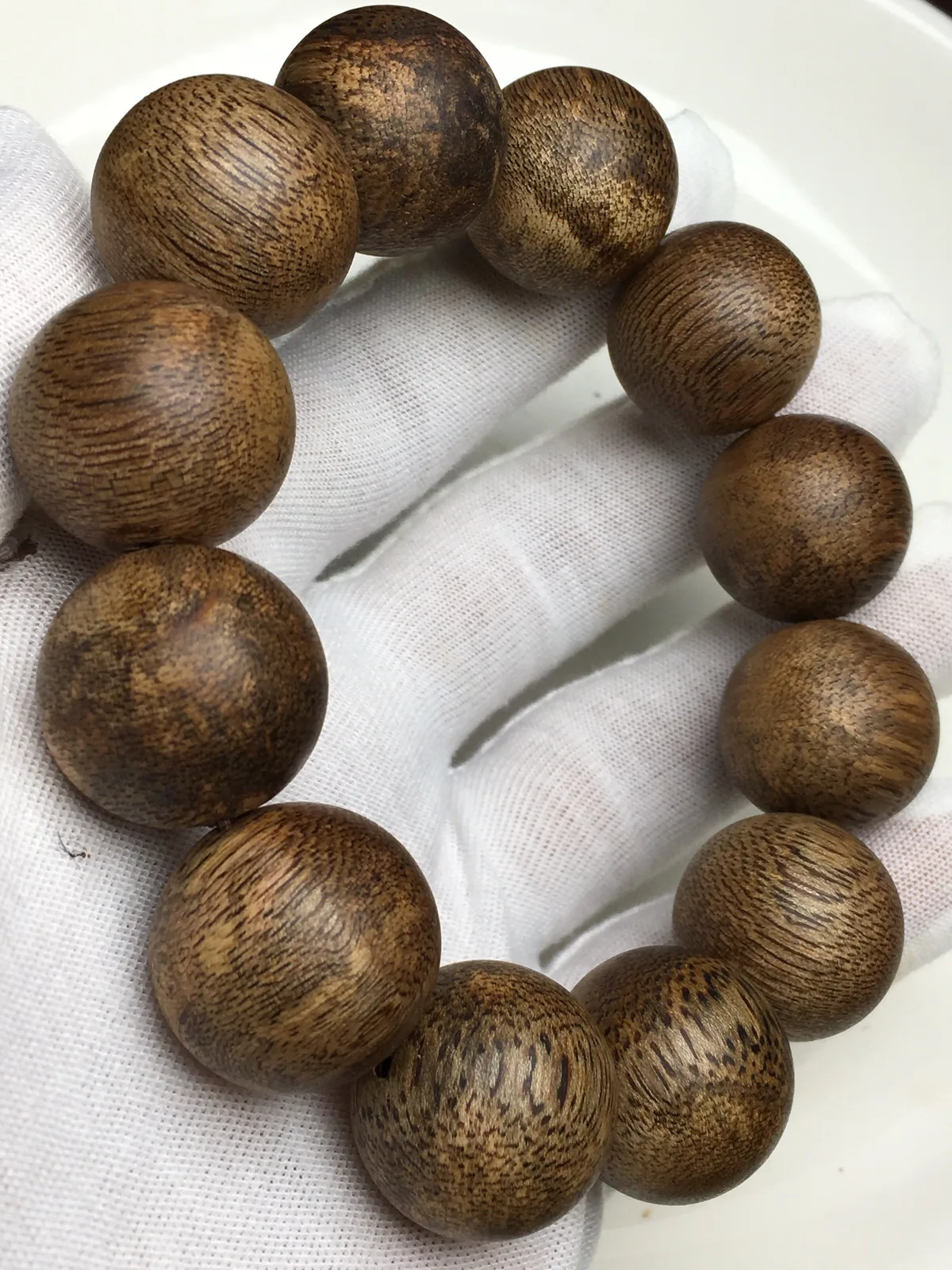
 A strand
 Loose large beads
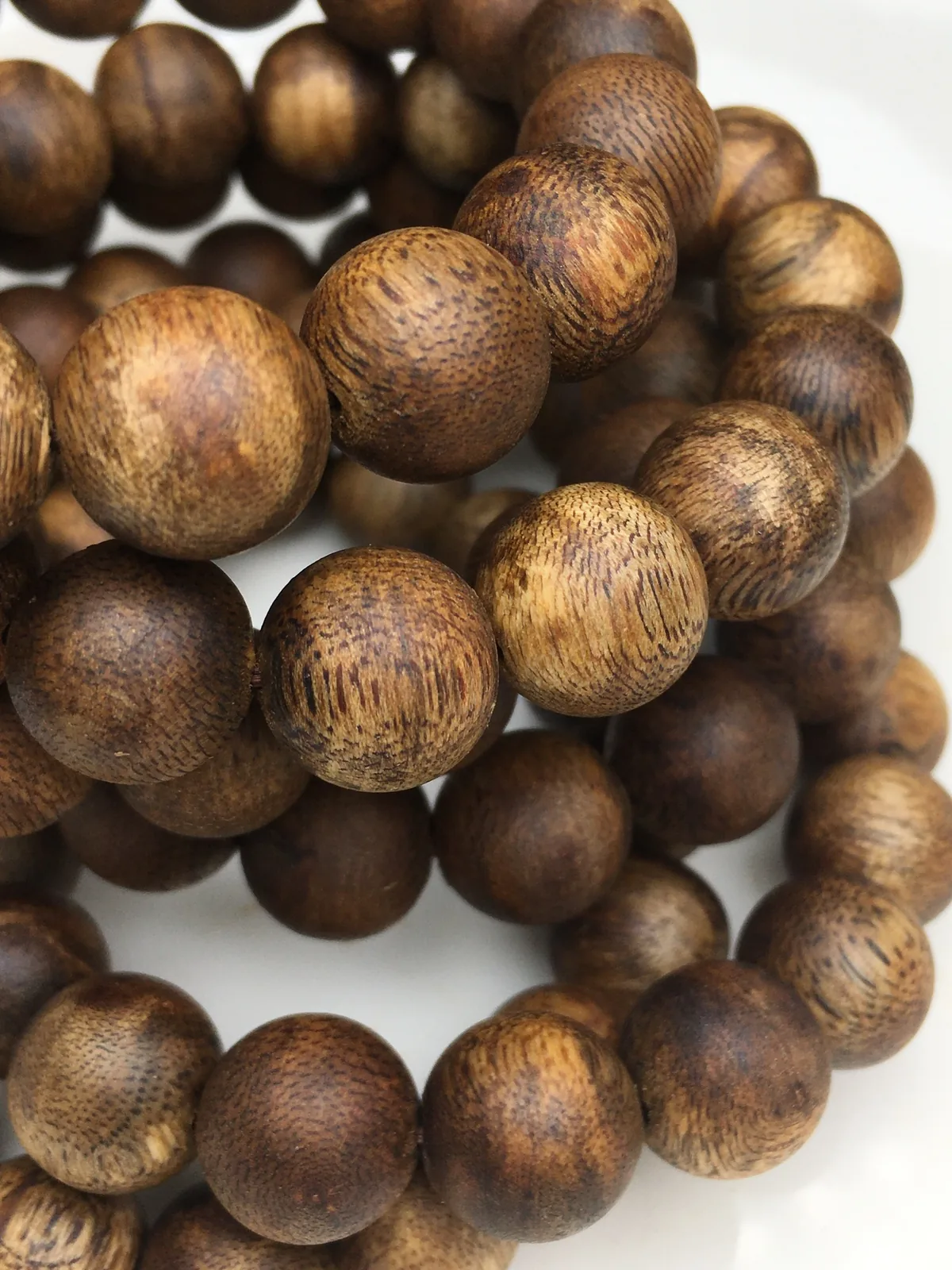
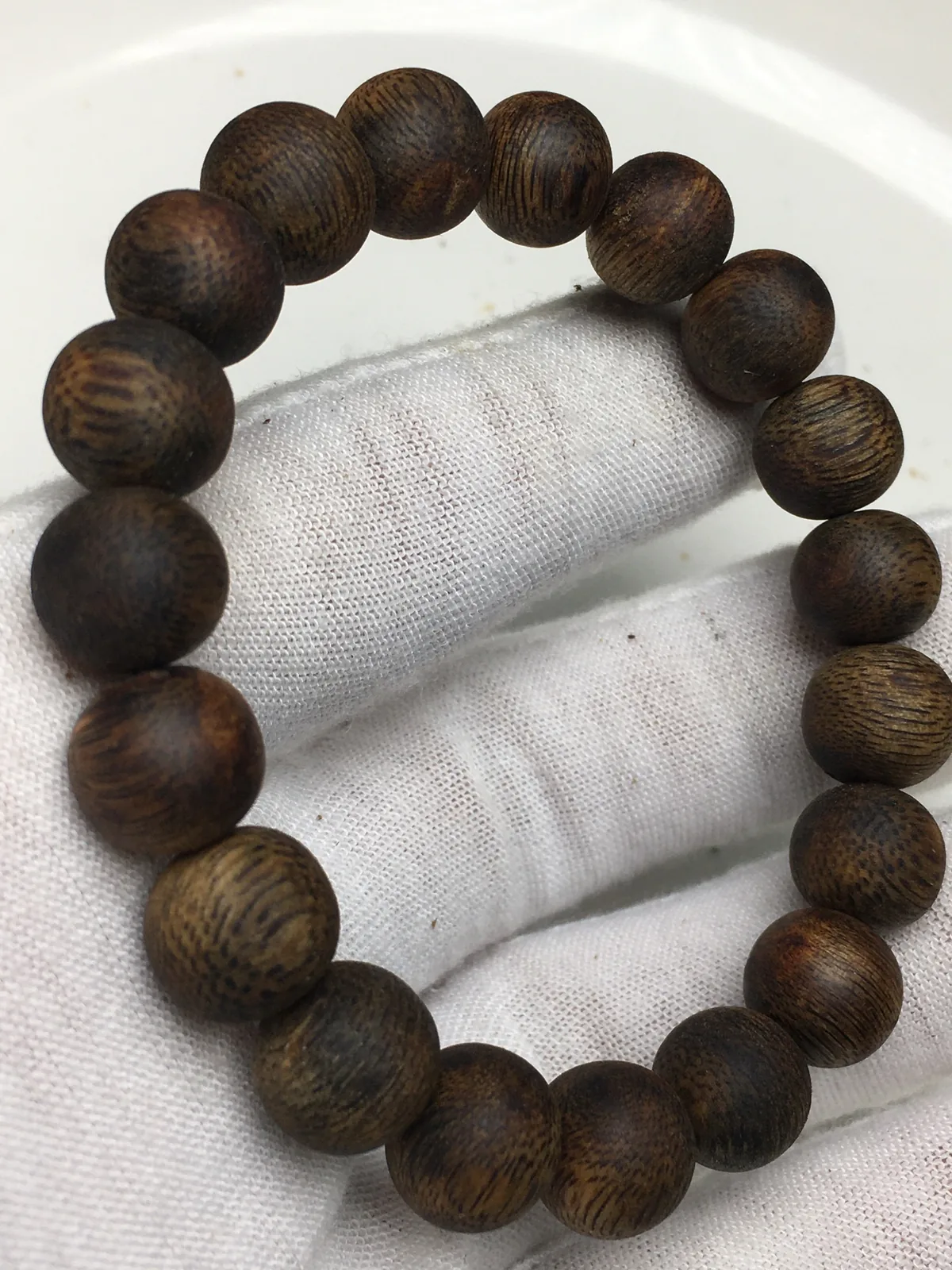
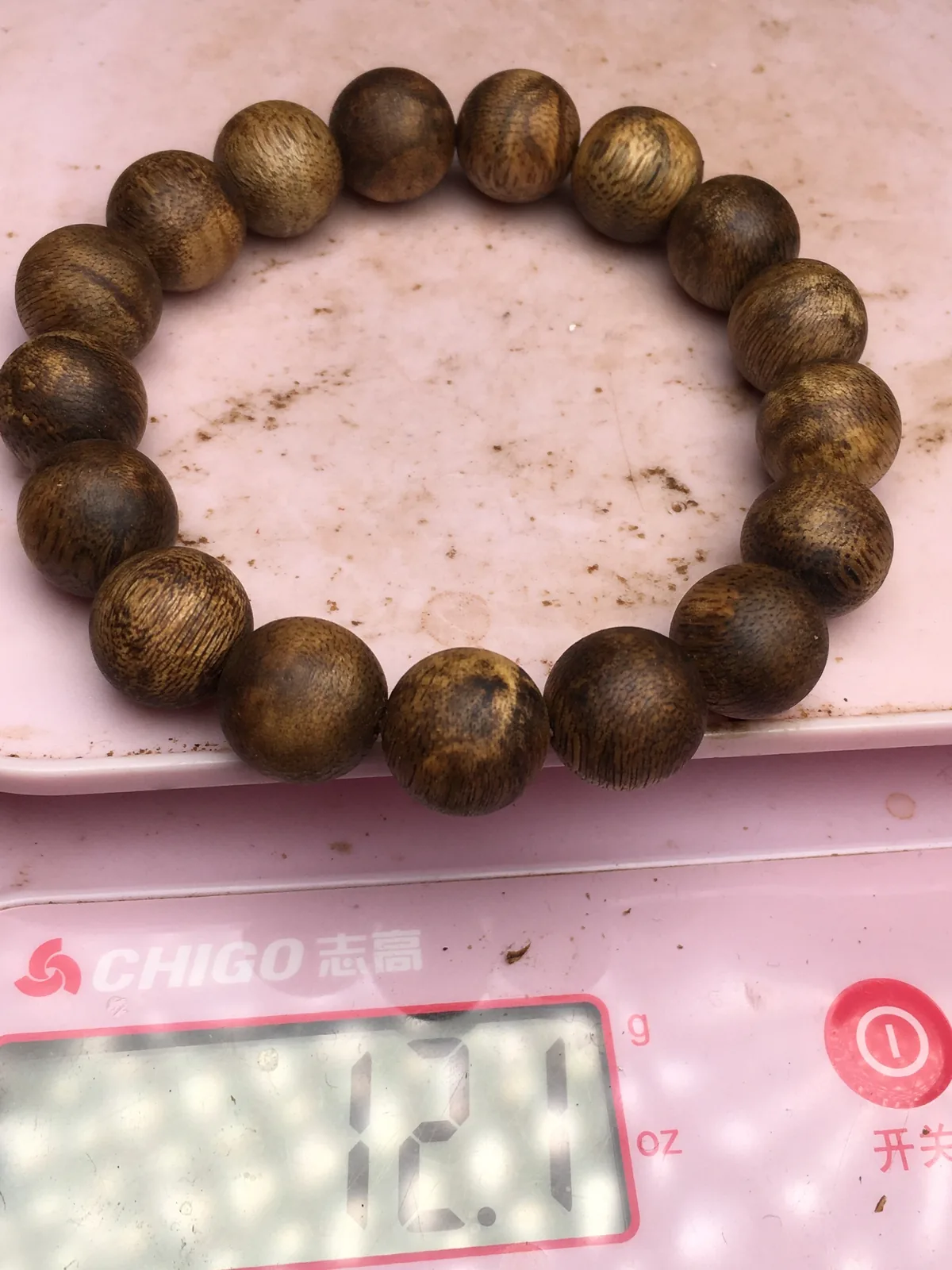
A finished round-bead strand and a handful of large loose beads from our stock. It is the same kind of wood, cut to different sizes. You would forget you wore one, yet feel the other every time you moved your hand. So which agarwood bead size belongs on your wrist?
What agarwood bead size should you choose?
An agarwood bead size is not a fit. Choose 8 mm or 18 mm, and either can fit a 16 cm wrist. The number of beads changes, while the inside of the ring stays close to what you asked for.
However, agarwood bead size changes almost everything else. It decides how far away you can see the grain, and whether the strand slips under a cuff. It also decides how it feels when you type, and how much wood you buy.
Oudbracelet is the retail shop of AgarwoodTown, and we weigh every strand on camera before we quote it. So we see daily how differently one design reads at 10 mm and at 16 mm. The numbers here come from the same bead geometry as our wrist fitter. Also, we label every weight as an estimate.
First, start with the agarwood bead size bands below. Then narrow things down with two questions, and read the parts that matter to you. For the wood itself, see our guide to buy an agarwood bracelet, because this article stays with size.
According to the USDA Wood Handbook, the weight of wood depends on its density, and density differs from piece to piece.(USDA 2010) First, that means a larger agarwood bead size adds weight quickly, since volume grows with the cube of the diameter. Finally, doubling the bead size from 6 mm to 12 mm makes each bead about 8 times heavier.
Agarwood bead size chart at a glance
This table is a 5-row summary. First read the size column, then compare the how it reads, grain you can see, everyday ease, beads, 16 cm wrist, strand weight (est.), best for across each row. For example, the first row covers “6 mm”.
| Size | How it reads | Grain you can see | Everyday ease | Beads, 16 cm wrist | Strand weight (est.) | Best for |
|---|---|---|---|---|---|---|
| 6 mm | Fine texture, layered | ★★★★★ | ★★★★★ | 31 per turn | 1.8–2.8 g per turn | Multi-wrap strands and malas |
| 8–10 mm | Quiet, understated | ★★★★★ | ★★★★★ | 20–24 | 3.5–9.4 g | Every day; beside a watch |
| 12–14 mm | A clear statement | ★★★★★ | ★★★★★ | 15–17 | 8.8–20 g | A first strand; showing the grain |
| 16 mm | Bold | ★★★★★ | ★★★★★ | 14 | 18–28 g | Larger wrists; worn on its own |
| 18–20 mm | Very bold, heavy | ★★★★★ | ★★★★★ | 12–13 | 23–47 g | Occasional wear; collectors |
Bead counts and weights are worked out, not measured: round beads touching, a 2 mm drilled hole, standard fit (about 1 cm of room), density 0.60–0.95 g/cm³. The star ratings are our judgement, for comparison only. Below 8 mm we string multi-wrap strands, so 6 mm appears per turn.
Choose an agarwood bead size in two questions
This chooser is a 2-question guide with 8 possible answers. First answer “What look do you want?”, then pick the option that fits, such as “Barely there”.
Choosing an agarwood bead size is mostly a choice of look, and the wrist then fixes the count. First, pick the look: under 8 mm reads as texture on a multi-wrap strand, 8–10 mm is quiet, 12–14 mm is a statement and 16–20 mm is bold. Second, measure the wrist, because the wrist size turns the look into a bead count. For example, 10 mm beads on a 16 cm wrist need 20 beads at a standard fit. A multi-wrap strand forgives more, which helps when the strand is a gift.
Part 1 — Choose an agarwood bead size by the look first
Think about where the strand will sit in your day, rather than about the number. 6 mm beads read as texture. Below 8 mm, we string round beads as multi-wrap, because a single thin turn gets lost among other bracelets.
Next, 8–10 mm is quiet. It sits beside a watch and draws the eye only up close. At 12–14 mm, however, each bead shows its own streaks and flecks from across a table. Finally, an agarwood bead size of 16 mm and above is bold, so the beads read as individual objects.
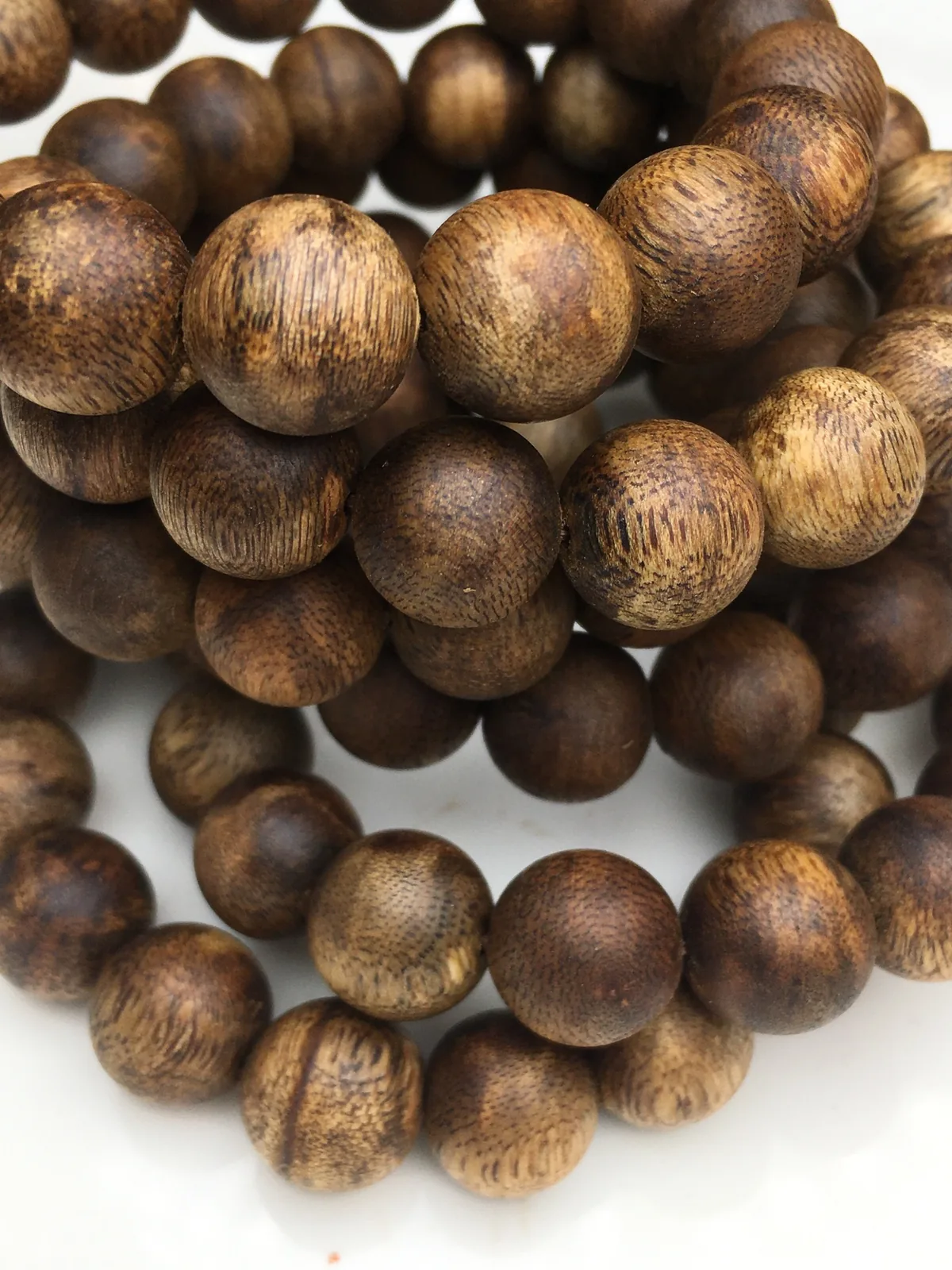
Grain is the other half of the look. Resin forms unevenly inside a wounded Aquilaria tree, in streaks and patches around the damage.(Tan 2019) So a small bead catches only a fragment of a pattern, while a large bead can hold a whole streak. As a result, the same batch of wood can look plain at 8 mm and striking at 16 mm. Also, a large agarwood bead shows every pale patch as clearly as every dark line.
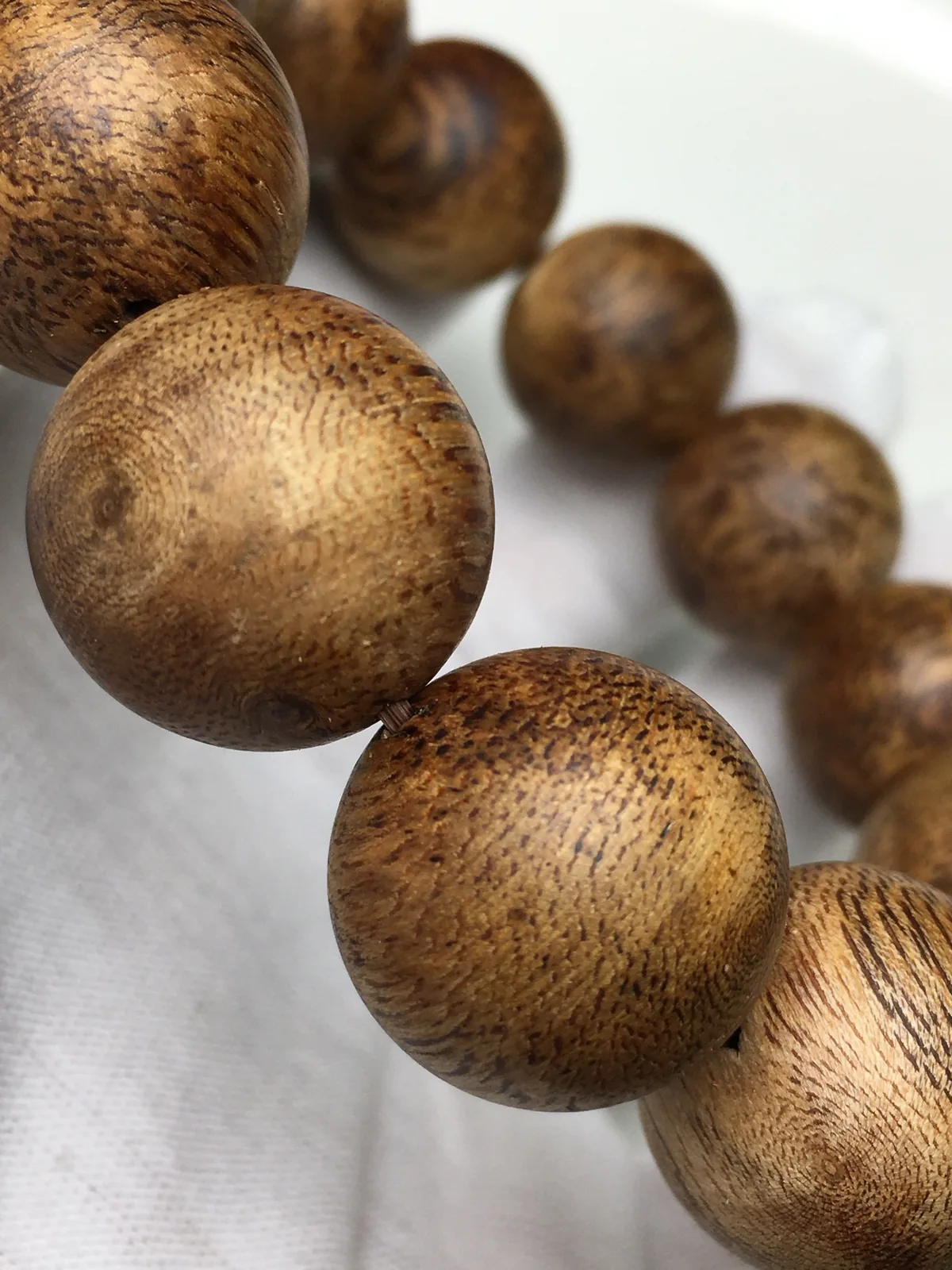
 Small beads
 Large beads
Left: small beads read as a fine, layered texture. Right: large beads, however, show whole streaks of grain, and every pale patch too.
Part 2 — How does agarwood bead size set the count on your wrist?
The bead count is pure geometry. Agarwood beads on a strand touch their neighbours, so bead size and count fix the inside of the ring, not cord length. We choose the count that brings the inside closest to your wrist plus the room you asked for: snug (about 0.5 cm), standard (about 1 cm) or relaxed (about 2 cm).
For example, with an agarwood bead size of 12 mm on a 16 cm wrist, the counts are 17 beads snug, 17 beads standard, 18 beads relaxed. Fits move in whole beads, so two can land on the same count.
Finally, read across a row below. A centimetre of wrist is roughly one extra bead at 10–12 mm. At 18–20 mm, however, the count often stays the same between neighbouring wrists.
How many beads go round your wrist at each size?
This table is a 8-row summary. First read the bead column, then compare the 14 cm wrist, 15 cm wrist, 16 cm wrist, 17 cm wrist, 18 cm wrist, 19 cm wrist across each row. For example, the first row covers “6 mm”.
| Bead | 14 cm wrist | 15 cm wrist | 16 cm wrist | 17 cm wrist | 18 cm wrist | 19 cm wrist |
|---|---|---|---|---|---|---|
| 6 mm | 28 | 30 | 31 | 33 | 35 | 36 |
| 8 mm | 22 | 23 | 24 | 26 | 27 | 28 |
| 10 mm | 18 | 19 | 20 | 21 | 22 | 23 |
| 12 mm | 16 | 16 | 17 | 18 | 19 | 20 |
| 14 mm | 14 | 14 | 15 | 16 | 17 | 17 |
| 16 mm | 12 | 13 | 14 | 14 | 15 | 16 |
| 18 mm | 11 | 12 | 13 | 13 | 14 | 14 |
| 20 mm | 11 | 11 | 12 | 12 | 13 | 13 |
Standard fit, about 1 cm of room. We work these out from bead geometry rather than counting stock. 6 mm is here for reference, because below 8 mm we string multi-wrap strands rather than single turns.
For example, at 10 mm a 14 cm wrist takes 18 beads and a 19 cm wrist takes 23. At 20 mm, the same two wrists take 11 and 13 beads. So the range narrows sharply as the beads grow.
Why does a large agarwood bead size fit in steps?
The reason is simple: a strand can only hold whole beads, so a large agarwood bead size fits in steps. You cannot add a third of an agarwood bead. With 6–10 mm beads, one bead moves the inside length by well under a centimetre. With 20 mm beads, however, one bead moves the inside length by about two. For example, on a 14 cm wrist, 11 beads of 20 mm give 16.0 cm inside, while 10 would give 14.0 cm, too tight to wear. So if you fall between counts, tell us which way you would rather err.
The steps matter most on a slim wrist. On a 14–15 cm wrist, 18–20 mm beads make a short ring of about a dozen beads, and the forced extra room lets the ring turn and slide. In practice, 12–14 mm beads often sit better on a slim wrist. Finally, the wrist fitter draws each count at true size before you ask for a strand.
Part 3 — How does agarwood bead size change the weight you feel?
Weight is where agarwood bead size has its biggest effect. A bead’s volume rises with the cube of its diameter. So one 20 mm agarwood bead holds about 8.4 times the wood of a 10 mm bead.
Fewer large beads fit round the wrist, but not nearly few enough to compensate. For example, on an 18 cm wrist a 20 mm strand carries about 5.0 times the wood of a 10 mm one. You feel that every time you lift a cup. Also, since we sell agarwood by weight, it shows in the quote too, as our guide to agarwood bracelet price explains.
Density matters as well. Most woods are lighter than water, and any wood’s density varies with its structure and what it contains,(USDA 2010) as the Wood Handbook sets out. In agarwood, that is resin. So the table uses 0.60–0.95 g/cm³, our working range for floating-grade wood, on a slim and a larger wrist.
Estimated weight by agarwood bead size: one bead, and a strand on two wrists
This table is a 7-row summary. First read the bead column, then compare the one bead, 14 cm wrist, 18 cm wrist, wood vs 10 mm (18 cm wrist) across each row. For example, the first row covers “8 mm”.
| Bead | One bead | 14 cm wrist | 18 cm wrist | Wood vs 10 mm (18 cm wrist) |
|---|---|---|---|---|
| 8 mm | 0.15–0.23 g | 22 beads · 3.2–5.1 g | 27 beads · 3.9–6.2 g | about 0.6× |
| 10 mm | 0.30–0.47 g | 18 beads · 5.3–8.4 g | 22 beads · 6.5–10 g | about 1.0× |
| 12 mm | 0.52–0.82 g | 16 beads · 8.3–13 g | 19 beads · 9.9–16 g | about 1.5× |
| 14 mm | 0.84–1.32 g | 14 beads · 12–19 g | 17 beads · 14–22 g | about 2.2× |
| 16 mm | 1.26–1.99 g | 12 beads · 15–24 g | 15 beads · 19–30 g | about 2.9× |
| 18 mm | 1.80–2.85 g | 11 beads · 20–31 g | 14 beads · 25–40 g | about 3.9× |
| 20 mm | 2.48–3.92 g | 11 beads · 27–43 g | 13 beads · 32–51 g | about 5.0× |
Estimates, not measurements: spheres with a 2 mm hole, standard fit, density 0.60–0.95 g/cm³. Resin-rich or sinking wood weighs more than the top of each range. For a 16 cm wrist, see the table in our buying guide or the wrist fitter.
Part 4 — How does each agarwood bead size wear day to day?
The real test of an agarwood bead size is an ordinary day with the strand on. First, at a desk, 8–10 mm agarwood beads rest flat and rarely knock as you type. By contrast, 16 mm and up sit higher and meet the desk first. Second, small agarwood beads stack beside a watch, while large beads crowd the watch face. Third, up to about 12 mm slides into a fitted cuff, whereas bigger beads want a loose sleeve.
A heavier strand also pulls harder on the cord each time your arm swings. For example, a 20 mm strand on an 18 cm wrist carries about 5.0 times the wood of a 10 mm strand. Finally, a strand with a large agarwood bead size is worth checking a little more often than a light strand, both for gaps and for a tired cord.
Small or large beads?
This comparison is a 6-point check of Small (8–10 mm) against Large (16–20 mm). For example, the first row compares beads on a 16 cm wrist. Finally, pick the column that matches what you need.
| Feature | Small (8–10 mm) | Large (16–20 mm) |
|---|---|---|
| Beads on a 16 cm wrist | 20–24 | 12–14 |
| Strand weight (estimate) | 3.5–9.4 g | 18–47 g |
| Fine-tuning the fit | Close — one bead changes little | In steps — one bead is up to 2 cm |
| With a watch or cuff | Stacks and slides under easily | Best worn alone, loose sleeve |
| Grain | Fragments of pattern; even look | Whole streaks; every patch visible |
| Cord | Light load | Heavier load; check it more often |
Small agarwood beads are the easier everyday choice, and large beads are the bolder choice with far more wood per bead. One 20 mm bead holds about 8.4 times the wood of a 10 mm bead. In practice, small beads suit a watch and a fitted cuff, while large beads suit a loose sleeve and a wearer who wants the grain to show.
Which agarwood bead size we would suggest, by wearer
This section is a set of 4 short notes, from “Your first strand” to “Slim wrist, bold taste”. First scan the 4 titles under “Which agarwood bead size we would suggest, by wearer”, then read the note that matches your case.
Your first strand
Choose 12 mm round beads with a standard fit. A 12 mm bead is enough to see the grain, yet light enough for all day. On a slim wrist, however, choose 10 mm. So start in round beads.
Desk and daily life
Choose 8–10 mm, or a multi-wrap strand of small beads. Small beads sit beside a watch, slide under a cuff and stay quiet on a desk.
For the grain itself
Choose 14–16 mm, and ask for the clearest streaks we have in that size. Alternatively, try cube beads, because their flat faces show resin lines at any size.
Slim wrist, bold taste
Try 14 mm with a snug fit before 18–20 mm. For example, 14 mm gives most of the presence, in a ring that sits flat instead of turning.
Part 5 — Agarwood bead size under 8 mm: malas and multi-wrap strands
Below 8 mm, the question becomes “how many turns”. A traditional mala has 108 beads. At 6 mm it is about 65 cm long, and it wraps roughly 3.4 times round a 16 cm wrist. Each extra millimetre of agarwood bead size adds about 11 cm of strand. So size decides whether a mala is a triple wrap or a necklace.
Small beads do not mean a small scent, however. What you smell comes from aromatic compounds in the resin.(Naef 2011) So resin-rich 6 mm beads can smell stronger than pale 16 mm ones. In short, agarwood bead size sets the look and weight, while resin sets the scent.
108-bead malas: length, turns and weight
This table is a 3-row summary. First read the bead column, then compare the strand length, turns on a 16 cm wrist, estimated weight across each row. For example, the first row covers “5 mm”.
| Bead | Strand length | Turns on a 16 cm wrist | Estimated weight |
|---|---|---|---|
| 5 mm | 54 cm | about 2.9 | 3.2–5.1 g |
| 6 mm | 65 cm | about 3.4 | 6.1–9.7 g |
| 8 mm | 86 cm | about 4.4 | 16–25 g |
We count turns along the centre line of the beads, so larger beads wrap slightly fewer times than length alone suggests. The weights are estimates at the same density range as the tables above.
For example, a 108-bead mala in 8 mm beads is about 86 cm long, so the strand reads as a necklace rather than a wrist wrap. A 5 mm mala, at about 54 cm, wraps more tightly and suits a slim wrist.
Part 6 — How do you choose and confirm your agarwood bead size?
Confirming an agarwood bead size is quick once you know the look and the wrist. First, everything we sell is plantation agarwood. CITES Appendix II lists wild Aquilaria and Gyrinops,(CITES) so we sell no wild wood in any agarwood bead size. Also, if paperwork applies to your country, we confirm the paperwork with your quote. The whole Aquilaria genus has sat in CITES Appendix II since 2004, so international shipments travel with export permits. Finally, the four steps below take you from a size on a screen to a strand you have seen on the scale.
How do you get from an agarwood bead size to your strand?
This process is a 4-step sequence, from “Measure and choose” to “Approve, then invoice”. First follow step 1, then work down the 4 steps of “How do you get from an agarwood bead size to your strand?” in order.
- 1
Step 1: Measure and choose
Measure your wrist with a paper strip. Then pick a look: 8–10 mm quiet, 12–14 mm a statement, 16 mm and up bold.
- 2
Step 2: Check it in the fitter
Choose snug, standard or relaxed. The fitter then shows the bead count, the inside length and an estimated weight, drawn to scale.
- 3
Step 3: We weigh and film
We pick a strand in that size and count, put it on the scale, and film it close up with the weight on the display.
- 4
Step 4: Approve, then invoice
Approve the video, or ask for another strand. After you approve, we send a PayPal invoice and ship the strand you saw.
How grain reads on a round bead
Part 7 — Living with the agarwood bead size you chose
This timeline is a 5-stage sequence, from “Wear it through a normal day” to “Check the cord”. First read “Part 7 — Living with the agarwood bead size you chose” from top to bottom, since each stage follows the one before.
- Day oneWear it through a normal dayType, drive and cook. The ring should roll a little, but the strand should not slide onto the hand.
- First weeksNotice where it sitsA heavy strand settles lower. So if the strand knocks or turns constantly, a snugger fit may suit you.
- Every dayKeep it dryTake the strand off for water, sweat and perfume, because large beads show marks more plainly.
- Months onWatch the colour deepenThe wood darkens and softens with wear. On large beads, however, the change is easier to see, bead by bead.
- Now and thenCheck the cordHeavier strands work the cord harder. So when small gaps appear between beads, get a restring done early.
Finally: which agarwood bead size is right for you?
The right agarwood bead size is the one that suits your wrist and the way you live; no size is correct for everyone. Small beads disappear into a day, while large beads make the day about the strand. Neither is better wood, and the count takes care of fit. For example, 12 mm round beads with a standard fit make a balanced first strand, and 10 mm suits a slim wrist.
First, choose the look, and check the look at true size in the wrist fitter. Second, remember that weight rises much faster than diameter. Finally, ask to see the strand. A size that seemed right on a screen can feel different in the video, and the video is the moment to change your mind.
Frequently asked questions
This FAQ is a set of 8 short answers about agarwood bead size chart. First find your question below. For example, many facts in these answers about agarwood bead size chart come from the 4 published sources in References, which we checked in September 2026.
What agarwood bead size suits everyday wear?
For a single bracelet worn all day, 8 to 12 mm is the easiest range. It sits beside a watch, slides under a cuff, and rarely knocks on a desk. Below 8 mm, however, we string multi-wrap strands instead. From 16 mm up, a strand is better treated as a statement piece you wear on its own.
How many 12 mm beads do I need?
For a standard fit, with about one centimetre of room, a 14 cm wrist takes 16 beads of 12 mm. A 16 cm wrist takes 17, and an 18 cm wrist 19. The bead-count table in this guide lists every agarwood bead size from 6 to 20 mm for wrists from 14 to 19 cm. The wrist fitter also shows your own number.
Why does my large-bead bracelet feel looser than expected?
Because the fit moves in whole beads, and with 18 to 20 mm beads each one adds about two centimetres to the ring. So the nearest count that still goes over your hand can leave more room than you asked for. If you prefer it tighter, tell us, and we will choose the count just under rather than just over.
Is a 20 mm strand too heavy to wear every day?
It depends on you, but it is a lot of wood. On an 18 cm wrist our estimate is 32–51 g for floating-grade wood, several times a 10 mm strand. So many people keep large beads for occasional wear, and choose 10 to 12 mm for daily use. The weighing video also shows the real figure before you decide.
Can I wear 6 mm beads as a single bracelet?
Physically, yes. However, we string round beads under 8 mm as multi-wrap strands. A single thin turn of 6 mm beads is light, and it gets lost among other bracelets or under a sleeve. Wrapped two, three or more times, the same beads read as a deliberate layered piece, and a 108-bead mala doubles as a necklace.
How long is a 108-bead mala?
It depends on the agarwood bead size. At 6 mm, 108 beads make a strand about 65 cm long, which wraps roughly 3.4 times round a 16 cm wrist. At 8 mm, however, it is about 86 cm and wraps more than four times. The mala table gives lengths, turns and weights for 5, 6 and 8 mm.
Are the weights in this guide exact?
No. They are estimates from bead volume and a density range typical of floating agarwood, using the same geometry as our wrist fitter. Real strands vary with resin content, so two strands of the same size can differ noticeably. Your quote, however, uses the weight of your own strand, read off the scale in the video.
Should agarwood bead size follow wrist size?
Loosely. Any size can fit any wrist, but proportion matters. On a slim wrist, 18 to 20 mm beads make a short ring of about a dozen beads that rides up and turns. On a large wrist, however, 8 mm beads can look slight. So use the fitter to see the strand at true size on your own wrist.
References
This reference list is the source record for “Agarwood Bead Size Chart: Choosing 6–20 mm by Look, Wrist, Wear and Weight”, with 4 published sources. According to the citations in “Agarwood Bead Size Chart: Choosing 6–20 mm by Look, Wrist, Wear and Weight”, such as (Tan 2019), each one links to one entry below. Finally, we checked all 4 links behind “Agarwood Bead Size Chart: Choosing 6–20 mm by Look, Wrist, Wear and Weight” in September 2026.
- 1Tan C.S., Isa N.M., Ismail I., Zainal Z.. Agarwood induction: current developments and future perspectives. Frontiers in Plant Science 10: 122, 2019.doi:10.3389/fpls.2019.00122
- 2Forest Products Laboratory. Wood Handbook — Wood as an Engineering Material (General Technical Report FPL-GTR-190). USDA Forest Service, 2010.View source
- 3Naef R.. The volatile and semi-volatile constituents of agarwood, the infected heartwood of Aquilaria species: a review. Flavour and Fragrance Journal 26(2): 73–87, 2011.doi:10.1002/ffj.2034
- 4CITES Secretariat. Appendices I, II and III. Convention on International Trade in Endangered Species of Wild Fauna and Flora, current.View source
References are listed for transparency. We summarise them for general reading; nothing here is medical advice, and no health effect is claimed.
In this article
Styles mentioned


Related articles
Weighed before you pay
Choose a style, get your strand weighed
Pick a bead and size, send your request, and we reply with a video of your piece on the scale — its exact weight and price. Nothing is charged until you approve.