
Agarwood Bracelet Care: Water, Perfume, Heat, Cleaning, Patina and Restringing
Good agarwood bracelet care is simple, because agarwood is wood and behaves like wood. It dislikes water, chemicals and heat. So look after it, and a strand slowly darkens and gains a soft sheen with wear. This guide covers what to avoid, how to clean and store it, which changes are normal, when to restring, and how to travel with it.

Written by
Founder & Chief Sourcing Officer, AgarwoodTown
Wang Jianyu is the founder of AgarwoodTown, the agarwood business behind Oudbracelet, trading since 2014. 15+ years grading plantation agarwood and advising buyers on grade selection and CITES paperwork. These guides draw on the same bead geometry our wrist fitter uses and on the questions buyers ask before they approve a weighing video.
In this article
- What does agarwood bracelet care involve?
- Agarwood bracelet care at a glance: what can harm a strand
- Agarwood bracelet care in two questions
- Part 1 — Why is water the first rule of agarwood bracelet care?
- Part 2 — Why does agarwood bracelet care put perfume first?
- Bracelet on last, or first?
- Part 3 — What does agarwood bracelet care mean in heat and sunlight?
- Part 4 — How do you clean and store an agarwood bracelet?
- Agarwood bracelet care: cleaning, step by step
- What a clean agarwood bracelet surface looks like
- Part 5 — Patina: what changes are normal
- Which changes are normal in agarwood bracelet care?
- Part 6 — When does agarwood bracelet care mean a new cord?
- How many beads should you account for?
- Part 7 — How does agarwood bracelet care work on the road?
- Agarwood bracelet care in four everyday situations
- An agarwood bracelet care routine you can keep
- Finally: what does agarwood bracelet care come down to?
- Frequently asked questions
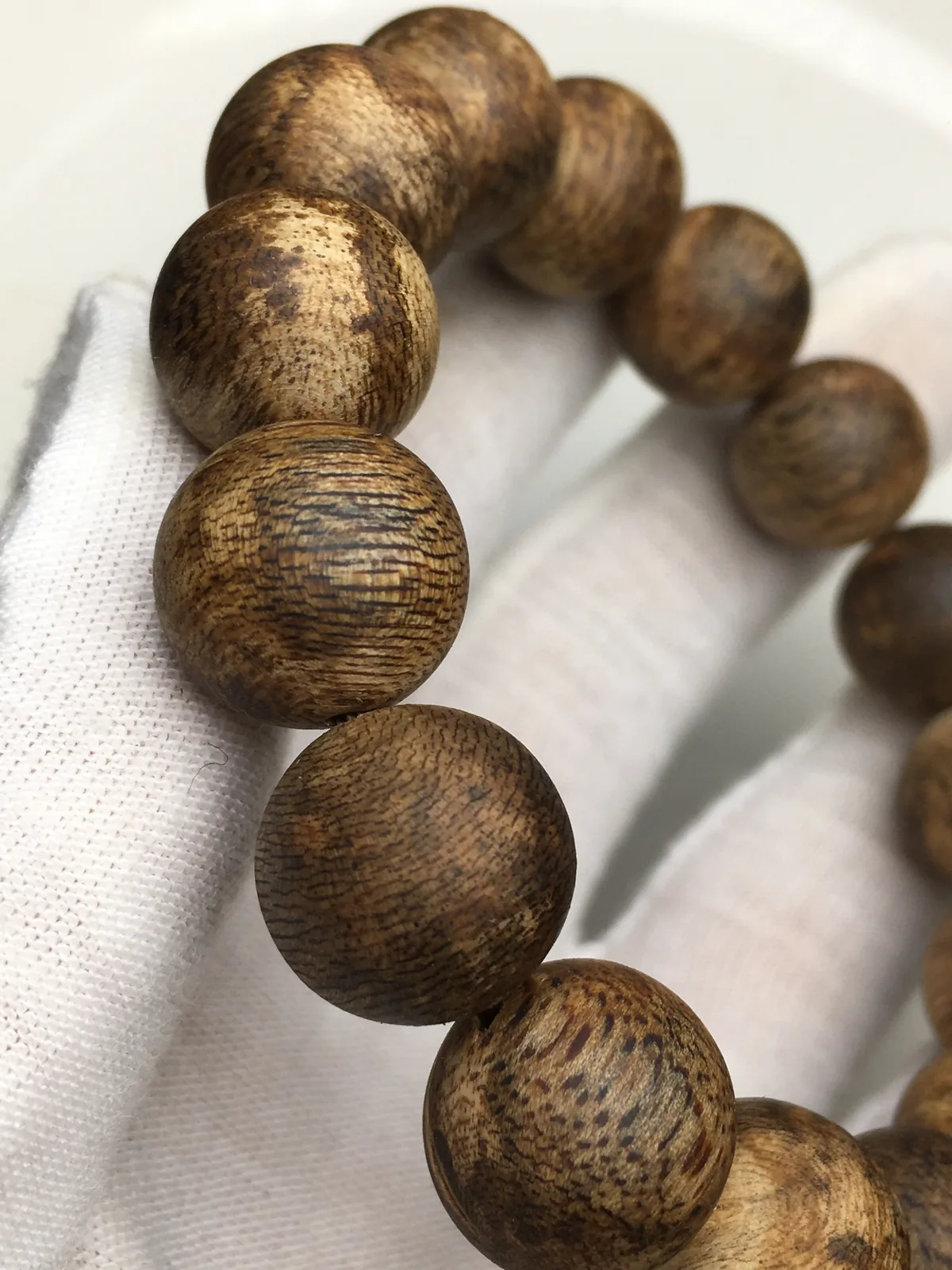
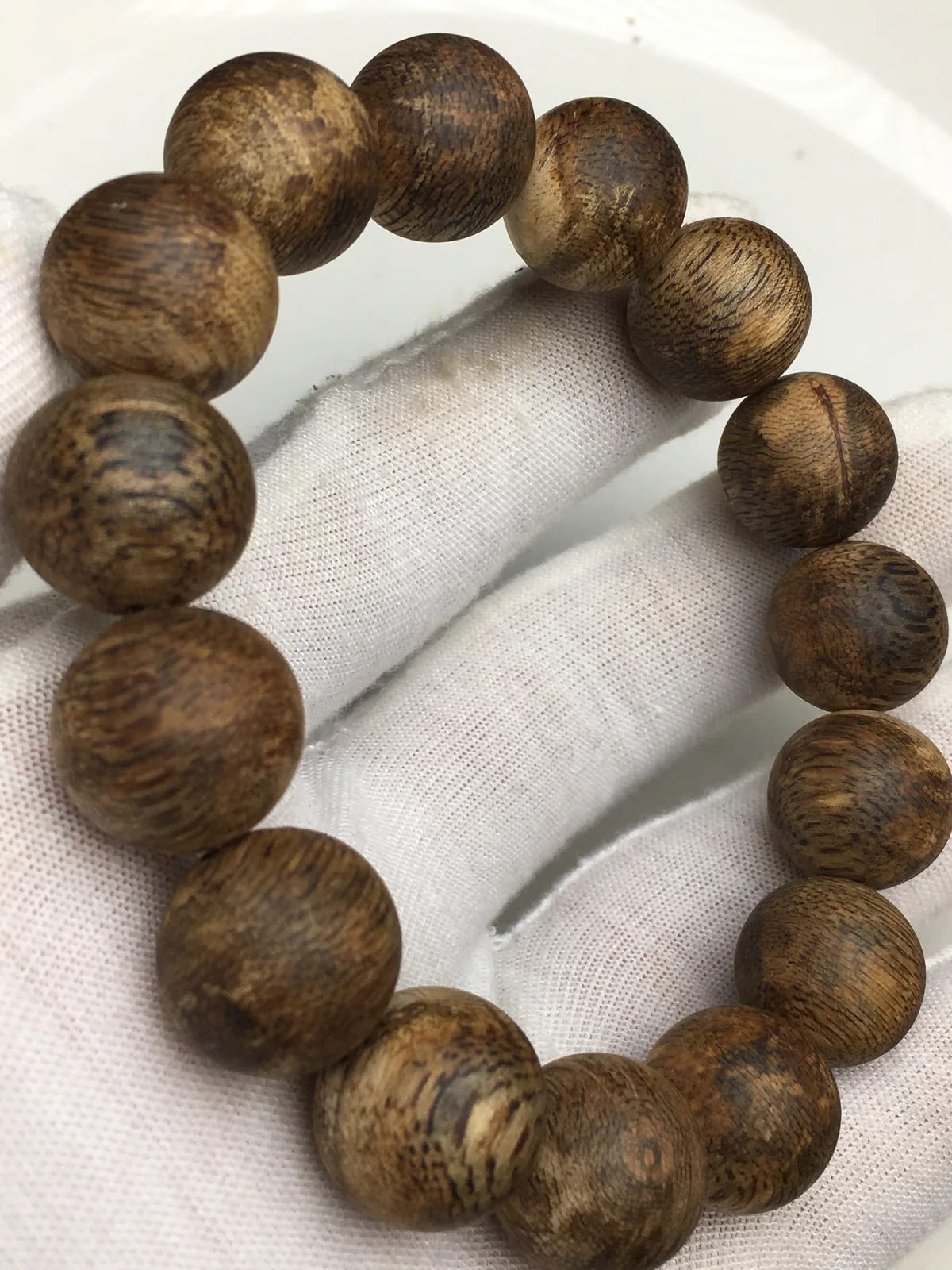
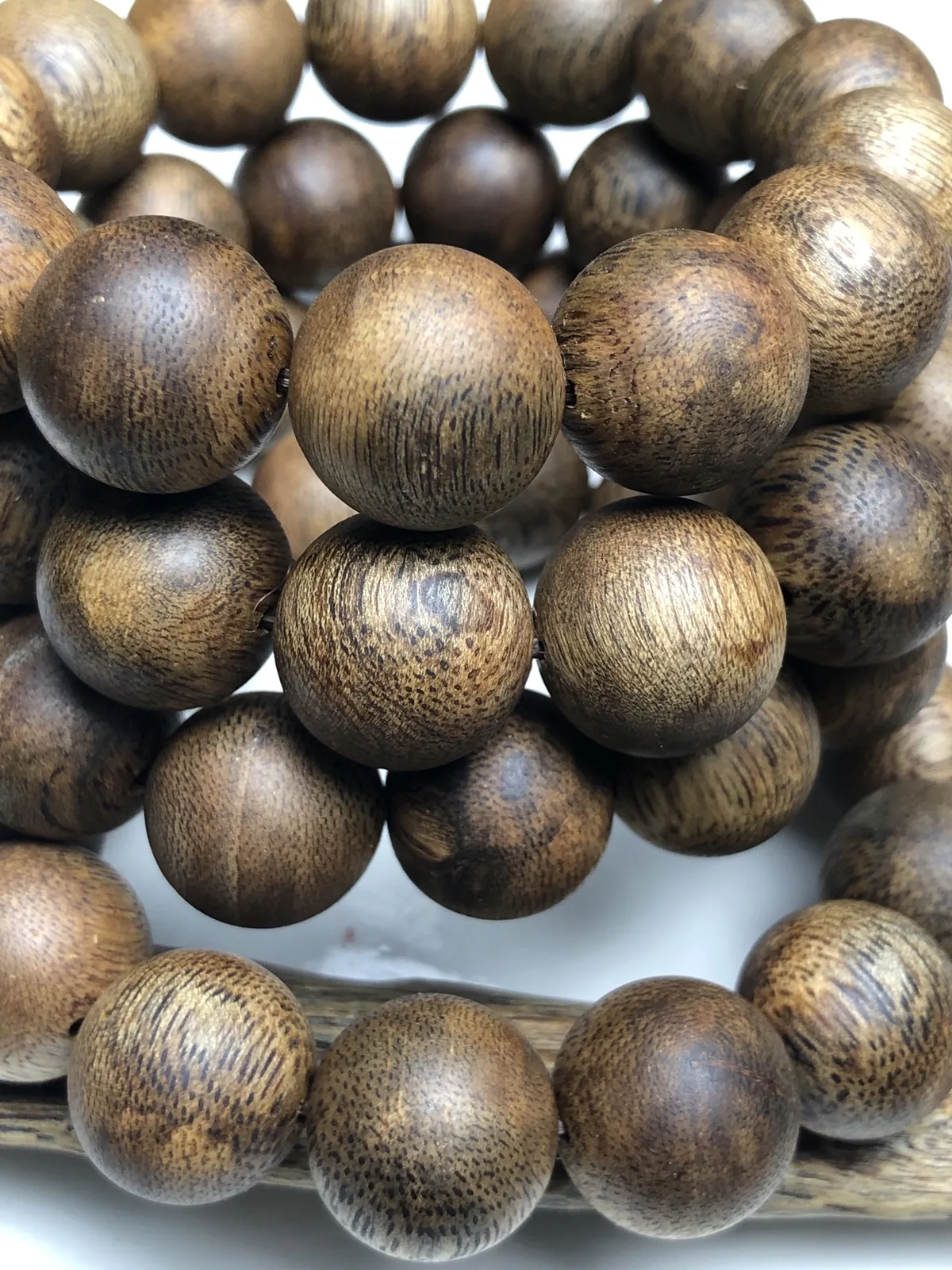 Round beads
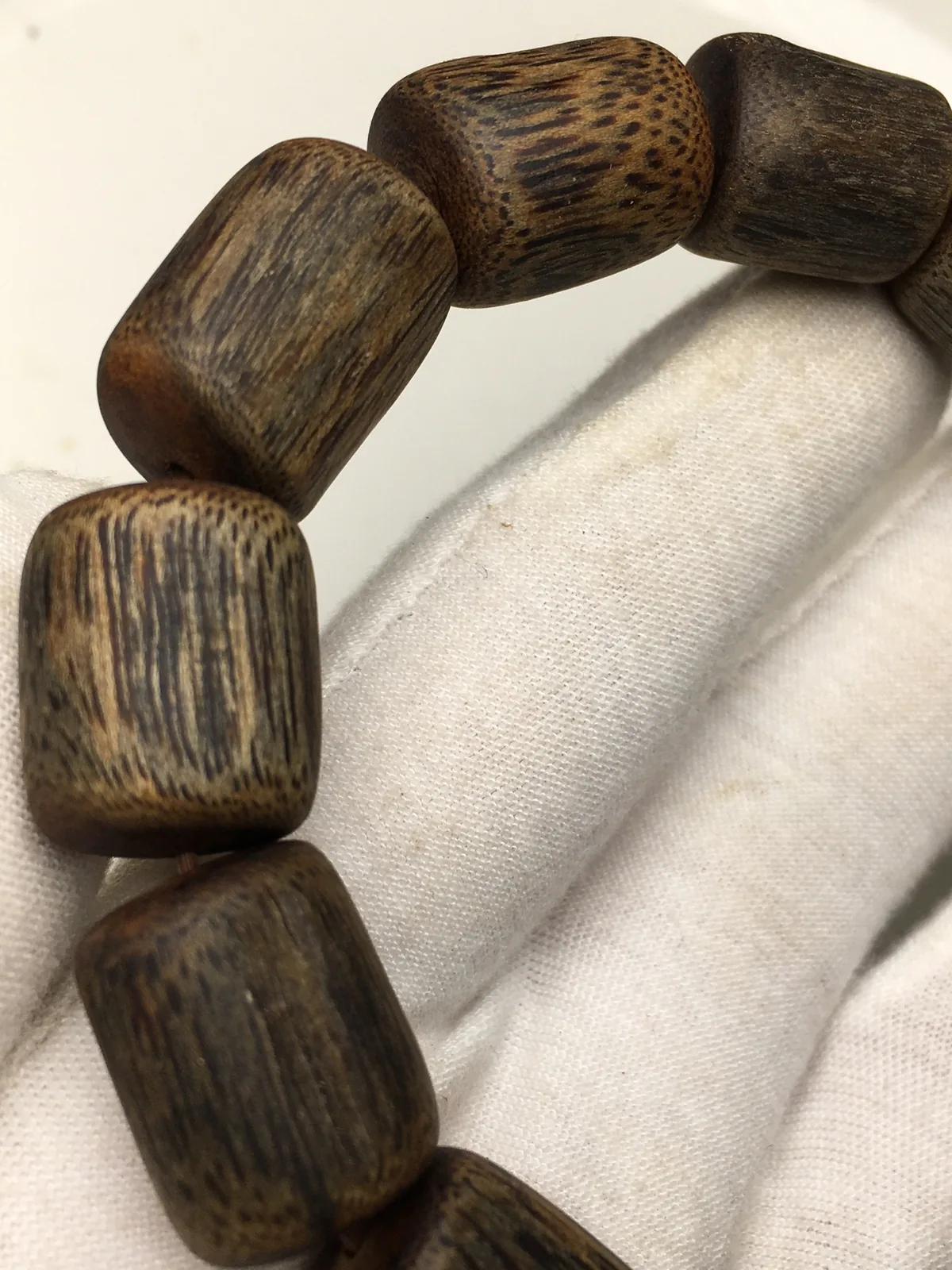
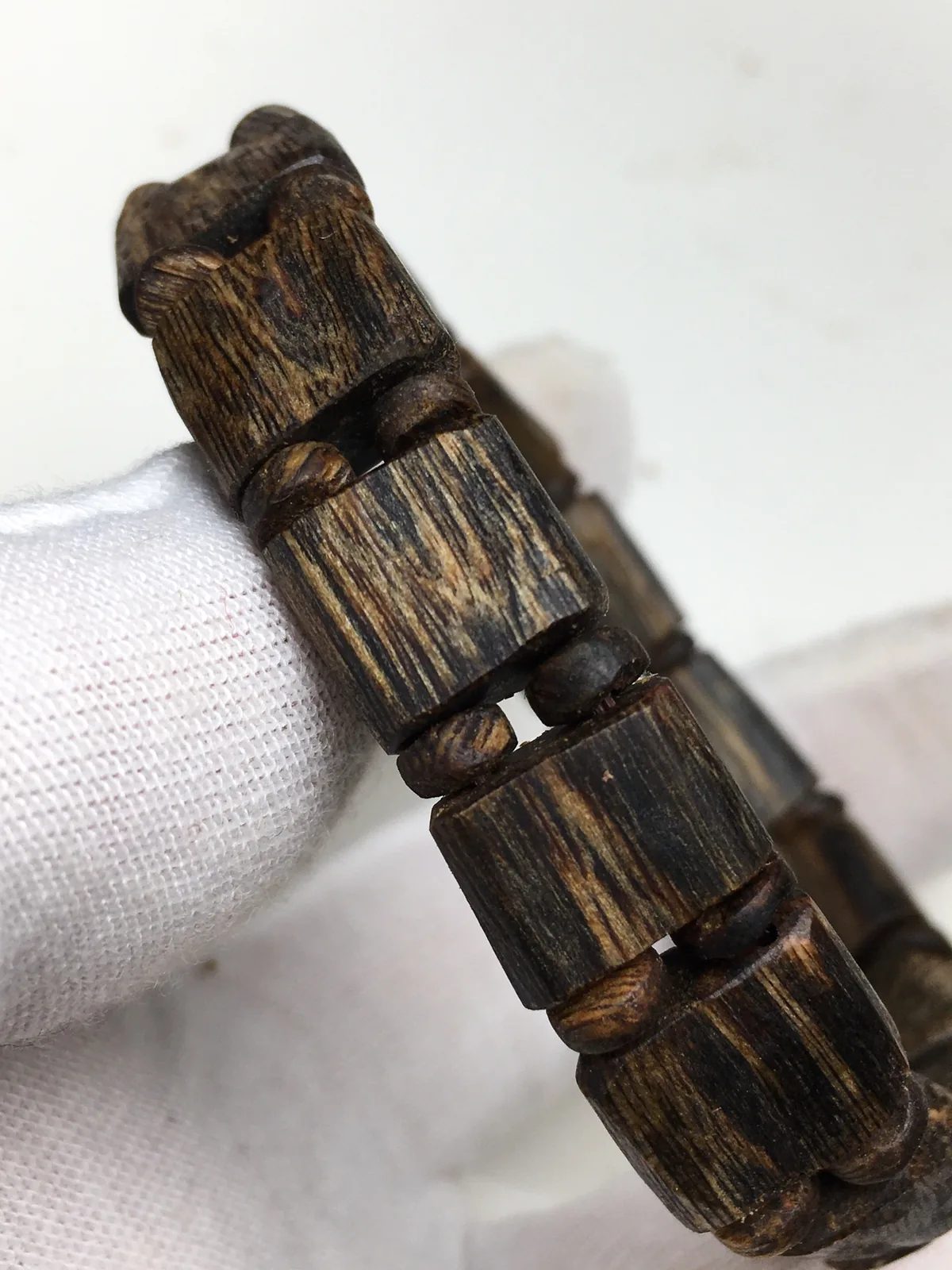
 Cube beads
A round-bead strand and a cube-bead strand from our stock. They look like gems, but both are wood. So both can crack if you dry them on a radiator. What does agarwood bracelet care actually ask of you?
What does agarwood bracelet care involve?
People treat agarwood like a gem. Still, an agarwood bracelet is wood, and good agarwood bracelet care starts there. Wood takes up moisture and gives it off again. It swells and shrinks as it does, and repeated wetting and drying opens small cracks.(USDA 2010)
Agarwood is Aquilaria wood that the tree filled with resin after a wound.(Tan 2019) Its scent comes from aromatic compounds in that resin, and heat releases them faster.(Naef 2011) (How that fragrance behaves on the wrist is covered in do agarwood beads smell?) So almost all agarwood bracelet care follows from three rules: keep it dry, keep it cool, and keep other chemicals away.
The cord is the only part that truly wears out. Everything else is about slowing changes that happen anyway. Oudbracelet sells to individual buyers on behalf of AgarwoodTown, an agarwood business founded in 2014. This is what we tell people when they approve a strand. In short, your agarwood bracelet needs a soft cloth, a pouch and a few habits, not a cleaning kit. If you have not bought yet, start with how to buy an agarwood bracelet.
According to the USDA Wood Handbook, wood swells and shrinks as its moisture content changes.(USDA 2010) First, that is why water is the main risk in agarwood bracelet care. Then sweat and perfume come second. Finally, a dry cloth and dry storage prevent most wear, on the wood and on the cord.
Agarwood bracelet care at a glance: what can harm a strand
This table is a 6-row summary. First read the risk column, then compare the what it does, how much it matters, the habit that fixes it across each row. For example, the first row covers “Water and sweat”.
| Risk | What it does | How much it matters | The habit that fixes it |
|---|---|---|---|
| Water and sweat | Swells the wood, dulls the surface, weakens the cord | ★★★★★ | Take it off for showers, swimming, washing up and workouts |
| Perfume, cream, sunscreen | Stains the wood and masks its scent | ★★★★★ | Bracelet on last, after everything has dried |
| Heat and strong sun | Dries the wood too fast; drives off scent | ★★★★★ | No radiators, hot cars or sunny windowsills |
| Cord wear | Stretches, thins, eventually snaps | ★★★★★ | Roll it on and off; restring when gaps appear |
| Knocks and hard neighbours | Dents and scratches the bead surface | ★★★★★ | Store it on its own, away from stones and metal |
| Dust and skin oil | A dull film in the carving or on flat faces | ★★★★★ | A dry cotton cloth after wearing |
Star ratings are our rough judgement of how often each causes lasting trouble. They are for comparison only, not measurements.
Agarwood bracelet care in two questions
This chooser is a 2-question guide with 8 possible answers. First answer “What is your strand made of?”, then pick the option that fits, such as “Agarwood only”.
The two questions sort agarwood bracelet care into a material and a worry. First, the material decides the extra rules. A pure Agarwood strand needs only the wood rules. Amber is soft and dislikes solvents and heat, while jade is much harder than wood, so a jade strand should travel apart from other pieces. Second, the worry points to one part of the guide: water in Part 1, scent in Part 2, the cord in Part 6 and travel in Part 7.
Part 1 — Why is water the first rule of agarwood bracelet care?
First, take your agarwood bracelet off before you shower, swim, wash dishes or train hard. Water soaks into the wood and the beads swell a little. Then the beads shrink back as the wood dries. The repeated cycle, not one splash, dulls the surface and opens hairline cracks.(USDA 2010)
Sweat is water with salt and skin oil in it. So a long workout is harder on an agarwood bracelet than a rain shower. Both also soak into the cord and weaken the cord from inside, which is why water comes first in agarwood bracelet care.
If the strand does get wet, pat the beads dry with a soft cloth straight away. Then lay the bracelet flat on a towel and let the wood air-dry at room temperature for a day. Only after a full day should the strand go back in the pouch. A closed pouch holds damp in, so a strand that goes away wet stays wet.
Part 2 — Why does agarwood bracelet care put perfume first?
Put your agarwood bracelet on after perfume, hand cream, sunscreen and hair products, not before. Also give the products a minute to dry. Perfume, cream and sunscreen soak into the wood and change both the colour and the scent of the beads.
Perfume is the worst offender. Agarwood’s own scent is a quiet mix of many aromatic compounds,(Naef 2011) so a strong perfume can mask the wood for weeks. So bracelet-on-last is the single most useful habit in agarwood bracelet care.
Likewise, take the bracelet off for cleaning products, hand sanitiser and anything with solvents. Uneven dark patches on a strand almost always come from something on the skin, not from the wood itself. For example, a cream that is still wet under the beads can leave darker marks along the inside of the wrist.
Bracelet on last, or first?
This comparison is a 4-point check of Bracelet on last against Bracelet on first. For example, the first row compares scent you notice. Finally, pick the column that matches what you need.
| Feature | Bracelet on last | Bracelet on first |
|---|---|---|
| Scent you notice | The wood’s own, warming with your skin | Mostly the perfume or cream |
| Colour over months | Even darkening where the hand touches | Blotches where products soaked in |
| The cord | Stays clean and elastic longer | Takes up oils and loses stretch sooner |
| Cleaning | A dry cloth is enough | Marks that a cloth will not lift |
Bracelet on last is the better habit on every row of the comparison. Agarwood scent comes from a mix of many volatile compounds, according to a 2011 review by Naef,(Naef 2011) and a perfume sitting on the wood simply covers them. In practice, the order costs nothing: dress, let products dry, then put the strand on. The cord benefits too, because oil and cream shorten the life of the stretch.
Part 3 — What does agarwood bracelet care mean in heat and sunlight?
Heat is a double risk for an agarwood bracelet. First, heat dries the wood, with the same cracking risk as fast drying after a soaking. Second, heat drives off the aromatic compounds that carry the scent.(Naef 2011) A strand left on a car dashboard will not fail in a day. However, the strand will smell of less, sooner.
Strong sunlight also changes wood surfaces over time. Exposed wood lightens or greys as the surface layer breaks down, according to the USDA Wood Handbook.(USDA 2010) On a bracelet you wear, the effect is small. So in agarwood bracelet care, the places to avoid are spots where a strand sits still in the heat. For example, dashboards, windowsills, a sauna or a beach bag all count. Finally, body warmth is fine: a closed hand brings the scent up without drying the wood.
Part 4 — How do you clean and store an agarwood bracelet?
Cleaning an agarwood bracelet is simple: the job takes a clean, dry, soft cotton cloth and nothing else. So skip water, oil, polish, wax, cleaning spray and ultrasonic cleaners. Each product either soaks into the wood or changes the surface. The cut of the beads then decides the technique. For example, round beads roll through the cloth, while cube beads need a wipe along each flat face.
Between wears, keep the agarwood bracelet in a closed pouch or box, away from sun and heat. A closed pouch keeps the surface clean and slows the fading of the scent. Also store the strand away from hard stones and metal that can scratch the beads. Finally, keep the bracelet away from scented soap and perfume bottles, because the wood picks up any strong smell nearby.
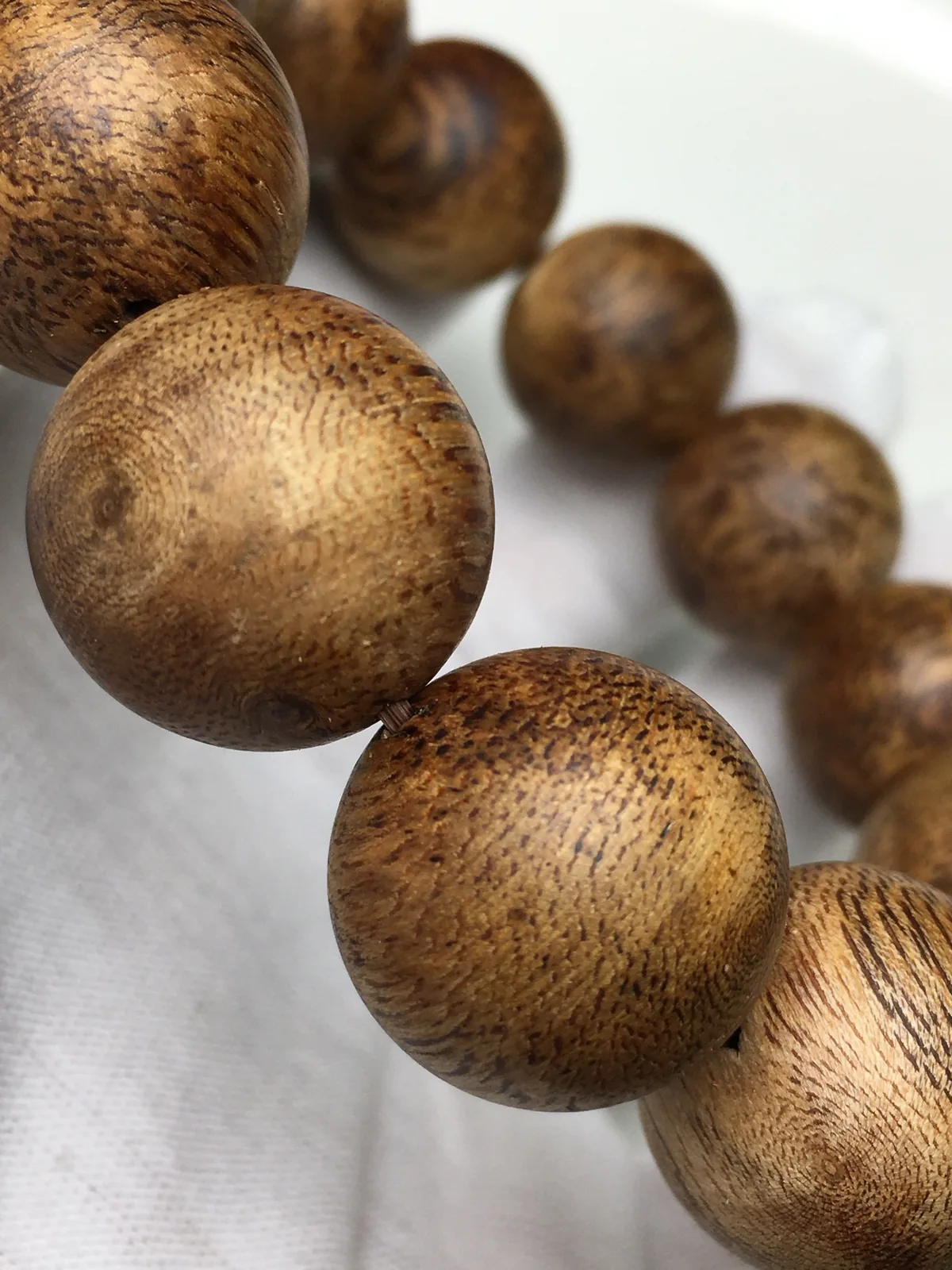 Round beads
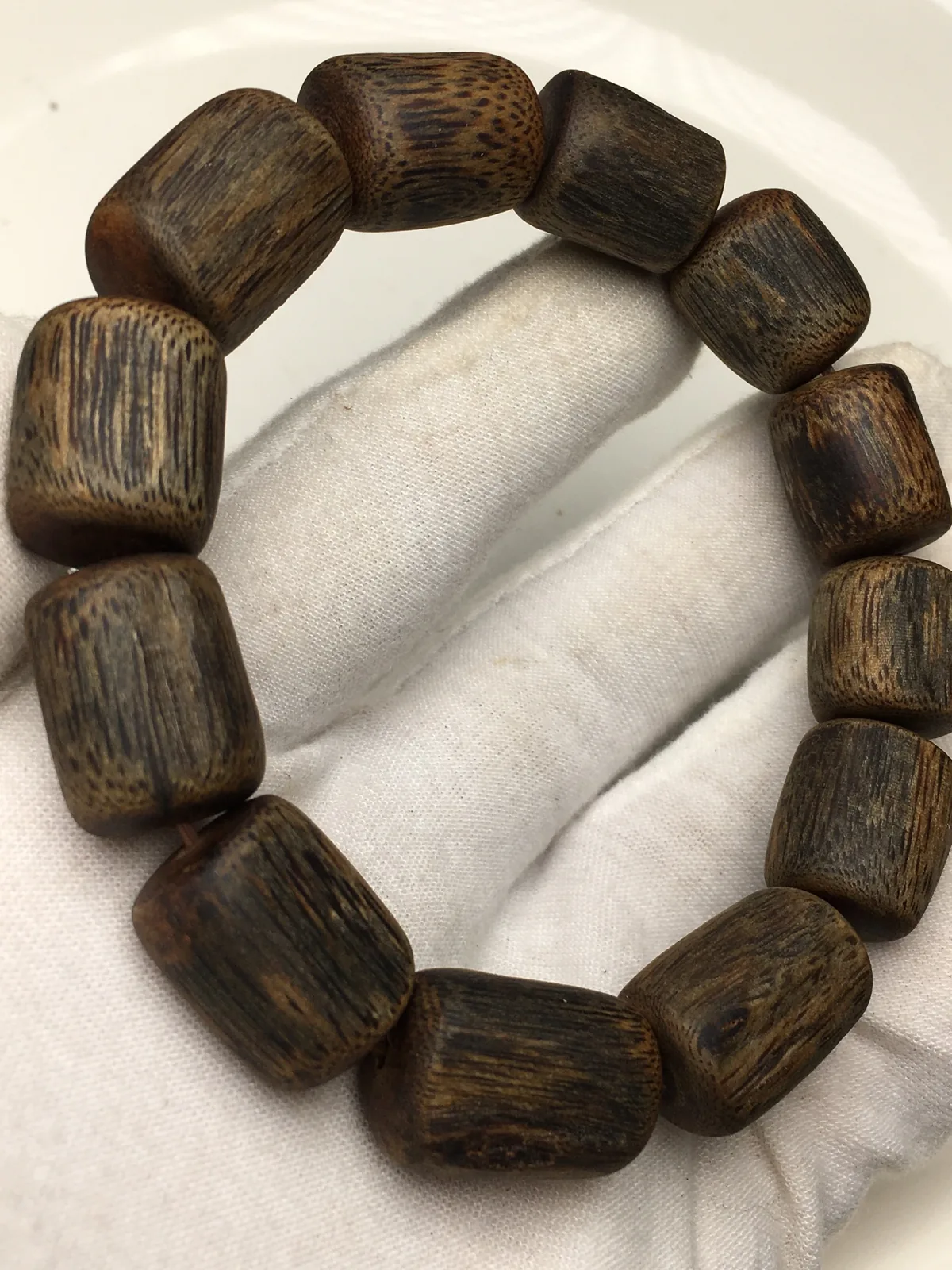 Cube beads
Round beads turn in the cloth, so they clean themselves as they roll. Cube beads, however, have faces and edges. So wipe along each face instead of scrubbing across the corners.
Agarwood bracelet care: cleaning, step by step
This process is a 4-step sequence, from “Dry cloth only” to “Put it away”. First follow step 1, then work down the 4 steps of “Agarwood bracelet care: cleaning, step by step” in order.
- 1
Step 1: Dry cloth only
Use a clean, dry, soft cotton cloth. Skip water, oil, polish and cleaning spray.
- 2
Step 2: Roll or wipe
Roll round beads through the cloth. For flat-faced beads, wipe along each face instead.
- 3
Step 3: Mind the hole
Never push anything into the bead holes, because it can fray the cord.
- 4
Step 4: Put it away
Then return it to its pouch, out of the sun and away from other scents.
Cleaning an agarwood bracelet is a four-step job with one tool, a dry cotton cloth. In step 1, skip water, oil and spray. In step 2, roll round beads through the cloth, or wipe flat faces one by one. Next, keep pins and brushes out of the bead holes, because a sharp point can fray the cord. Finally, put the strand back in the pouch, out of the sun.
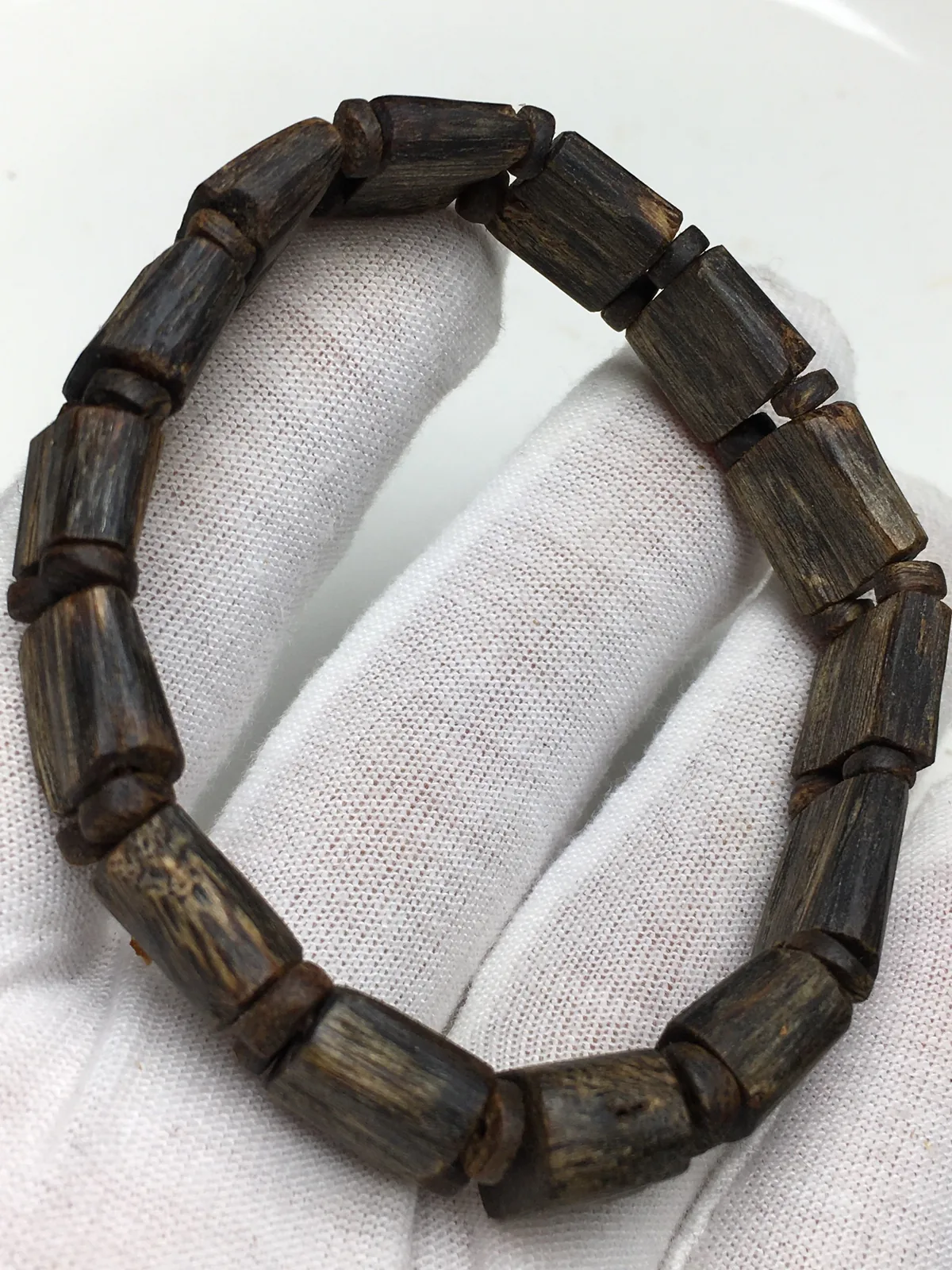
What a clean agarwood bracelet surface looks like
Part 5 — Patina: what changes are normal
Patina is the slow darkening and soft sheen that an agarwood bracelet gains from handling, and gentle wear is good agarwood bracelet care. First, with regular wear, the beads usually darken slightly. Second, the beads develop a soft sheen from contact with the hand. The change is expected, and the patina is one reason many people prefer a worn agarwood bracelet to a strand kept in a drawer.
Patina is also why oiling a strand is a mistake. Oil gives a quick shine that your hand would give slowly. On the way, the oil changes the colour and the scent. For example, an oiled strand can look darker within days but smell of the oil rather than the wood. So good agarwood bracelet care means patience rather than products.
Plantation strands differ in resin, so two strands of one style will not age the same way. Use the table below to tell the normal changes from the ones that need a response.
Which changes are normal in agarwood bracelet care?
This table is a 7-row summary. First read the you notice column, then compare the normal?, what to do across each row. For example, the first row covers “Beads slowly darkening with wear”.
| You notice | Normal? | What to do |
|---|---|---|
| Beads slowly darkening with wear | Yes | Nothing; many people value the patina |
| A soft sheen where your hand touches | Yes | Nothing |
| Scent fainter than when new | Yes, over time | Store closed, away from other fragrances; warm the strand in your hand |
| A dull, dry look after getting wet | Common | Let the strand dry slowly at room temperature, then wear the bracelet again |
| Uneven dark patches | Usually from perfume, cream or water | Keep those products away from the wood |
| Hairline cracks | A sign of fast wetting and drying | Keep the strand dry and away from heat to stop the cracks growing |
| Gaps between beads | The cord is stretching | Have the strand restrung before the cord breaks |
Most of the changes in the table are normal patina, and only three call for action. First, uneven dark patches point to perfume, cream or water on the skin. Second, hairline cracks point to fast wetting and drying, so slow drying matters from then on. Finally, gaps between beads mean the cord is stretching and needs a restring soon.
Part 6 — When does agarwood bracelet care mean a new cord?
The cord is the part of an agarwood bracelet that wears out, not the wood. So if the cord looks thin, loses the stretch, or shows gaps between beads, have the strand restrung before the cord breaks. A snapped strand scatters beads across the floor. Each agarwood bead has its own colour and grain, so a lost bead is hard to match.
Two habits make a cord last much longer. First, roll the bracelet on and off over the hand instead of pulling it wide. Second, never leave the strand stretched over a jar or a box. Any jeweller who strings beads can restring the bracelet. Tell the jeweller our beads have a 2 mm hole, because the hole limits how thick a cord will pass. For example, a cord that fits a 2 mm hole easily may not pass a narrower one. Also take the bead count with you; the table below shows a typical count.
How many beads should you account for?
This table is a 5-row summary. First read the bead size column, then compare the beads (16 cm wrist), inside length, whole strand, estimated across each row. For example, the first row covers “8 mm”.
| Bead size | Beads (16 cm wrist) | Inside length | Whole strand, estimated |
|---|---|---|---|
| 8 mm | 24 | 16.7 cm | 3.5–5.5 g |
| 10 mm | 20 | 16.9 cm | 5.9–9.4 g |
| 12 mm | 17 | 16.7 cm | 8.8–14 g |
| 14 mm | 15 | 16.8 cm | 13–20 g |
| 16 mm | 14 | 17.6 cm | 18–28 g |
Worked out, not measured: round beads with a 2 mm hole, standard fit (about 1 cm of room), density 0.6–0.95 g/cm³. The table uses the same geometry as our wrist fitter. Your own strand’s count and weight are in your quote.
For example, a 10 mm strand on a 16 cm wrist holds 20 beads, with an estimated whole-strand weight of 5.9–9.4 g. Smaller beads leave more pieces to find after a snapped cord: at 8 mm, the count rises to 24. In practice, count the beads you pick up against the table first, and then against your weighing video.
Part 7 — How does agarwood bracelet care work on the road?
The travel kit for an agarwood bracelet is a small closed pouch. First, pack the bracelet apart from other jewellery. If the strand has jade accents, pack the piece on its own, since jade is much harder than wood. Also keep the pouch in your hand luggage, because a suitcase may sit in a hot hold or on a sunny tarmac.
Crossing borders is the one part of agarwood bracelet care that is about paperwork. Every Aquilaria and Gyrinops species is listed in Appendix II of CITES,(CITES) and the rules for carrying agarwood differ by country. So check the rules for where you are going. Finally, keep your weighing video with the strand. We sell plantation agarwood only. When we ship to you, we also confirm what applies to your country with your quote.
Agarwood bracelet care in four everyday situations
This section is a set of 4 short notes, from “Desk and daily wear” to “With stones or metal”. First scan the 4 titles under “Agarwood bracelet care in four everyday situations”, then read the note that matches your case.
Desk and daily wear
Daily wear is what a strand is for. So wear the bracelet, and wipe the beads with a dry cloth now and then. However, take the strand off to wash your hands, for example with strong soap or sanitiser.
Gym, pool, sea
Take the strand off before you go. Sweat, chlorine and salt water all soak into the wood and the cord. So leave the bracelet in its pouch in your bag, not loose where it can take knocks.
Hot weather and holidays
Wear the strand in the evening rather than all day on the beach. Also never leave the bracelet in a parked car. Sunscreen goes on first, and the bracelet goes on once it has dried.
With stones or metal
Jade and agate are harder than wood. Amber, however, is soft and dislikes solvents and heat. Silver fittings tarnish, but keep silver dips well away from the wood. See our agarwood jade bracelet guide.
An agarwood bracelet care routine you can keep
This timeline is a 5-stage sequence, from “Bracelet on last” to “Pouch and paperwork”. First read “An agarwood bracelet care routine you can keep” from top to bottom, since each stage follows the one before.
- Every dayBracelet on lastPut the bracelet on after perfume, cream and sunscreen have dried. Then take the strand off again for showers, swimming, washing up and workouts.
- After wearingWipe and put awayUse a dry, soft cotton cloth. Then store the strand in a closed pouch out of the sun and away from other scents.
- If wetDry it slowlyPat the beads dry and lay the strand on a towel at room temperature. Only then put the bracelet back in the pouch.
- Now and thenCheck the cordLook for thinning, lost stretch or gaps between beads. Then restring before the cord breaks.
- Before a tripPouch and paperworkPack the strand on its own in hand luggage. Also check the agarwood rules for where you are going.
Finally: what does agarwood bracelet care come down to?
Agarwood bracelet care comes down to one idea: an agarwood bracelet is wood, so the strand asks for what wood asks for. First, keep the beads away from water, heat and chemicals. Second, give the strand a dry cloth and a closed pouch. Finally, replace the cord before the cord gives up.
The reward is an agarwood bracelet that changes slowly in your hands. The beads grow darker and softer in sheen, and the wood still carries a scent when you warm the strand. If something does go wrong, such as a crack or a snapped cord, you can usually stop or fix the problem. For example, slow drying stops hairline cracks from growing, and any jeweller who strings beads can replace a cord. Our FAQ also covers the questions we hear most.
Frequently asked questions
This FAQ is a set of 8 short answers about agarwood bracelet care. First find your question below. For example, many facts in these answers about agarwood bracelet care come from the 4 published sources in References, which we checked in September 2026.
Can I wear my agarwood bracelet in the shower?
Please do not. Water soaks into the wood and dulls the surface. With repeated wetting and drying, beads can also crack, and the cord weakens. So take the bracelet off before showering, swimming or washing up. If it does get wet, pat it dry straight away and then let it dry slowly at room temperature.
How do I clean an agarwood bracelet?
Use a clean, dry, soft cotton cloth and nothing else. Roll round beads through the cloth, and wipe flat-faced beads along each face. Avoid water, oils, polish and ultrasonic cleaners. Also never push anything into the bead holes, because that can fray the cord. Then put the bracelet back in a closed pouch.
Why has my agarwood bracelet lost its scent?
The scent fades with time, heat and exposure. Perfume or cream on the wood can also mask it. So keep the strand in a closed pouch out of the sun, away from other fragrances. Holding it in a warm hand for a minute usually brings the scent up again for a while, without any risk to the wood.
Is it normal for the beads to get darker?
Yes. With regular wear, agarwood beads usually darken slightly and develop a soft sheen from contact with the hand. That is expected, and many people value it. However, uneven dark patches from perfume, cream or water are different. That is why good agarwood bracelet care keeps those products away from the wood.
Should I oil my agarwood beads?
No. Oil soaks into the wood, changes its colour and masks its natural scent. It also shortens the life of the cord. Agarwood needs no conditioning, because handling gives it all the sheen it needs. So if the surface looks dry or dull, a few days of regular wear and a wipe with a dry cloth is the right fix.
When should I restring my agarwood bracelet?
Restring it when the cord looks thin, loses its stretch, or shows gaps between the beads. Do it before the cord breaks, because a snapped strand scatters beads that are hard to match. Afterwards, count the beads against your weighing video. Also roll the bracelet on and off over the hand, instead of pulling it, so the cord lasts longer.
My strand has jade or amber beads. Does it need different care?
Mostly the same care, with two additions. Jade is much harder than agarwood, so store the strand where the jade cannot rub other beads or jewellery. Amber, however, is soft and sensitive to heat and solvents such as perfume. So it needs the same distance from chemicals and heat as the wood. A dry cloth suits both.
Can I take my agarwood bracelet abroad?
Usually, but check first. CITES Appendix II lists the trees that form agarwood, and the rules for carrying it differ by country. So look up the rules for your destination before you travel. For packing, use a closed pouch in your hand luggage, away from harder jewellery and out of hot holds and parked cars.
References
This reference list is the source record for “Agarwood Bracelet Care: Water, Perfume, Heat, Cleaning, Patina and Restringing”, with 4 published sources. According to the citations in “Agarwood Bracelet Care: Water, Perfume, Heat, Cleaning, Patina and Restringing”, such as (USDA 2010), each one links to one entry below. Finally, we checked all 4 links behind “Agarwood Bracelet Care: Water, Perfume, Heat, Cleaning, Patina and Restringing” in September 2026.
- 1Forest Products Laboratory. Wood Handbook — Wood as an Engineering Material (General Technical Report FPL-GTR-190). USDA Forest Service, 2010.View source
- 2Tan C.S., Isa N.M., Ismail I., Zainal Z.. Agarwood induction: current developments and future perspectives. Frontiers in Plant Science 10: 122, 2019.doi:10.3389/fpls.2019.00122
- 3Naef R.. The volatile and semi-volatile constituents of agarwood, the infected heartwood of Aquilaria species: a review. Flavour and Fragrance Journal 26(2): 73–87, 2011.doi:10.1002/ffj.2034
- 4CITES Secretariat. Appendices I, II and III. Convention on International Trade in Endangered Species of Wild Fauna and Flora, current.View source
References are listed for transparency. We summarise them for general reading; nothing here is medical advice, and no health effect is claimed.
In this article
Styles mentioned
Browse more: Agarwood Bracelets
Related articles
Weighed before you pay
Choose a style, get your strand weighed
Pick a bead and size, send your request, and we reply with a video of your piece on the scale — its exact weight and price. Nothing is charged until you approve.