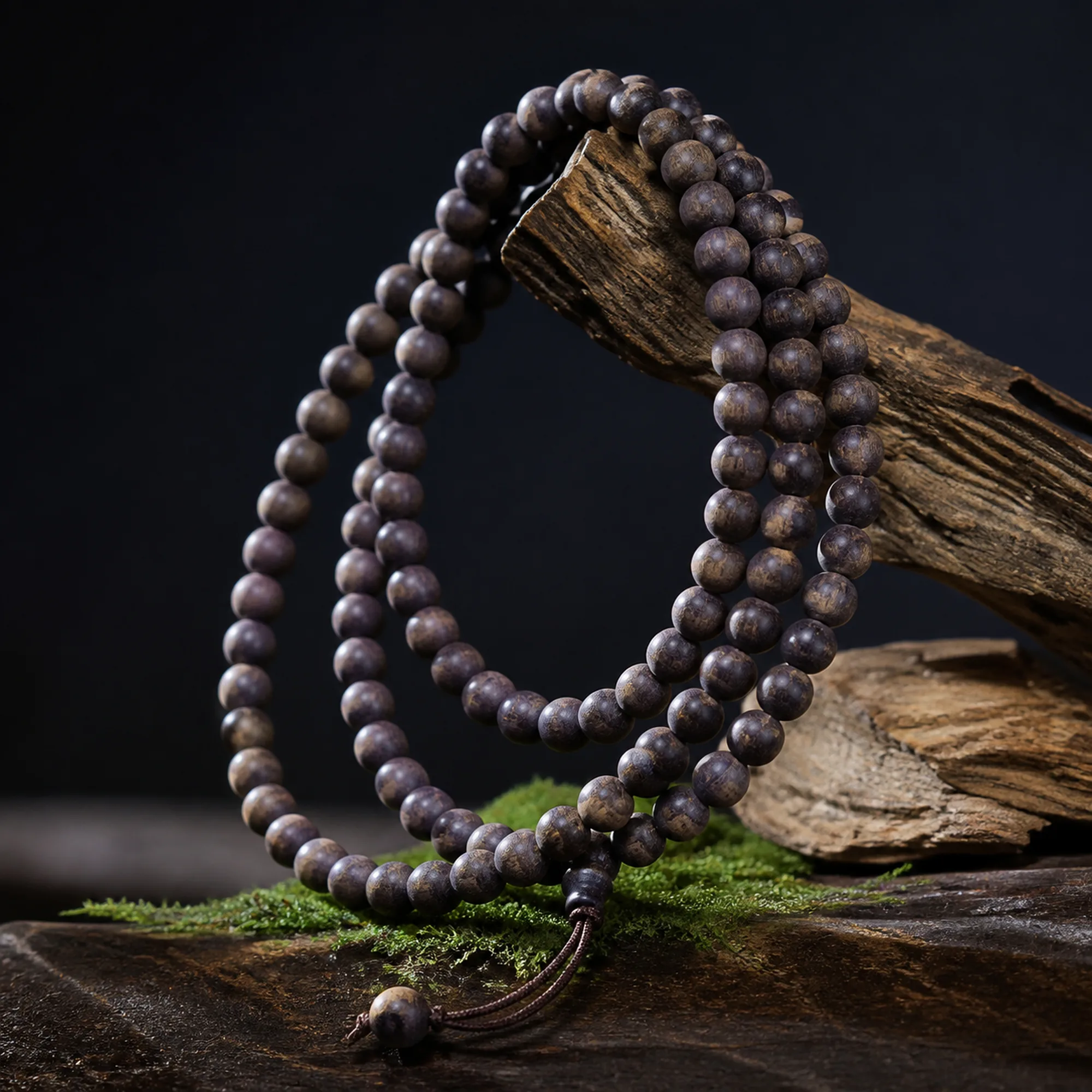
Do Agarwood Beads Smell? What Oud Smells Like, and How It Differs From a Diffuser Bracelet
Do agarwood beads smell? Yes, but quietly at rest, and more in a warm hand. The scent is resin inside the wood, not something added. That is why agarwood beads behave so differently from a diffuser or essential oil bracelet. So this guide covers what oud actually smells like, why resin-rich strands give more, what makes a strand fade, and how to spot beads dosed with fragrance oil.

Written by
Founder & Chief Sourcing Officer, AgarwoodTown
Wang Jianyu is the founder of AgarwoodTown, the agarwood business behind Oudbracelet, trading since 2014. 15+ years grading plantation agarwood and advising buyers on grade selection and CITES paperwork. These guides draw on the same bead geometry our wrist fitter uses and on the questions buyers ask before they approve a weighing video.
In this article
- Do agarwood beads smell? The short answer
- Do agarwood beads smell like other scented jewellery? At a glance
- Two questions before you read on
- Part 1 — Do agarwood beads smell, and where does the smell come from?
- Part 2 — Why do agarwood beads smell faint at rest and fuller in a warm hand?
- Part 3 — Do resin-rich agarwood beads smell more, and does bead size matter?
- Surface and weight of agarwood beads, by bead size
- Part 4 — What makes agarwood beads smell fainter, and what brings it back
- Four things that make agarwood beads smell fainter
- Part 5 — Do agarwood beads smell like a diffuser bracelet?
- Agarwood beads or a diffuser bracelet?
- Part 6 — When agarwood beads smell too loud: signs of fragrance oil
- What other signs show fragrance oil on agarwood beads?
- Do your agarwood beads smell right? A four-step test
- What the beads look like while you smell them
- Part 7 — A routine so your agarwood beads smell for years
- Finally: do agarwood beads smell? Yes, quietly
- Frequently asked questions
 Strand A
 Strand B
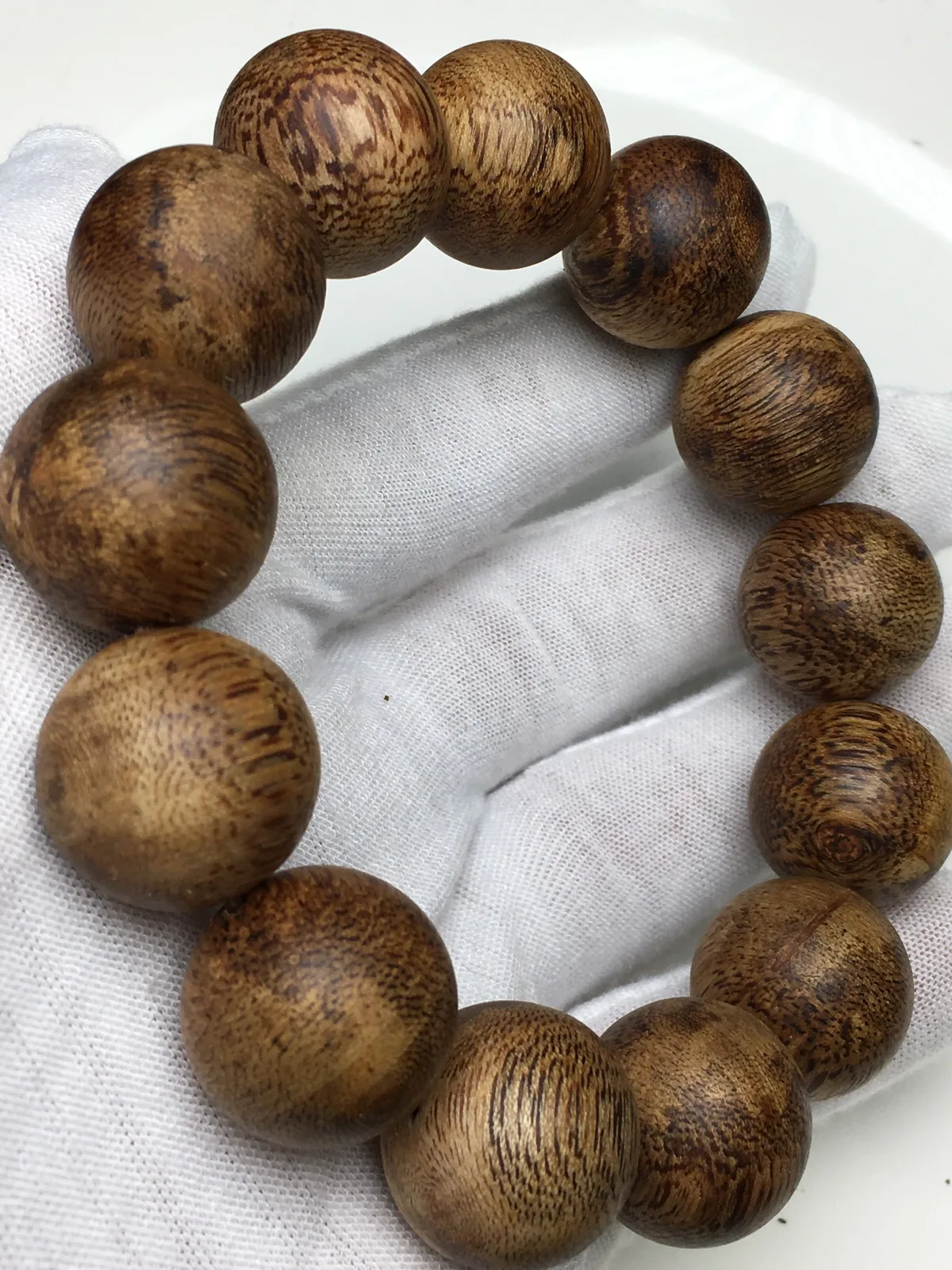
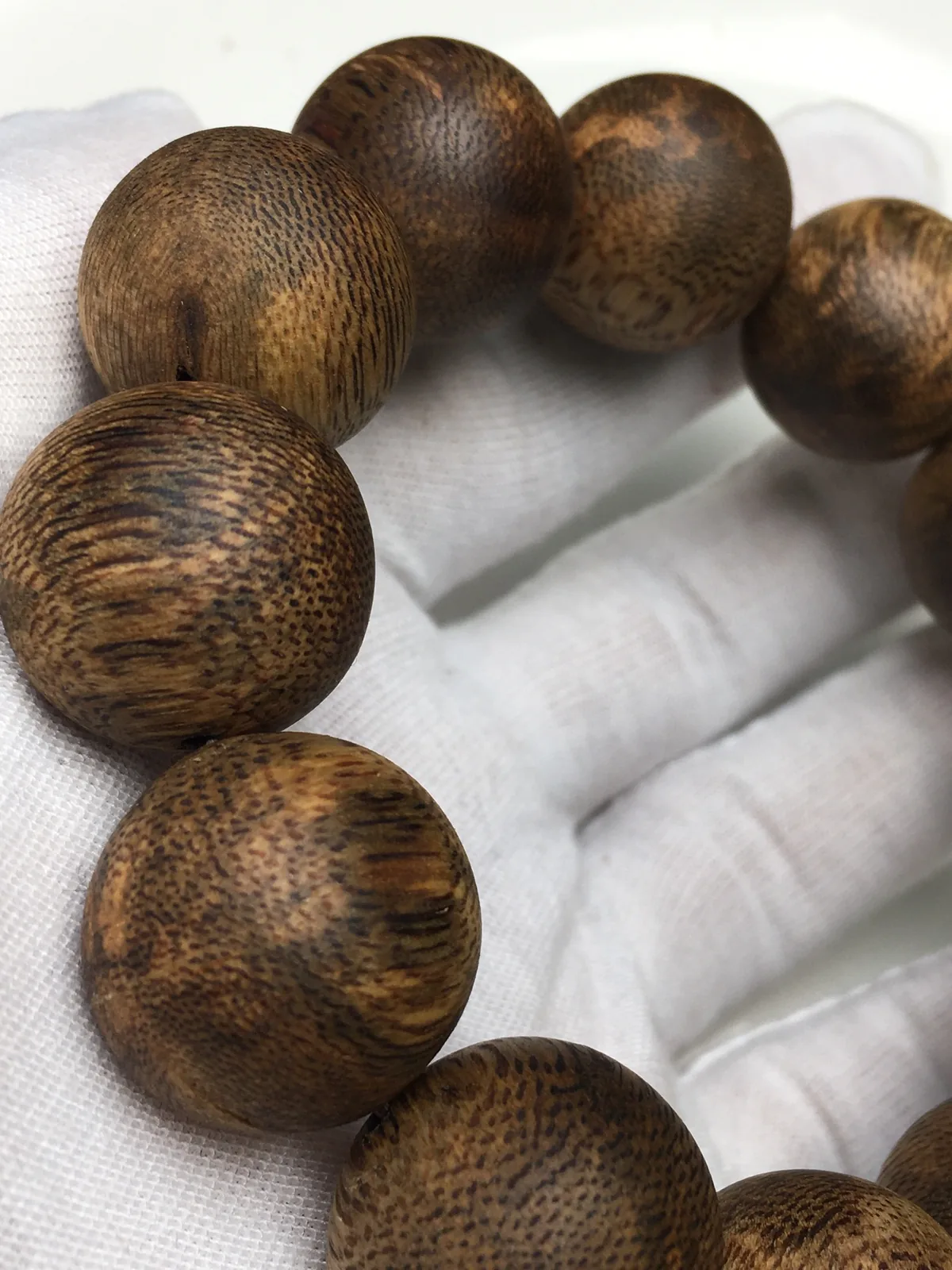
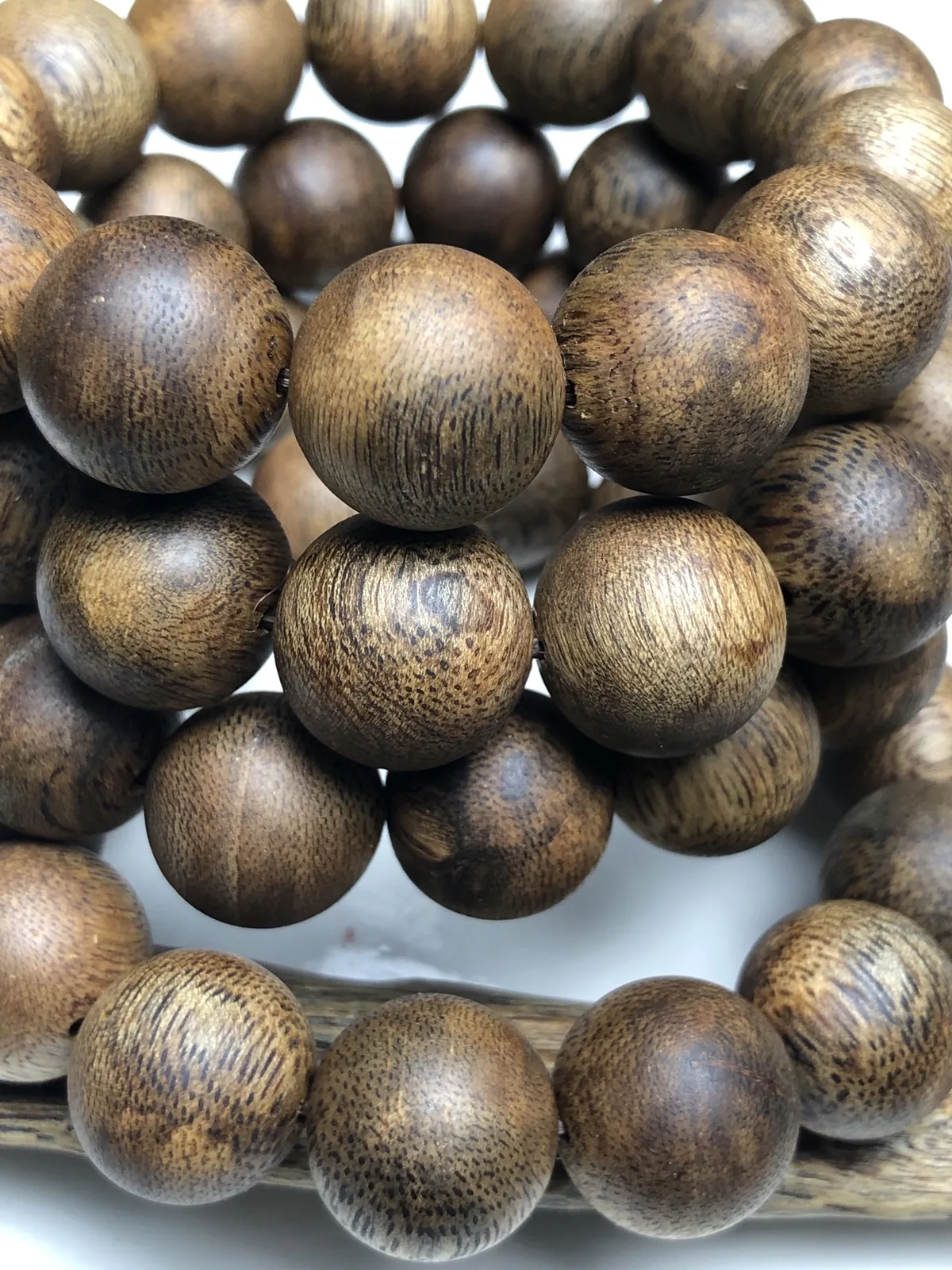
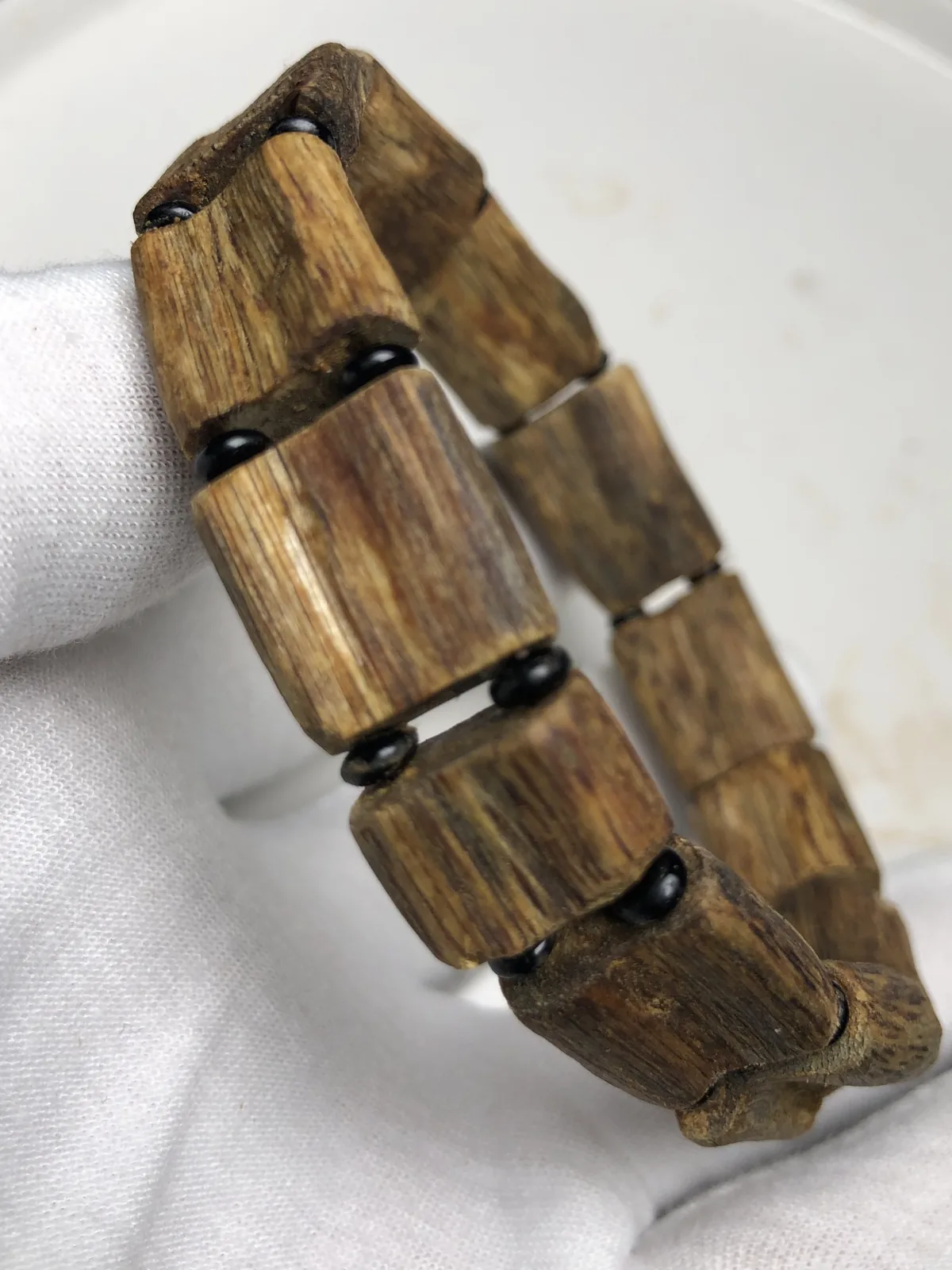
Two round agarwood bead strands from our stock, photographed the same way. A photograph carries no smell, and neither does a listing that promises one. So the honest question is the one buyers ask us: do agarwood beads smell at all, and what should you expect when you open the parcel?
Do agarwood beads smell? The short answer
Yes, agarwood beads smell. However, agarwood beads rarely smell the way a shop listing implies. A strand of genuine plantation agarwood is usually quiet at rest and fuller when it is warm. In a cool room, at arm’s length, you may notice very little.
Cupped in a closed hand for a minute, however, the same agarwood beads smell woody, sweet-resinous and a little balsamic. The scent stays close to the skin rather than filling a room.
That behaviour comes from where the scent lives. Agarwood beads are not a scented product. Instead, it is wood that a tree has filled with resin, and the smell is the resin’s own aromatic compounds leaving the surface. Warmth makes them leave faster. Also, nobody added anything, so nothing runs out, unlike a diffuser bracelet or a wood bead dosed with fragrance oil.
Oudbracelet belongs to AgarwoodTown; we have smelled a great many strands since 2014. We will not promise you a scent strength, because strands differ and noses differ. Still, we can explain why agarwood beads smell, what changes it, and how to tell the wood’s own smell from an added one. So start with the table.
According to Naef (2011), agarwood contains a wide range of volatile and semi-volatile compounds.(Naef 2011) First, those compounds are why agarwood beads smell at all. Then warmth releases more of them. Finally, the scent of a bead bracelet is quiet: you notice it most when the beads are warm in the hand.
Do agarwood beads smell like other scented jewellery? At a glance
This table is a 4-row summary. First read the what it is column, then compare the where the scent comes from, cold, at rest, in a warm hand, changes with warmth, does it run out? across each row. For example, the first row covers “Agarwood beads”.
| What it is | Where the scent comes from | Cold, at rest | In a warm hand | Changes with warmth | Does it run out? |
|---|---|---|---|---|---|
| Agarwood beads | Resin inside the wood itself | Usually faint, close to the skin | Fuller for a while, then settles | ★★★★★ | Nothing added to run out; softens slowly over years |
| Lava-stone or ceramic diffuser beads | Essential oil you drip on, held in the pores | Strong just after dosing | Much the same as cold | ★★★★★ | Yes — you re-dose it, often every few days |
| Oil-dosed “scented” wood beads | Fragrance oil added by the maker | Strong, often sweet and flat | Much the same as cold | ★★★★★ | Yes — commonly weeks to months, then the wood is plain |
| Plain, non-aromatic wood beads | Little or none | A faint woody smell at most | Slightly warmer, still faint | ★★★★★ | Nothing to run out |
Star ratings describe how much the smell changes between cold and warm, not how strong it is. They are our working comparison of categories, not measurements. So no row is a promise about any individual strand.
Two questions before you read on
This chooser is a 2-question guide with 8 possible answers. First answer “What kind of scent are you after?”, then pick the option that fits, such as “The wood itself”.
Agarwood scent is a quiet, woody smell from resin inside the wood, so the first question is what kind of scent you want. For example, a pure strand gives the wood itself, while dark, resin-rich wood usually has more resin to release. The second question is what you are checking: a dosed fake, a scent that has faded, the link between density and smell, or simply which strand to buy. Each answer points to one part of the guide below, or to a related guide.
Part 1 — Do agarwood beads smell, and where does the smell come from?
Agarwood is not a species of tree. Also, Aquilaria heartwood on its own is pale and close to odourless. Agarwood forms only after the tree takes a wound or an infection. Then it lays down a dark resin around the damage over years, and plantations start the same process on purpose.(Tan 2019) So when agarwood beads smell, all of that smell comes from the resin. Wood with little resin therefore has little to give.
The resin is not one substance, however. Reviews of agarwood chemistry list a long family of volatile and semi-volatile compounds, in proportions that differ between samples.(Naef 2011) That is why “what does oud smell like” has no single answer.
Most people describe a genuine strand as woody and resinous with a sweet edge. Sometimes it is leathery, and sometimes faintly sour when cold. It is not the syrupy sweetness of most oud-labelled perfumes.
Two consequences follow. First, the scent is a property of the wood rather than a coating, spread through the bead. So polishing or years of wear do not remove it. Second, those compounds are volatile. They leave the surface as vapour, and they leave faster when the surface is warm. That is why agarwood beads smell more on a warm wrist.
Part 2 — Why do agarwood beads smell faint at rest and fuller in a warm hand?
Faint agarwood beads at rest are the commonest surprise. It is also the commonest reason a buyer writes to ask whether a strand is real. A strand of agarwood beads sitting on a table smells of almost nothing from half a metre away. However, wear it for twenty minutes, raise your wrist to your face, and the agarwood beads smell clearly.
The mechanism is ordinary physics. Aromatic compounds must evaporate from the bead surface before your nose can reach them, and evaporation rises steeply with temperature.(Naef 2011) Skin is warmer than a room by ten degrees or more, and your wrist is close to your face. By contrast, a strand shut in a drawer is cool, still, and nowhere near anyone’s nose.
Two smaller effects work the same way. First, moving air carries vapour off the surface. So a strand turned between the fingers reads stronger than one lying flat. Second, a closed pouch concentrates what has already evaporated. That is why opening the pouch is often the clearest moment when agarwood beads smell. Neither changes how much resin the wood holds, only how much reaches you.
Part 3 — Do resin-rich agarwood beads smell more, and does bead size matter?
If agarwood beads smell of resin, more resin means more scent to release. So two strands of identical size and cut can differ so much. Resin is also heavy, so resin raises density. As a result, weight is the practical stand-in for resin that a buyer can check, as our guide to sinking agarwood explains. Trade grading systems lean on resin content for the same reason.(Wang 2021)
For example, a 17-bead strand of 12 mm rounds holds about 14.7 cm³ of wood, or roughly 8.8 g at the light end of our estimating band, and roughly 14 g at the heavy end. Most of the difference is resin. You cannot see resin content in a photograph, and you should not expect to smell the difference through a screen either.
Bead size pulls both ways, and the table shows why. Scent leaves only from the surface, and large beads have less surface for the wood they hold. So an 8 mm strand carries far less wood than a 16 mm strand. However, the 8 mm strand offers about twice the surface per unit of wood. Small agarwood beads smell more than people expect for that reason.
Surface and weight of agarwood beads, by bead size
This table is a 5-row summary. First read the bead size column, then compare the beads (16 cm wrist), outer surface, whole strand, estimated weight, surface per unit of wood across each row. For example, the first row covers “8 mm”.
| Bead size | Beads (16 cm wrist) | Outer surface, whole strand | Estimated weight | Surface per unit of wood |
|---|---|---|---|---|
| 8 mm | 24 | 48 cm² | 3.5–5.5 g | 8.3 cm² per cm³ |
| 10 mm | 20 | 63 cm² | 5.9–9.4 g | 6.4 cm² per cm³ |
| 12 mm | 17 | 77 cm² | 8.8–14 g | 5.2 cm² per cm³ |
| 14 mm | 15 | 92 cm² | 13–20 g | 4.4 cm² per cm³ |
| 16 mm | 14 | 113 cm² | 18–28 g | 3.8 cm² per cm³ |
Worked out, not measured: round beads with a 2 mm hole, a standard fit of about 1 cm of room, and an estimating density of 0.6–0.95 g/cm³, with the same geometry as our wrist fitter. Surface is the outer sphere area, ignoring the drill hole. So these figures describe how much wood faces the air, not how strongly any strand smells.
 Round beads
 Cube beads
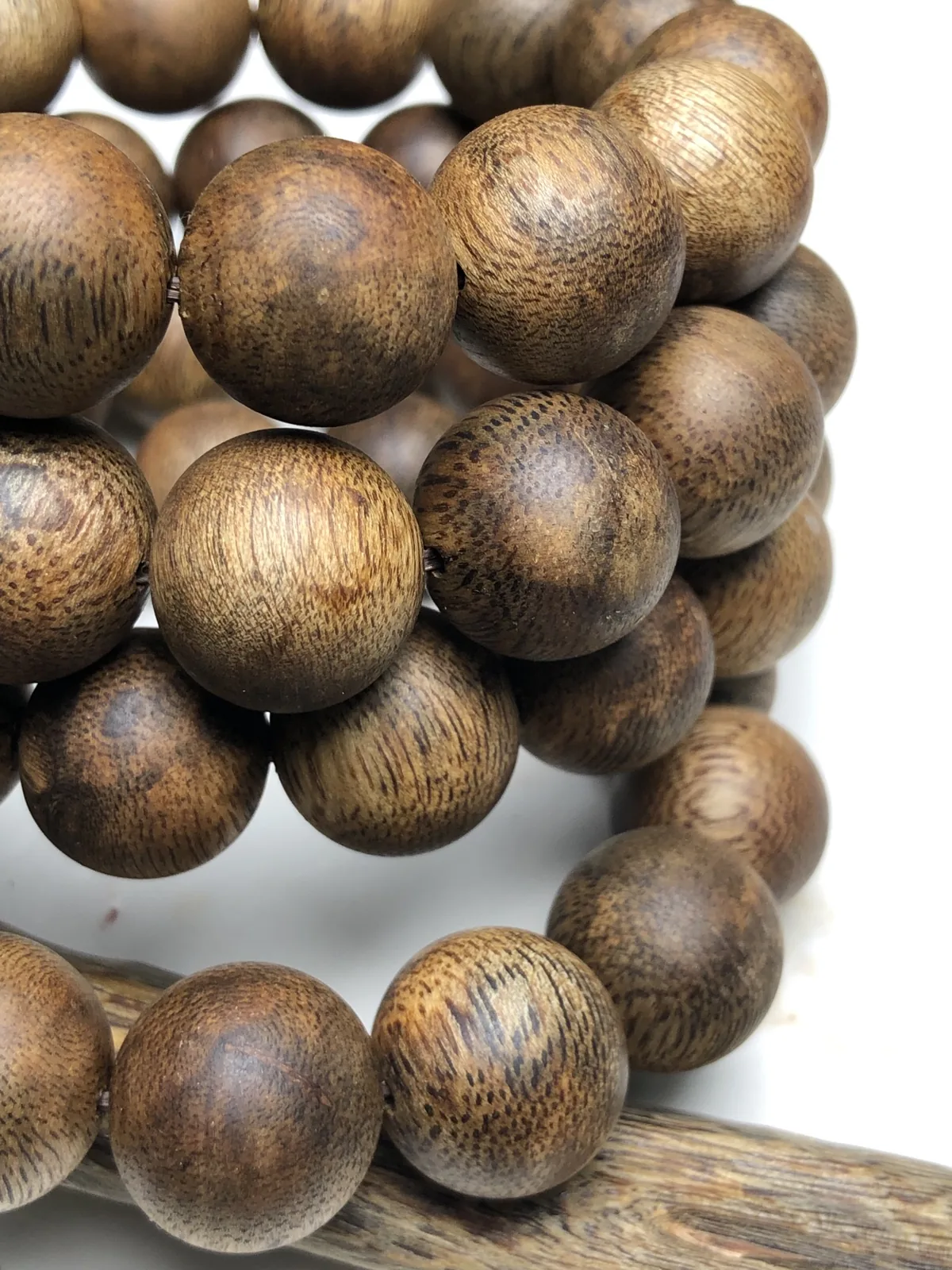
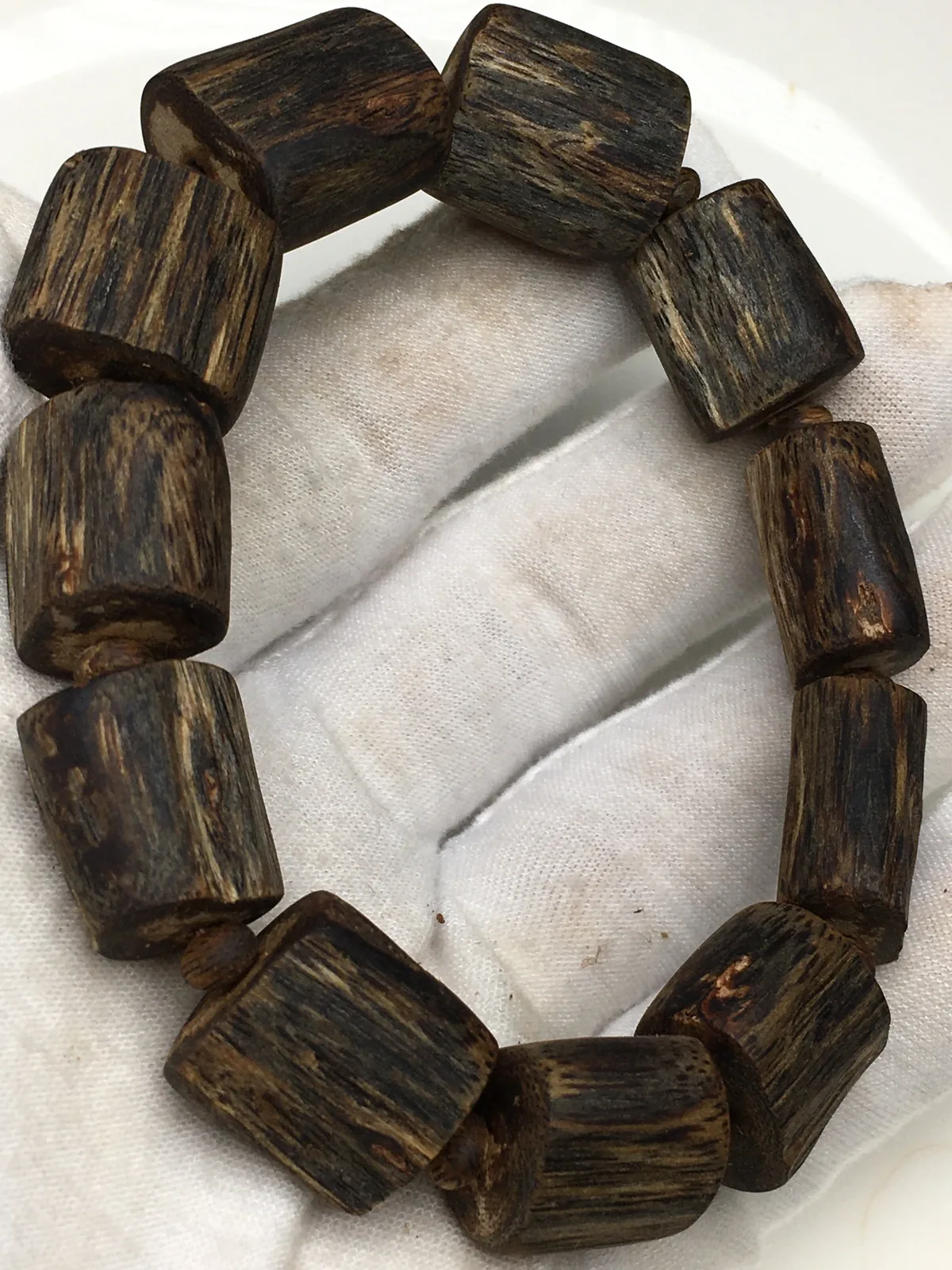
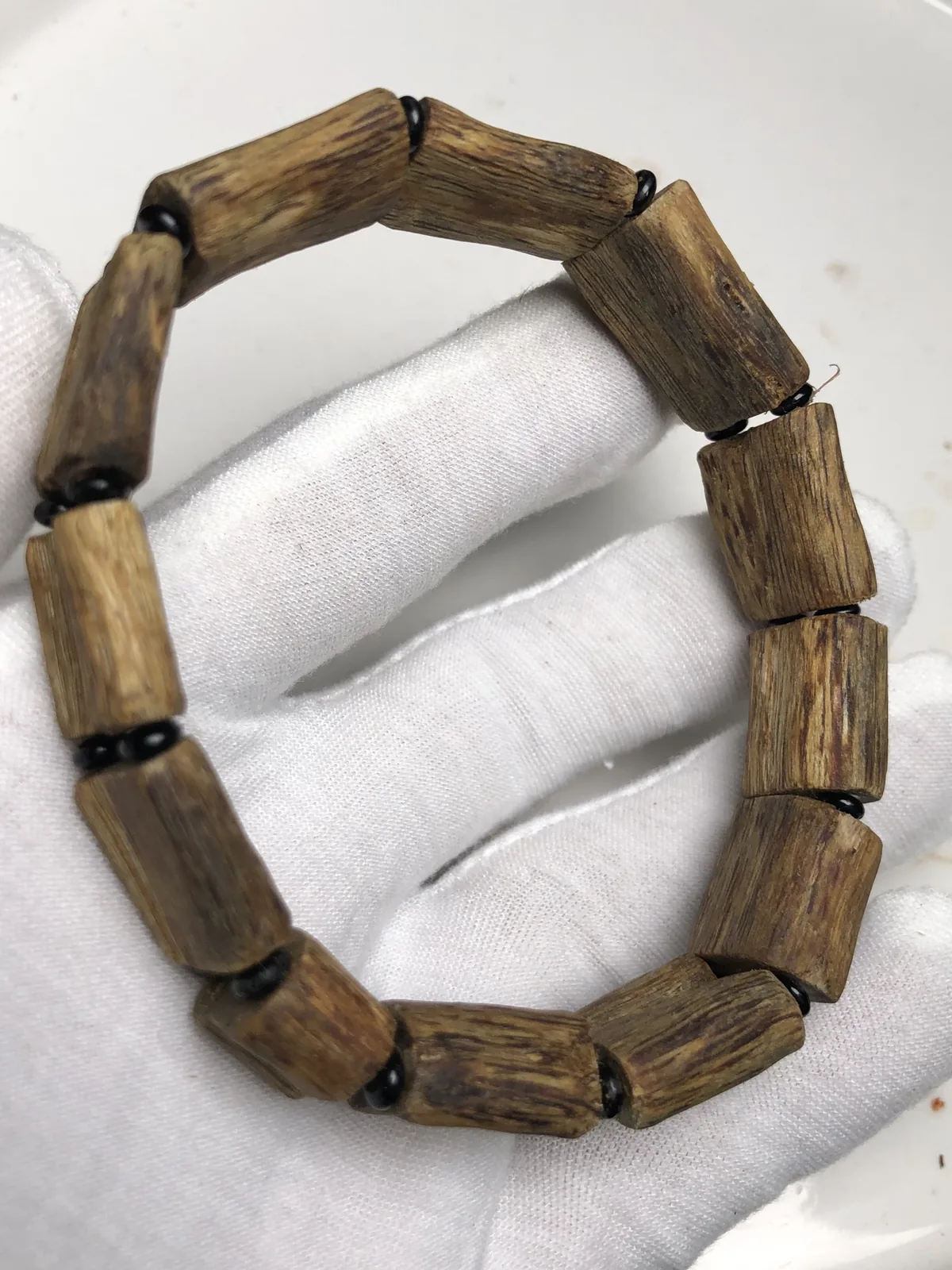
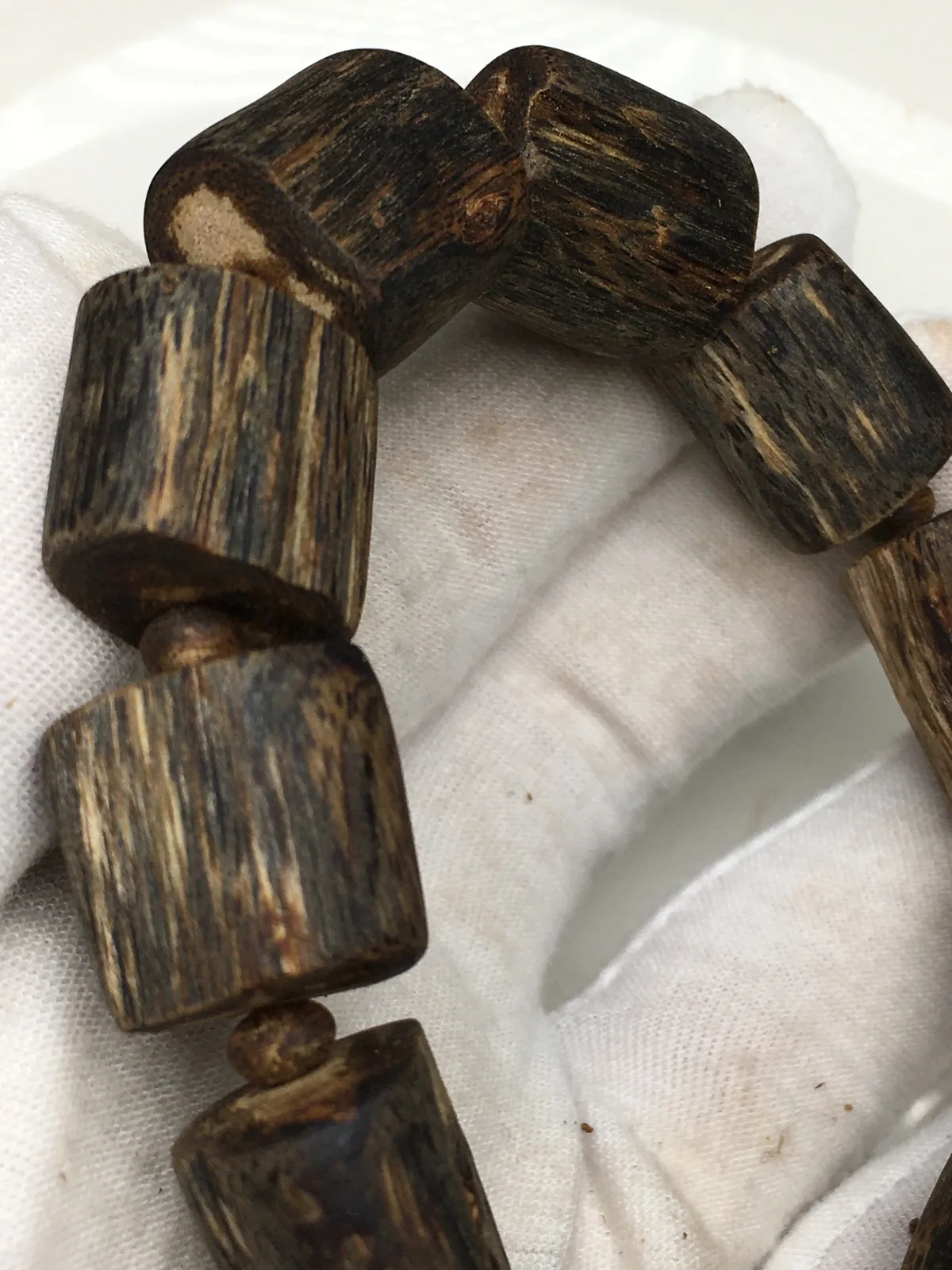
The cut changes how much wood faces the air, and how much of it presses against your skin. Round agarwood beads roll and leave gaps. Cube agarwood beads, however, sit as a continuous band against the wrist. Both bead cuts smell of the same wood, so the cut only changes the arithmetic slightly.
Part 4 — What makes agarwood beads smell fainter, and what brings it back
Agarwood beads do get quieter, and usually the owner’s routine is the cause rather than the wood. Four things account for nearly every message we get about agarwood beads that smell fainter: heat, sunlight, perfume and washing. Each factor either drives the aromatic compounds off faster, or covers the wood with something louder.
Heat is the big one for agarwood beads, for the reason in Part 2. A dashboard or a sunny windowsill holds a strand warm all day, unattended. Heat also dries the wood, and wood that dries fast checks and splits.(USDA 2010) Perfume, hand cream and sunscreen, by contrast, soak in and sit over the wood’s own smell, sometimes for weeks.
What brings the scent back is unglamorous. First, wear the strand, because a warm wrist is the best thing you can do for the scent. Then keep the beads in a closed pouch, out of the sun and away from other fragrances. Finally, give the strand the warm-hand minute before you decide the scent has gone. For example, a cold strand often reads clearly after a minute in a closed fist. The full routine is in our agarwood bracelet care guide.
Four things that make agarwood beads smell fainter
This section is a set of 4 short notes, from “Heat and sunlight” to “Wear and a closed pouch”. First scan the 4 titles under “Four things that make agarwood beads smell fainter”, then read the note that matches your case.
Heat and sunlight
Dashboards, windowsills, radiators, hot cars and beach bags release the aromatic compounds unattended. Heat and sun also dry the wood. So store the strand cool and shaded.
Perfume, cream, sunscreen
Perfume, cream and sunscreen sit on the wood and mask the natural smell, often for weeks. Such products can also stain the wood unevenly. So put the bracelet on last, once everything else has dried, and keep the strand away from scented soap and hand sanitiser.
Water and washing
Never wash an agarwood bracelet. For example, a rinse under the tap dulls the surface, and repeated wetting and drying opens hairline cracks. So take the strand off for showers, swimming, washing up and hard exercise, and dry the beads slowly after any soaking.
Wear and a closed pouch
Wear and a closed pouch are the two things that help. Skin warmth brings the scent up daily. Meanwhile, a closed pouch keeps evaporating scent from escaping into the room. So agarwood beads you wear often generally smell better than beads kept in a drawer.
Part 5 — Do agarwood beads smell like a diffuser bracelet?
No: a diffuser bracelet is a different product altogether. A diffuser or aromatherapy bracelet usually uses porous lava stone, unglazed ceramic or felt, and the bead carries no scent until you drip essential oil onto the surface. The porous bead is just a holder. When the oil evaporates, in a few days or so, you add another dose. The design is honest, because the scent is whatever you put on the bead.
An essential oil bracelet sold ready-scented is the same idea with the first dose already applied. Similarly, “scented wood beads” are ordinary wood soaked in fragrance oil at the factory. Such beads smell strong out of the packet and then get quieter every week.
Agarwood beads smell for a different reason. The aromatic material is resin that the tree formed in the wood over years. Nobody added the scent, so there is no dose to top up. For example, fresh oil on lava stone will out-smell Agarwood easily on day one. Yet a year later, the lava stone smells of whatever you last put on it, and the agarwood beads still smell of agarwood.
Agarwood beads or a diffuser bracelet?
This comparison is a 6-point check of Agarwood beads against Diffuser / oil bracelet. For example, the first row compares where the scent lives. Finally, pick the column that matches what you need.
| Feature | Agarwood beads | Diffuser / oil bracelet |
|---|---|---|
| Where the scent lives | Resin spread through the wood itself | Oil held in the pores of a stone or bead |
| Out of the box | Faint at rest; fuller when warmed | As strong as the dose you just applied |
| Cold versus warm | A clear difference you can test in a fist | Much the same either way |
| After a year of wear | Still the wood’s own scent, softened | Whatever oil you last added, or nothing |
| Upkeep | Dry cloth, closed pouch, no additions | Re-dose regularly; oil can stain clothes and skin |
| Choosing one | Choose the wood: resin, weight, cut | Choose the bead as a holder; the oil decides the smell |
In practice, the choice is between a scent you top up and a scent the wood already carries. A diffuser bracelet suits someone who wants a strong, changeable smell and does not mind adding oil every few days. Agarwood beads suit someone who wants the material itself, with a quiet scent that rises on a warm wrist and softens slowly over years.
Part 6 — When agarwood beads smell too loud: signs of fragrance oil
A loud strand is the classic sign of fragrance oil, and the two categories above meet in the one place buyers get hurt. Some sellers dose ordinary wood beads with fragrance oil and sell the beads as agarwood. A dosed strand is the easiest fake to make, because the oil copies the one thing a photo cannot show. However, the tells are consistent, and none of the checks need equipment.
First, a dosed strand is usually loud at once, out of a sealed packet, from across a desk. Second, the smell is often sweet in a flat, single-note way, closer to a perfume counter than to wood. Finally, and crucially, a dosed strand barely changes between cold and warm, because the oil already sits on the surface. For example, real Agarwood reads fuller after a minute in a warm fist, while an oiled bead smells much the same before and after.
What other signs show fragrance oil on agarwood beads?
The other signs of fragrance oil are texture, transfer, sameness and fade. First, an oily or slightly tacky feel is a warning. Second, a smell that clings to the pouch or the packet is another. Additionally, beads that all smell exactly alike are suspicious, because resin forms unevenly, so real agarwood beads smell a little different bead to bead. In practice, time is the simplest test. Added scent usually fades markedly over weeks. So a strand that was loud in month one and silent in month three carried something that ran out.
None of these signs makes faint agarwood beads suspect, however. Plenty of honest plantation agarwood is pale, light and quiet until warm. Scent also softens with age and storage in any case. So judge the whole picture, grain, weight and scent together, as our guide to real agarwood sets out.
Do your agarwood beads smell right? A four-step test
This process is a 4-step sequence, from “Open and note the first impression” to “Check again in a month”. First follow step 1, then work down the 4 steps of “Do your agarwood beads smell right? A four-step test” in order.

- 1
Step 1: Open and note the first impression
Open the pouch at arm’s length in a room with no other fragrance. Then note whether the smell reaches you before the strand does. Loud from a sealed packet is a flag, not a feature.
- 2
Step 2: Smell it cold
Hold the agarwood beads a few centimetres from your nose at room temperature. Genuine agarwood is often very faint here. So note what you get, and try one or two single beads as well as the whole strand.
- 3
Step 3: Warm it, then smell again
Close the agarwood beads in your fist for a minute, open, and smell at once. Look for the change rather than the strength: it should be fuller, then settle back within a few minutes.
- 4
Step 4: Check again in a month
Wear the agarwood beads, store them closed, and repeat the cold-and-warm test after several weeks. Natural resin scent softens slowly, whereas added fragrance usually drops away far faster.
What the beads look like while you smell them
Part 7 — A routine so your agarwood beads smell for years
This timeline is a 6-stage sequence, from “Wear it” to “Expect the scent to soften”. First read “Part 7 — A routine so your agarwood beads smell for years” from top to bottom, since each stage follows the one before.
- Every dayWear itSkin warmth is the free, safe way to bring the scent up. So a strand you wear regularly generally smells better than a strand kept in a drawer.
- Every dayBracelet on lastPut the bracelet on after perfume, cream and sunscreen have dried. Then nothing soaks into the wood and sits over the natural smell.
- Before waterTake it offRemove the strand for showers, swimming, washing up and hard exercise. Never wash the beads, and dry wet beads slowly at room temperature.
- After wearingDry cloth, closed pouchUse a soft cotton cloth, then a closed pouch away from sunlight, radiators and other fragrances, not loose in a scented drawer.
- When it seems faintWarm hand firstGive the strand a minute in a closed fist before you conclude anything. Also skip lighters, hairdryers and radiators, because strong heat spends the scent.
- Over the yearsExpect the scent to softenSlow softening is normal for a worn strand, for example over several years of daily wear. However, a sudden collapse over weeks usually means an added fragrance ran out.
Finally: do agarwood beads smell? Yes, quietly
Agarwood is the rare wood whose beads smell good with nothing done to them. People have valued agarwood for so long not because the scent is loud, but because the smell is the material. So you can wear the strand, wipe the beads, restring the cord and pass the bracelet on, and the wood still smells of agarwood.
Set your expectations by the wood, not by a listing. First, expect agarwood beads to smell quiet at rest and fuller in a warm hand. Second, expect strands to differ. Finally, expect the scent to soften over years, and to come back under your palm. If a strand does the opposite, loud cold, unchanged warm and gone by spring, you bought a fragrance, not a wood. Our pure agarwood strands are the plainest place to see how the real thing behaves, and we weigh every one on camera before you decide.
Frequently asked questions
This FAQ is a set of 9 short answers about do agarwood beads smell? what oud smells like, and how it differs from a diffuser bracelet. First find your question below. For example, many facts in these answers about do agarwood beads smell? what oud smells like, and how it differs from a diffuser bracelet come from the 4 published sources in References, which we checked in September 2026.
Do agarwood beads smell strongly when you first open them?
Usually not. A genuine strand is typically faint at room temperature, and fuller once it has warmed against your skin or in a closed hand. However, a bracelet that smells loud from a sealed packet, and the same warm as cold, more likely carries an added fragrance oil than resin.
What does oud actually smell like?
Most people describe genuine agarwood as woody and resinous with a sweet edge. Sometimes it is leathery or balsamic, and occasionally a little sour when cold. It varies between strands, because the resin mixes many aromatic compounds in different proportions. So it is quieter and less syrupy than most perfumes sold as oud.
Does agarwood smell like sandalwood?
Not really, although both are woody. Sandalwood is sweet and milky, and it smells the same from bead to bead. Agarwood, by contrast, is deeper and resinous, sometimes leathery, and it varies with each strand. So the agarwood vs sandalwood smell is easy to tell apart once the beads are warm.
Why do my agarwood beads smell only when my hand is warm?
The aromatic compounds have to evaporate from the bead surface before your nose can reach them, and evaporation rises steeply with temperature. Skin is far warmer than a room, so a worn strand releases more than one on a table. That cold-to-warm change is normal, and it is also a useful authenticity check.
Is an agarwood bracelet the same as an aromatherapy or diffuser bracelet?
No. A diffuser bracelet uses porous lava stone or ceramic beads that hold essential oil you drip on yourself, and it needs re-dosing every few days. Agarwood, however, carries no added oil at all, because the scent is resin formed inside the wood. So one holds a fragrance you choose, and the other is the fragrant material itself.
How long do agarwood beads smell for?
There is no dose to run out. So a strand keeps its own character for years, softening slowly with wear, storage and age. That is the main difference from wood beads dosed with fragrance oil, which usually fade markedly over weeks or months. Still, we cannot promise a strength or a timeframe for any single strand.
My agarwood bracelet has stopped smelling. Can I bring it back?
Often, yes. First, hold it in a closed fist for a minute and smell at once. Then check your routine, because heat, sunlight, perfume, hand cream and washing are the usual causes. Wear it regularly and store it in a closed pouch away from sun and other fragrances. Also never use a lighter, hairdryer or radiator on it.
Can I add essential oil to agarwood beads to make them smell more?
We would not. Oil soaks into the wood, sits over its own scent, changes the colour unevenly and shortens the life of the cord. It also makes the strand impossible to judge honestly afterwards. If you want a fragrance you can change, a lava-stone diffuser bracelet is the right tool, worn separately.
Do heavier, resin-rich agarwood beads smell more?
More resin means more aromatic material, so heavier strands of the same size generally give more. Weight is also the practical way to compare them. However, it is a tendency, not a rule. Resin spreads unevenly, noses differ, and surface area matters too, so small beads are not the poor relation people assume.
References
This reference list is the source record for “Do Agarwood Beads Smell? What Oud Smells Like, and How It Differs From a Diffuser Bracelet”, with 4 published sources. According to the citations in “Do Agarwood Beads Smell? What Oud Smells Like, and How It Differs From a Diffuser Bracelet”, such as (Tan 2019), each one links to one entry below. Finally, we checked all 4 links behind “Do Agarwood Beads Smell? What Oud Smells Like, and How It Differs From a Diffuser Bracelet” in September 2026.
- 1Tan C.S., Isa N.M., Ismail I., Zainal Z.. Agarwood induction: current developments and future perspectives. Frontiers in Plant Science 10: 122, 2019.doi:10.3389/fpls.2019.00122
- 2Naef R.. The volatile and semi-volatile constituents of agarwood, the infected heartwood of Aquilaria species: a review. Flavour and Fragrance Journal 26(2): 73–87, 2011.doi:10.1002/ffj.2034
- 3Wang Y., Hussain M., Jiang Z., et al.. Aquilaria species (Thymelaeaceae) distribution, volatile and non-volatile phytochemicals, pharmacological uses, agarwood grading system, and induction methods. Molecules 26(24): 7708, 2021.doi:10.3390/molecules26247708
- 4Forest Products Laboratory. Wood Handbook — Wood as an Engineering Material (General Technical Report FPL-GTR-190). USDA Forest Service, 2010.View source
References are listed for transparency. We summarise them for general reading; nothing here is medical advice, and no health effect is claimed.
In this article
Styles mentioned

Related articles
Weighed before you pay
Choose a style, get your strand weighed
Pick a bead and size, send your request, and we reply with a video of your piece on the scale — its exact weight and price. Nothing is charged until you approve.