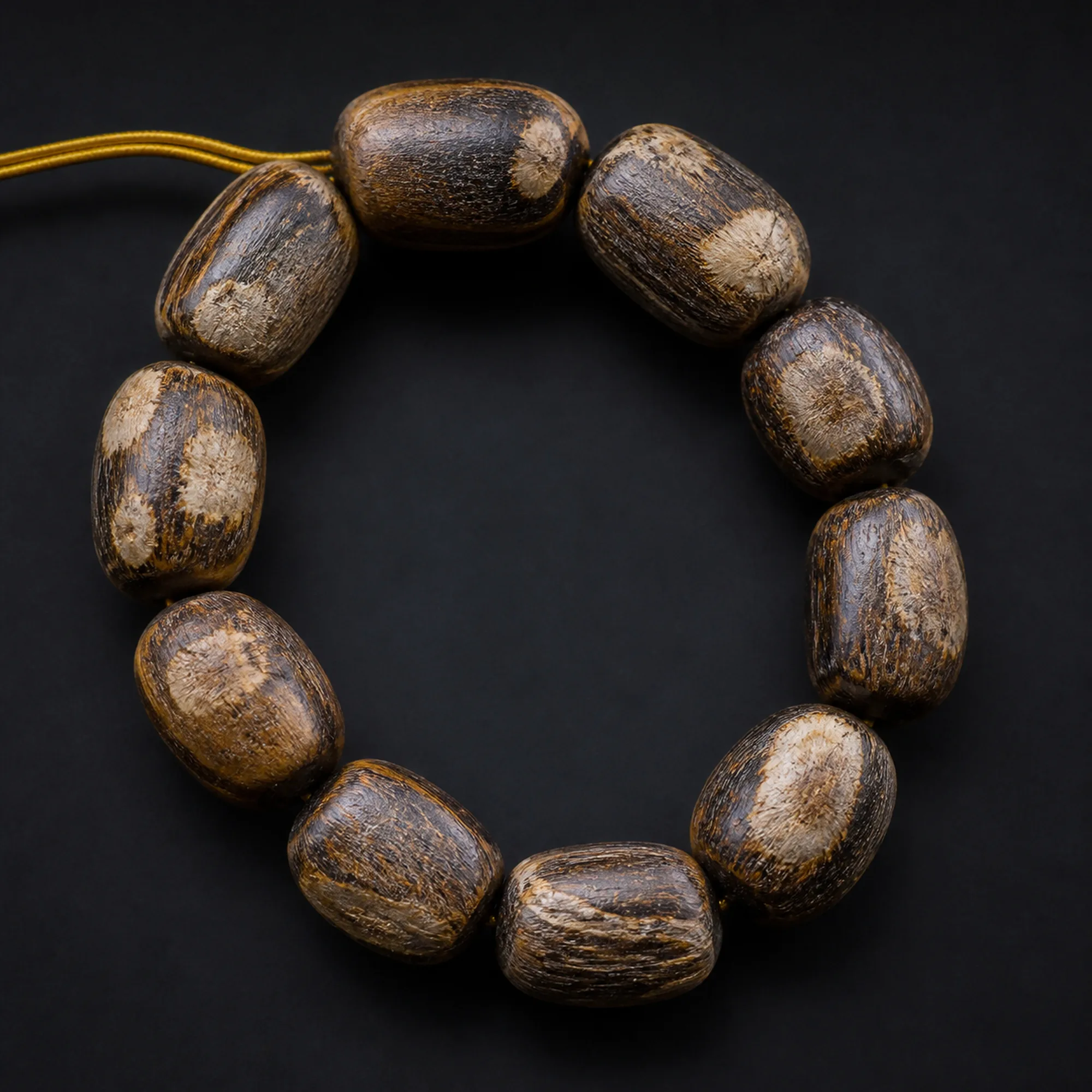
Sinking vs Floating Agarwood: Density, the Water Test and What a Strand Should Weigh
Chénxiāng, or agarwood, means “sinking fragrance”, because the most resin-rich wood is denser than water. The guide explains what makes sinking agarwood sink. The guide also shows how to work out your own strand’s density from weight and bead size, and how heavy each strand would need to be. Finally, the guide explains why the water test, and sinking agarwood itself, proves less than people think.

Written by
Founder & Chief Sourcing Officer, AgarwoodTown
Wang Jianyu is the founder of AgarwoodTown, the agarwood business behind Oudbracelet, trading since 2014. 15+ years grading plantation agarwood and advising buyers on grade selection and CITES paperwork. These guides draw on the same bead geometry our wrist fitter uses and on the questions buyers ask before they approve a weighing video.
In this article
- What is sinking agarwood?
- What are the density bands of sinking agarwood?
- Where should you go next with sinking agarwood?
- Part 1 — Why does resin make sinking agarwood?
- Part 2 — Working out density: is your agarwood sinking?
- How heavy must sinking agarwood be, strand by strand?
- Part 3 — Where does the sinking agarwood water test go wrong?
- How do you try the water test safely?
- Part 4 — What can sinking agarwood prove?
- Sinking and floating agarwood, compared
- How should you read a sinking agarwood result?
- Part 5 — How common is sinking agarwood in plantation wood?
- Part 6 — How do we weigh and report density?
- The grain, up close
- What is the bottom line on sinking agarwood?
- Frequently asked questions
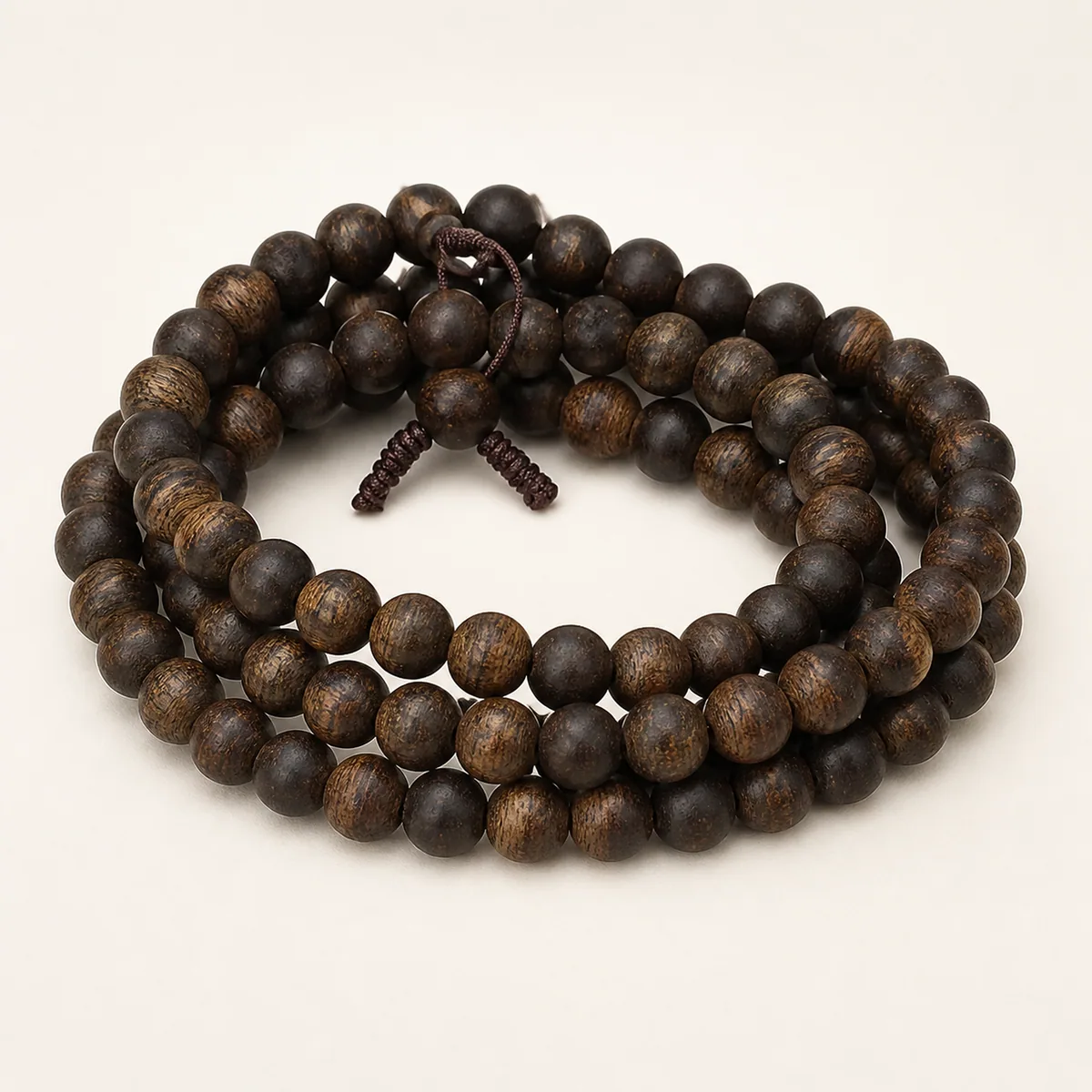 Darker wood
 Paler wood
A darker strand and a paler one from our studio. The darker wood looks heavier. But is it denser, and would either of them sink in a glass of water? A photo cannot answer that. However, a scale and a little arithmetic can.
What is sinking agarwood?
Sinking agarwood is agarwood dense enough to sink in water, and the name doubles as a physics lesson. In Chinese, agarwood is chénxiāng, “sinking fragrance”. The most resin-rich pieces weigh more than water, so the pieces go to the bottom of a bowl. For centuries, sink or float was the simplest grade there was.
Yet “sinking agarwood” is also one of the most misused phrases in the trade. Some agarwood sellers print “sinking” on strands that would bob on the surface of a teacup. Others recommend the water test as a way to spot fakes, which the test is not.
AgarwoodTown has traded agarwood since 2014, and Oudbracelet is the shop for single strands. We weigh every strand on camera, so we work out density every day.
The guide sticks to what you can check yourself. First, Part 1 covers density and resin. Next, Part 2 shows how to calculate density from a weight and a bead size. Then Part 3 covers what the water test can and cannot tell you. Finally, Part 6 explains how we handle the rare sinking agarwood strands. Choosing a bracelet from scratch? Then the buying guide is a better place to start.
Wood floats when wood density is below the density of water, 1.0 g/cm³, according to Forest Products Laboratory data in the 2010 Wood Handbook.(USDA 2010) Most agarwood floats, and sinking agarwood stays rare in plantation strands.
What are the density bands of sinking agarwood?
This table is a 4-row summary. First read the band column, then compare the density (g/cm³), in fresh water, resin, 12 mm × 17 would weigh, how common, on this site across each row. For example, the first row covers “Light”.
| Band | Density (g/cm³) | In fresh water | Resin | 12 mm × 17 would weigh | How common | On this site |
|---|---|---|---|---|---|---|
| Light | about 0.60–0.70 | Floats high | ★★★★★ | 8.8–10 g | Common | Shown and quoted as usual |
| Mid | about 0.70–0.85 | Floats, lower in the water | ★★★★★ | 10–13 g | Most plantation strands | Shown and quoted as usual |
| Dense | about 0.85–1.0 | Floats low in the water | ★★★★★ | 13–15 g | Less common | Shown and quoted as usual |
| Sinking | above 1.0 | Goes to the bottom | ★★★★★ | more than 15 g | Rare | Quoted separately, on request |
The bands are our working bands, not an industry standard. We calculated the weights rather than weighing the strands. Each weight assumes round beads with a 2 mm hole, a 16 cm wrist, standard fit and wood only. The stars compare typical resin content between bands. For example, most plantation strands fall in the mid band.
Where should you go next with sinking agarwood?
This chooser is a 2-question guide with 8 possible answers. First answer “What do you want to find out?”, then pick the option that fits, such as “How dense is my strand?”.
The chooser splits sinking agarwood questions into two groups. First, pick what you want to find out: the density of a strand, whether a strand is genuine, why weight sets the quote, or whether a sinking grade is available. Second, pick the wood you lean towards. For example, dark agarwood suits a buyer who wants resin-heavy beads, while pale agarwood shows clear grain lines. Additionally, loose agarwood beads are the safest way to try a water test, because a loose bead has no cord to soak.
Part 1 — Why does resin make sinking agarwood?
Density is mass packed into a volume, measured in grams per cubic centimetre. Fresh water sits at about 1.0 g/cm³. Anything denser sinks in water, while anything lighter floats, as Archimedes showed.
Wood is mostly cell walls around empty space. The wall material itself weighs more than water. However, hollow cells and pores full of air pull the average down, so most woods float, according to Forest Products Laboratory data.(USDA 2010) Agarwood starts life the same way, as the pale, light wood of an Aquilaria tree. When something wounds the tree, the tree defends the wound. Slowly, over years, the tree lays down a dark, aromatic resin around the damage, as a 2019 review by Tan and colleagues describes.(Tan 2019) The resin fills space that used to hold air. So the volume stays the same while the mass grows, and the density climbs.
Only when resin fills enough space does a piece cross 1.0 g/cm³ and become sinking agarwood. Most agarwood never gets there, including most good plantation wood. After all, resin forms in streaks and patches rather than evenly through the wood. For example, two beads from the same log can behave differently in water.
 Loose beads
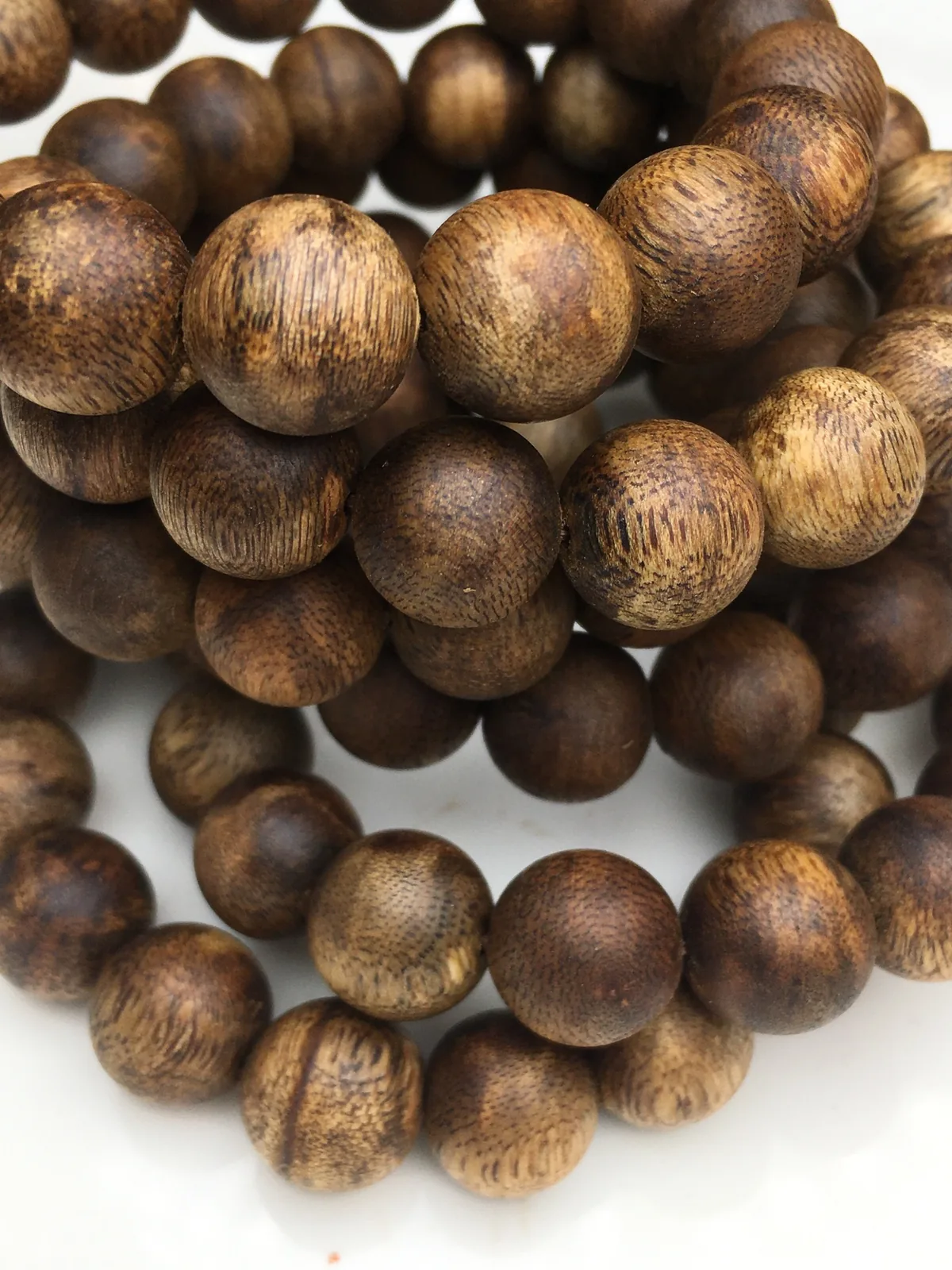 Larger beads
Resin forms in streaks, so density varies from bead to bead. A strand’s density, therefore, is an average of every bead on the strand.
Part 2 — Working out density: is your agarwood sinking?
Density is the number that decides sinking agarwood, and you do not need water to find density. Instead, you need a strand’s weight and volume. For round beads, the volume is plain geometry: a sphere with a 2 mm hole drilled through. The same formula sits behind our density check and our wrist fitter.
Here is a worked example from our own weighing sheet. 16 beads of 12 mm hold about 13.87 cm³ of wood. If the strand weighs 11.8 g, the density is 11.8 ÷ 13.87 = 0.85 g/cm³. The result marks a good, dense strand, but the strand still floats. To count as sinking agarwood, the same strand would need to weigh more than about 13.9 g.
Two details catch people out. The first is the hole. On a 12 mm bead, the 2 mm channel removes about 4% of the sphere. Forget the hole, and the same strand works out at 0.82 instead of 0.85.
The second is everything other than wood. Cord, spacers, stones and metal fittings all add weight without adding agarwood. So the arithmetic only stays clean for a pure agarwood strand of round beads. For other cuts, ask the seller for the bead dimensions, or simply use strand weight to compare like with like.
How heavy must sinking agarwood be, strand by strand?
This table is a 6-row summary. First read the strand (16 cm wrist) column, then compare the volume of wood, at 0.60 g/cm³, at 0.80 g/cm³, at 0.95 g/cm³, sinks if it weighs across each row. For example, the first row covers “8 mm × 24”.
| Strand (16 cm wrist) | Volume of wood | At 0.60 g/cm³ | At 0.80 g/cm³ | At 0.95 g/cm³ | Sinks if it weighs |
|---|---|---|---|---|---|
| 8 mm × 24 | 5.83 cm³ | 3.5 g | 4.7 g | 5.5 g | more than 5.8 g |
| 10 mm × 20 | 9.84 cm³ | 5.9 g | 7.9 g | 9.4 g | more than 9.8 g |
| 12 mm × 17 | 14.74 cm³ | 8.8 g | 12 g | 14 g | more than 14.7 g |
| 14 mm × 15 | 20.89 cm³ | 13 g | 17 g | 20 g | more than 20.9 g |
| 16 mm × 14 | 29.32 cm³ | 18 g | 23 g | 28 g | more than 29.3 g |
| 18 mm × 13 | 38.96 cm³ | 23 g | 31 g | 37 g | more than 39.0 g |
We calculated the weights in the table; we did not weigh the strands. Each row assumes round beads with a 2 mm hole and the bead count for a 16 cm wrist at standard fit, about 1 cm of room. Additionally, each weight counts wood only. The sink line is 1.0 g/cm³, the density of fresh water, per Forest Products Laboratory data. We use 0.60–0.95 g/cm³ to estimate floating strands. For example, a strand in the 12 mm row sinks only above the weight in the last column. Your quote gives the real weight, read off the scale.
Part 3 — Where does the sinking agarwood water test go wrong?
The sinking agarwood water test is the classic home check, and the test appeals because the result looks like proof. You drop a bead in and watch. In practice, however, the test answers a narrower question than people think: is the bead, right now, denser than the water in the glass? Several things can also bend the answer.
Air in the hole. A drilled bead traps air in the channel. So a bead only just denser than water can float until the bubble works out.
Water soaking in. Wood takes up moisture and gets heavier, according to Forest Products Laboratory data.(USDA 2010) As a result, a bead left in water for a long time can drift down and read as denser than the dry bead.
What is in the water. Salt raises the density of water, so a borderline bead that sinks in tap water may float in brine. Soap and oils, meanwhile, change how the surface holds a small bead.
Size. A single 12 mm bead holds about 0.87 cm³, so a single bead sinks only above roughly 0.87 g. A kitchen scale that reads to the gram cannot see the difference.
None of the four problems makes the water test useless. A clear sink or a clear float tells you something. Anything in between is better settled with a scale.
How do you try the water test safely?
This process is a 4-step sequence, from “One loose bead” to “Out and dry at once”. First follow step 1, then work down the 4 steps of “How do you try the water test safely?” in order.
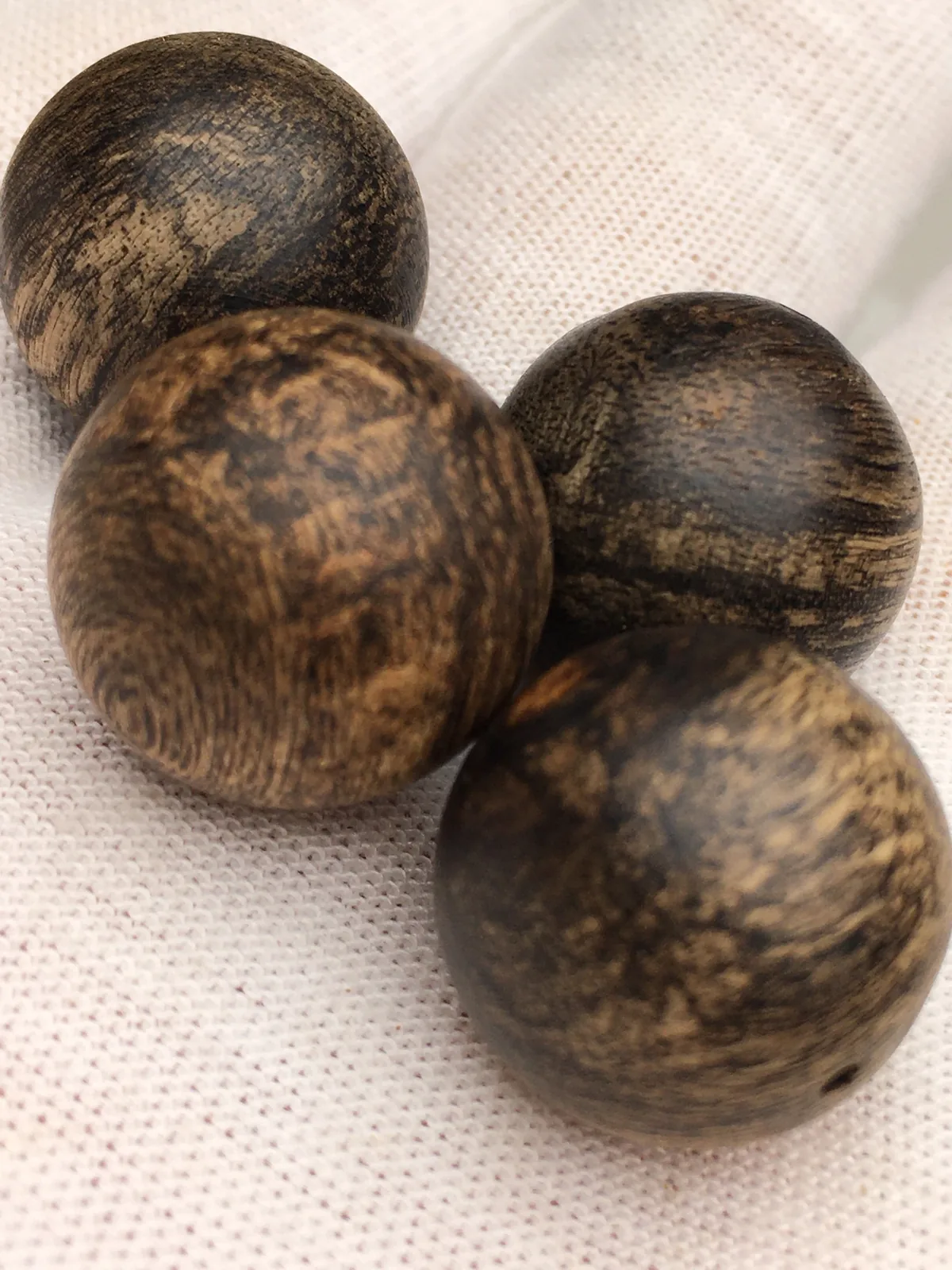
- 1
Step 1: One loose bead
Use a single loose bead. Soaking a strung bracelet wets the cord, stretches the cord and can mark the wood.
- 2
Step 2: Plain fresh water
Next, fill a clear glass with clean, room-temperature tap water. Add no salt and no soap, and skip hot water.
- 3
Step 3: Lay the bead on, wait a minute
Then set the bead on the surface without pushing. Give trapped air a minute to escape from the hole, and look.
- 4
Step 4: Out and dry at once
Finally, lift the bead out, pat the bead dry with a soft cloth and let the wood air-dry away from heat. Never leave a bead soaking.
Part 4 — What can sinking agarwood prove?
Density is a measure of one thing: how much mass the wood carries for the size. In genuine agarwood, extra mass mostly means extra resin, so density offers a sensible way to compare strands. Other things can add mass too. For example, someone can weight, soak or inject wood, and a treated bead can sink as convincingly as real sinking agarwood. Equally, a bead that floats may be perfectly genuine plantation agarwood with modest resin.
So treat a sink or a float as one piece of evidence among several. First, compare the density with the grain under magnification. Second, warm a bead and check the scent. Finally, ask whether the seller will show you the actual piece on video. Our guide to telling real agarwood covers each check and the limits of each one.
Sinking and floating agarwood, compared
This comparison is a 5-point check of Sinking against Floating. For example, the first row compares density. Finally, pick the column that matches what you need.
| Feature | Sinking | Floating |
|---|---|---|
| Density | Above about 1.0 g/cm³ | Below about 1.0 g/cm³ |
| Resin | Very high, through most of the wood | From modest to high, often in streaks |
| How common | Rare | Almost everything on the market |
| Proves it is genuine? | No — weighted wood can sink too | No — and floating is not a fault |
| On this site | Quoted separately, on request | Every style you see |
Sinking agarwood is rare, and floating agarwood is almost everything on the market. Neither column proves a bead genuine. For example, weighted wood can sink, while honest plantation wood with modest resin floats. The real difference is resin: sinking wood carries resin through most of the wood, and floating wood carries resin in streaks. In practice, the scale separates a dense floating strand from a borderline sinking strand better than the eye does. Additionally, every style on the site floats, and we quote sinking strands separately, on request.
How should you read a sinking agarwood result?
This section is a set of 4 short notes, from “A float, and the numbers match” to “The numbers do not add up”. First scan the 4 titles under “How should you read a sinking agarwood result?”, then read the note that matches your case.
A float, and the numbers match
Floating is the usual result for genuine plantation agarwood. Does your density sit somewhere in the 0.60–0.95 range, and does the grain look right? Then the strand matches what the seller said, even without sinking.
It is borderline
For example, a density close to 1.0 means a dense strand either way. So do not chase a sink with salt or patience in the glass. The scale judges sinking agarwood better, and the gap between just floating and just sinking is small.
A clear sink: sinking agarwood or treated wood
Either you have rare, resin-rich wood, or someone treated the wood. Look hard at the grain and scent, and ask how the seller knows. Also expect to see the actual piece before paying.
The numbers do not add up
Perhaps a “sinking agarwood” strand works out well under 1.0, or no bead size explains the weight. Either way, ask the seller to reweigh the strand on camera, or walk away.
Part 5 — How common is sinking agarwood in plantation wood?
Sinking agarwood is uncommon in plantation wood, because plantations do on purpose what happens by accident in the wild. Growers wound cultivated trees so the trees form resin. Studies of induced Aquilaria sinensis report resin chemistry close to wild agarwood, according to Liu and colleagues in 2013.(Liu 2013) Still, whether a piece turns into sinking agarwood depends on how much resin the individual piece holds.
Sinking is also only one part of how the trade grades agarwood. Grading systems in the research literature look at resin content, oil and chemical markers, plus appearance and density, as a 2021 review by Wang and colleagues sets out.(Wang 2021) So a strand is not simply “sinking” or “worthless”. In fact, most of the interesting wood lives in the floating bands, from mid to dense.

Part 6 — How do we weigh and report density?
This timeline is a 5-stage sequence, from “Choose and ask” to “Invoice, then shipping”. First read “Part 6 — How do we weigh and report density?” from top to bottom, since each stage follows the one before.
- YouChoose and askPick a style, bead size and wrist size. Add a note if you want our densest strand, or a sinking agarwood quote.
- ScaleWe weigh on cameraWe put the strand on the scale and film the strand close up, with the weight on the display in the same shot.
- NumbersYou get weight, size and countThree numbers are enough to work out the density yourself. If a number looks odd, ask, and we weigh the strand again on camera.
- ApproveYes, or another strandWe charge nothing until you approve the video. Ask for a denser or lighter strand if the numbers disappoint you.
- ShipInvoice, then shippingAfter approval, we send a PayPal invoice and ship the strand from the video.
The grain, up close
What is the bottom line on sinking agarwood?
Sinking agarwood is the top of a density range, not a line between good and bad. “Sinking fragrance” is a beautiful name, and the physics behind the name is real: resin fills the wood, and the wood grows heavy. Most agarwood worth wearing floats rather than sinking. A strand’s character does not switch on at 1.0 g/cm³, either. Grain, warm scent and the way the wood darkens with years of wear matter just as much.
So let the scale do the work the water test always tried to do. First, ask for the weight, the bead size and the bead count. Second, do the division. For example, the 12 mm strand in Part 2 weighs 11.8 g and works out at 0.85 g/cm³, dense but floating. Finally, judge the rest with your eyes and nose.
Frequently asked questions
This FAQ is a set of 8 short answers about sinking vs floating agarwood. First find your question below. For example, many facts in these answers about sinking vs floating agarwood come from the 5 published sources in References, which we checked in September 2026.
Does real agarwood sink in water?
Only the most resin-rich pieces do. Fresh water has a density of about one gram per cubic centimetre. Most wood weighs less and floats, and that includes most genuine plantation agarwood. Sinking agarwood is rare and prized for it. However, floating is not a sign of a fake. It simply means the wood carries less resin.
How do I work out my bracelet’s density?
Divide its weight by its volume. For round beads, the volume is the bead count times the volume of one sphere of that diameter, minus the drilled hole. Our density check does this from the weight, bead size and count, and every quote includes all three. Leave out stones, spacers and fittings, though, because they are not wood.
Why does the drilled hole matter?
Because it removes wood. On a 12 mm bead, the 2 mm channel takes out about 4% of the sphere. If you count solid spheres, you overstate the wood and understate the density. Our worked example drops from 0.85 to 0.82 g/cm³. That is small, but it matters near the line for sinking agarwood.
Why did my bead float at first and then sink?
Usually trapped air or soaked-in water is the cause. Air in the drilled hole holds a borderline bead up until it escapes. After that, the wood slowly takes up water and grows heavier. So a bead that only sinks after a long soak sits close to the line, not clearly above it. Dry it gently and use its weight instead.
Can I test a strung bracelet in water?
We would not. Water soaks and weakens the cord, and it can mark the surface of the wood. A borderline strand also gives a muddled result, because cord, spacers and air in the holes all affect it. So test one loose bead if you must. Better still, work out the density from the strand’s weight and bead size.
Does salt water change the result?
Yes. Salt makes water denser. So a bead that sinks in fresh water can float in salty water. Different tap water or additives can shift a borderline result further. That is why the test uses plain fresh water at room temperature. It is also why a clear sink or float means more than a bead hovering near the bottom.
How do you quote sinking agarwood?
Separately, and on request. Everything on the site floats. When we have sinking agarwood strands, we weigh and film them like any other strand. We also send the weight, bead size and count, so you can check the density yourself. We charge nothing until you approve the video, and you can still ask for another strand.
Is a heavier strand of the same size always better?
It usually carries more resin, since that is what heaviness means in genuine agarwood. But better depends on what you want. Denser wood, like sinking agarwood, tends to smell stronger when warm. Lighter wood, by contrast, often shows clearer grain against a pale ground. So use density to confirm what you heard, then choose by grain, scent and fit.
References
This reference list is the source record for “Sinking vs Floating Agarwood: Density, the Water Test and What a Strand Should Weigh”, with 5 published sources. According to the citations in “Sinking vs Floating Agarwood: Density, the Water Test and What a Strand Should Weigh”, such as (USDA 2010), each one links to one entry below. Finally, we checked all 5 links behind “Sinking vs Floating Agarwood: Density, the Water Test and What a Strand Should Weigh” in September 2026.
- 1Forest Products Laboratory. Wood Handbook — Wood as an Engineering Material (General Technical Report FPL-GTR-190). USDA Forest Service, 2010.View source
- 2Tan C.S., Isa N.M., Ismail I., Zainal Z.. Agarwood induction: current developments and future perspectives. Frontiers in Plant Science 10: 122, 2019.doi:10.3389/fpls.2019.00122
- 3Liu Y., Chen H., Yang Y., et al.. Whole-tree agarwood-inducing technique: an efficient novel technique for producing high-quality agarwood in cultivated Aquilaria sinensis trees. Molecules 18(3): 3086–3106, 2013.doi:10.3390/molecules18033086
- 4Wang Y., Hussain M., Jiang Z., et al.. Aquilaria species (Thymelaeaceae) distribution, volatile and non-volatile phytochemicals, pharmacological uses, agarwood grading system, and induction methods. Molecules 26(24): 7708, 2021.doi:10.3390/molecules26247708
- 5CITES Secretariat. Appendices I, II and III. Convention on International Trade in Endangered Species of Wild Fauna and Flora, current.View source
References are listed for transparency. We summarise them for general reading; nothing here is medical advice, and no health effect is claimed.
In this article
Styles mentioned

Related articles
Weighed before you pay
Choose a style, get your strand weighed
Pick a bead and size, send your request, and we reply with a video of your piece on the scale — its exact weight and price. Nothing is charged until you approve.