Agarwood Bracelet Price: Why It Is Set by Weight, and How to Read a Weighed Quote
Two agarwood strands with the same bead size and count can differ by several grams, and the difference is resin, the part you really buy. So this article explains how we set an agarwood bracelet price by weight rather than by the piece. It covers how bead size, bead count and resin each move the scale, what a weighed video quote shows you, and how to check its numbers yourself.

Written by
Founder & Chief Sourcing Officer, AgarwoodTown
Wang Jianyu is the founder of AgarwoodTown, the agarwood business behind Oudbracelet, trading since 2014. 15+ years grading plantation agarwood and advising buyers on grade selection and CITES paperwork. These guides draw on the same bead geometry our wrist fitter uses and on the questions buyers ask before they approve a weighing video.
In this article
- What sets an agarwood bracelet price?
- What moves an agarwood bracelet price, at a glance
- Agarwood bracelet price in two questions
- Part 1 — Why does agarwood bracelet price follow resin, not the piece?
- Part 2 — Bead size and agarwood bracelet price: the cube law
- One bead at each size: wood and estimated weight
- Part 3 — How do your wrist and fit change the agarwood bracelet price?
- 12 mm round beads: count and estimated weight by wrist size
- Part 4 — Why can the same bead size carry a different agarwood bracelet price?
- Part 5 — Why can one fixed agarwood bracelet price not be fair?
- Weighed agarwood bracelet price vs fixed price
- Four ways to steer your agarwood bracelet price
- Part 6 — How do you read an agarwood bracelet price quote?
- From request to agarwood bracelet price in four steps
- The kind of close-up you get
- Why are sales final once a strand ships?
- Part 7 — From tree to scale to agarwood bracelet price
- Finally: is a weighed agarwood bracelet price fairer?
- Frequently asked questions
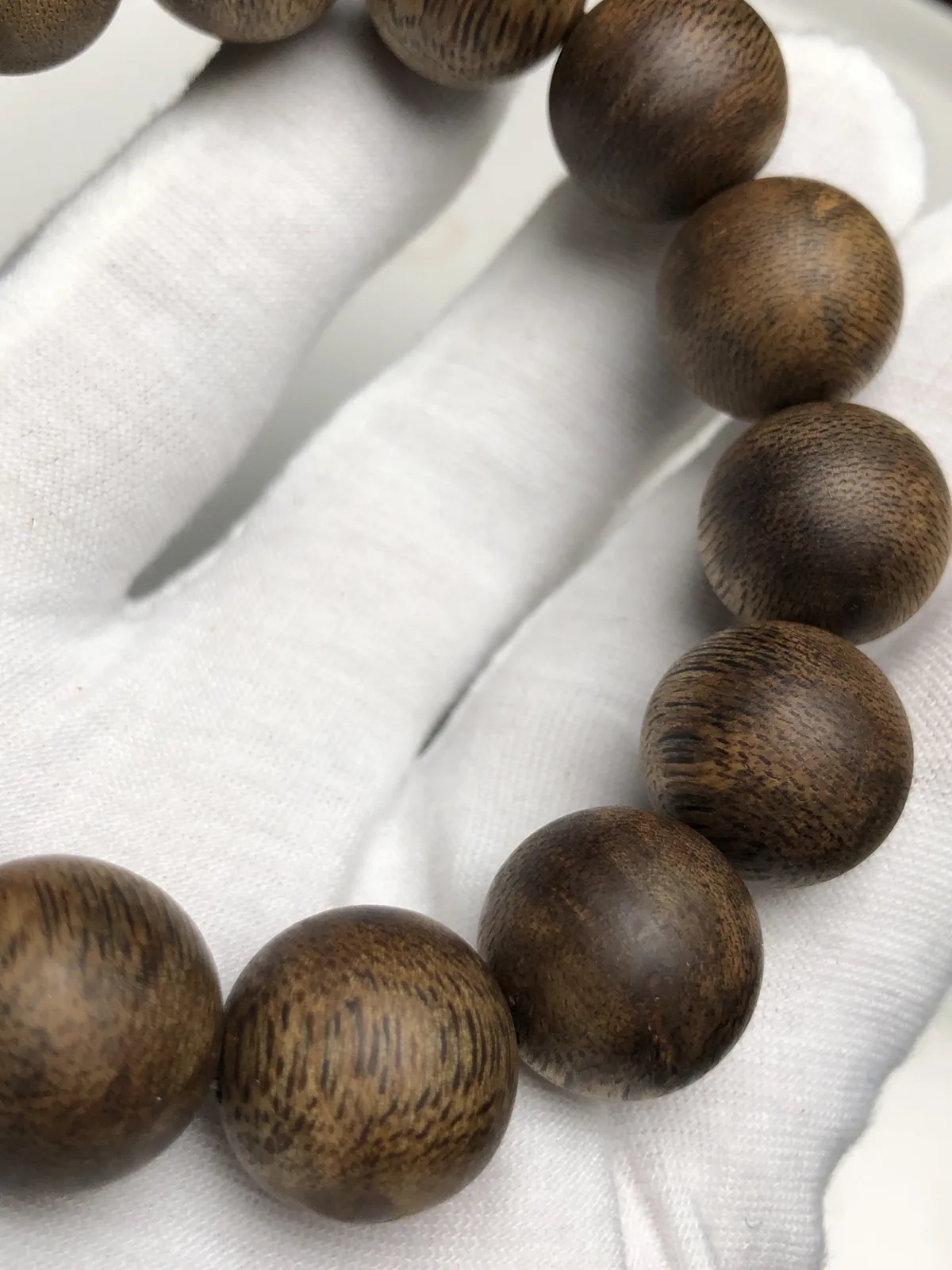
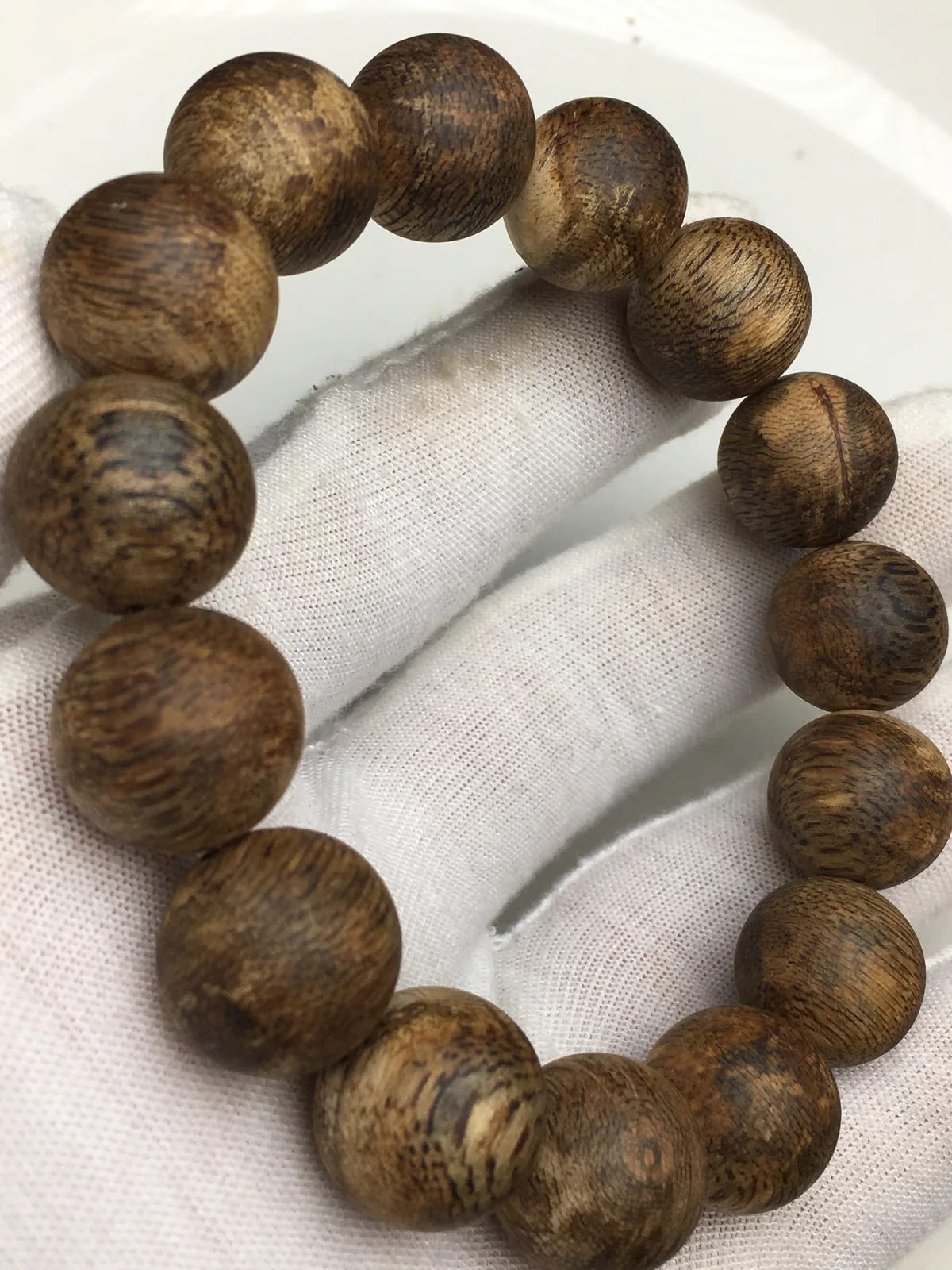
 Strand A
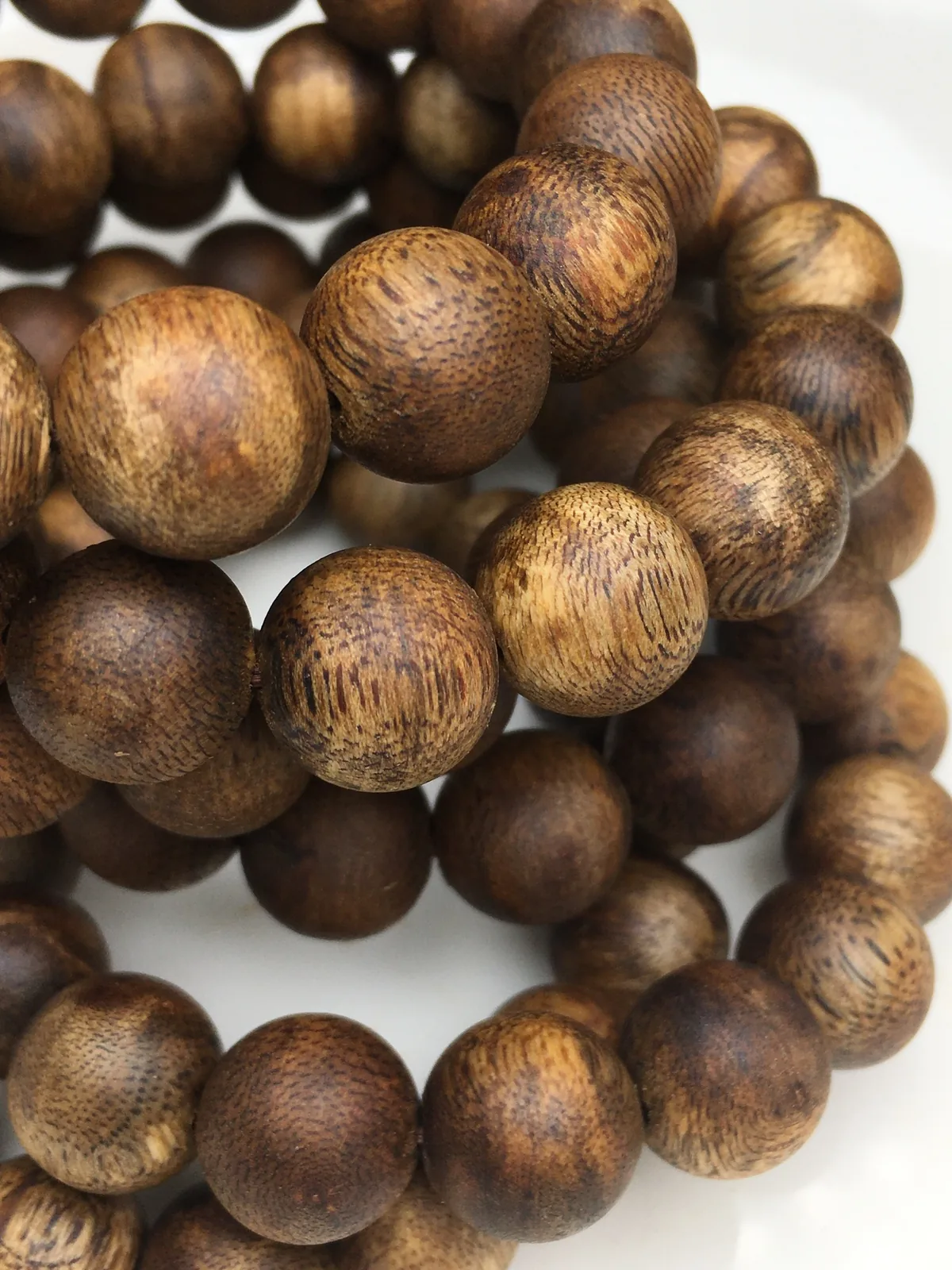
 Strand B
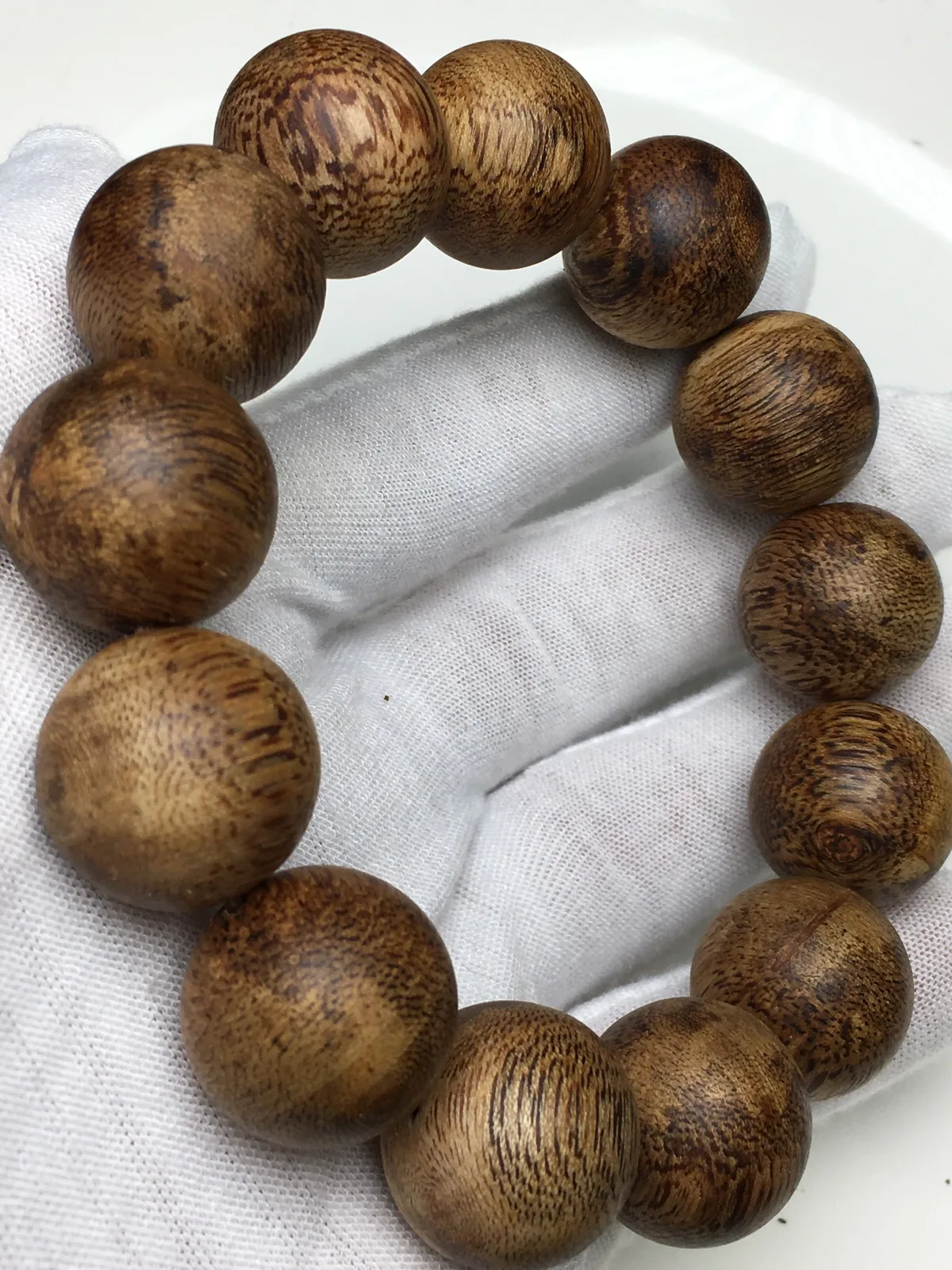
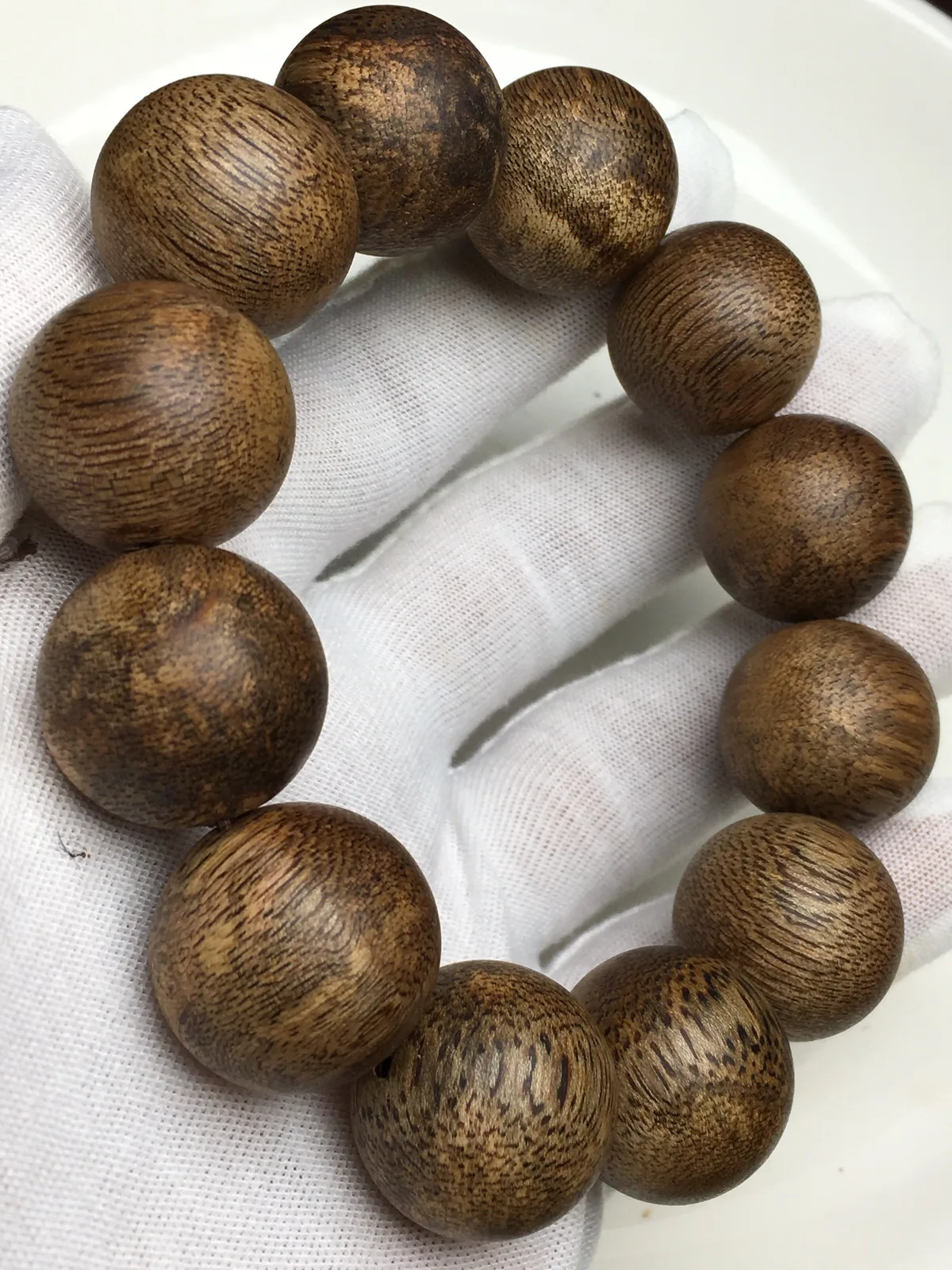
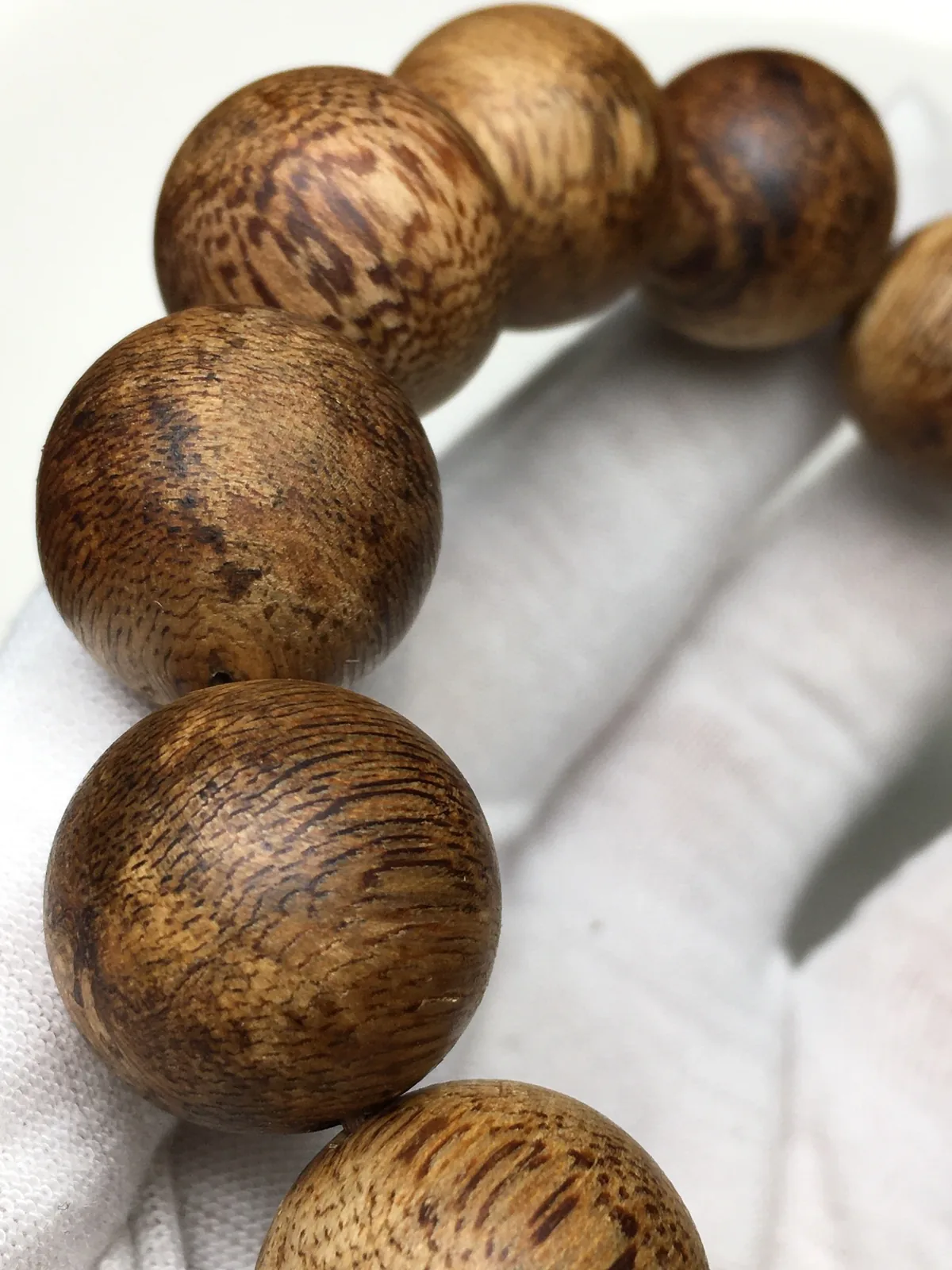
Two round-bead strands from our stock, photographed the same way. One agarwood bracelet will read several grams more on the scale. Which one? A photo cannot tell you. So why would one fixed agarwood bracelet price be fair to either of you?
What sets an agarwood bracelet price?
Most things online, even an agarwood bracelet, have one price per item. However, an agarwood bracelet price does not work well that way. The value of an agarwood bracelet sits mostly in its resin, and resin adds weight. Also, the amount of resin changes from bead to bead in ways no photograph can show. So the scale is the one tool that reports it honestly.
Oudbracelet is where AgarwoodTown, in the agarwood trade since 2014, sells single pieces to the public. We put every agarwood bracelet on the scale on camera before we quote it. As a result, we see the spread between two strands of “the same” style every working day.
This article explains how we set an agarwood bracelet price by weight, what moves that weight, and how to read the quote you get. First, the table below lists the five things that change the number on the scale, and how strongly each one pushes it.
According to Tan et al. (2019), agarwood resin forms only after a tree is wounded, and the amount varies widely.(Tan 2019) First, more resin means denser, heavier wood. Then denser wood costs more per gram. Finally, that is why an agarwood bracelet price follows the scale: in our estimates, density can vary by up to 58% between beads.
What moves an agarwood bracelet price, at a glance
This table is a 5-row summary. First read the factor column, then compare the effect on weight, visible in a photo?, who decides it, where it shows in your quote across each row. For example, the first row covers “Bead size”.
| Factor | Effect on weight | Visible in a photo? | Who decides it | Where it shows in your quote |
|---|---|---|---|---|
| Bead size | ★★★★★ grows with the cube | Yes | You | Bead size, in mm |
| Resin content | ★★★★★ the hidden one | Only partly | The tree | Weight read off the scale |
| Bead count | ★★★★★ one bead at a time | Yes | Your wrist and fit | Bead count |
| Accents and fittings | ★★★★★ depends on the piece | Yes | You | Listed as included |
| The drilled hole | ★★★★★ small, larger on small beads | No | Fixed by us | Built into the arithmetic |
The star ratings are our working judgement of how much each factor typically moves the weight of one bracelet. They are for comparison only, not measurements.
Bead size is the factor with the largest effect, and resin is the factor a photo hides. For example, a buyer controls bead size, bead count and accents, while the tree alone sets the resin. In practice, the scale is the only tool which sees all five factors at once. Resin forms only after a wound, and in uneven amounts, according to Tan and colleagues.(Tan 2019)
Agarwood bracelet price in two questions
This chooser is a 2-question guide with 8 possible answers. First answer “Which part of the weight do you want to understand?”, then pick the option that fits, such as “Bead size”.
The first question points to a guide, and the second points to a collection. For example, a buyer who wants a lighter strand can read the bead size chart, then browse multi-wrap malas. In practice, bead size is the best place to start, because bead size moves the weight more than any other choice. Additionally, the full buying guide covers grain, cut and care for anyone starting from scratch.
Part 1 — Why does agarwood bracelet price follow resin, not the piece?
Agarwood is not a kind of tree. Instead, agarwood forms inside an Aquilaria tree after a wound. The tree lays down a dark, fragrant resin in the wood around the damage over months and years. Plant scientists have reviewed that process in detail.(Tan 2019)
Plantations start the process on purpose in cultivated trees. Also, methods developed for cultivated Aquilaria sinensis can produce resin through much of the trunk, not just in a few small patches.(Liu 2013)
Even so, resin never fills the wood of an agarwood bracelet evenly. Resin runs in streaks, gathers in pockets and thins towards the edges of the wounded zone. So two beads turned from the same log a few centimetres apart can hold very different amounts. A “style” on our site is a cut, a bead size and a look. However, a style is not a promise about resin, because the tree made no such promise.
Uneven resin is the whole case for weighing every agarwood bracelet. Resin is heavier than the pale wood around the resin. So for beads of the same size and number, more weight means more resin, and a fair agarwood bracelet price follows the weight. A shop which charges by the piece really charges for an average strand, yet the strand you receive is never average.
Part 2 — Bead size and agarwood bracelet price: the cube law
Bead size is the single biggest lever on weight, and so on the agarwood bracelet price. It is also bigger than most people expect. A bead is a sphere, and a sphere’s volume grows with the cube of its diameter. So go from 12 mm to 14 mm, a small step to the eye, and each bead holds about 1.6 times the wood.
Larger beads do mean fewer beads around the same wrist. However, there are not nearly enough fewer to cancel the difference. For example, on a 16 cm wrist a strand of 16 mm beads holds roughly 3 times the wood of a strand of 10 mm beads. Yet it has only 6 fewer beads.
The table shows one bead at each size, so you can see how quickly it adds up. Our agarwood bead size chart then covers the look.
One bead at each size: wood and estimated weight
This table is a 6-row summary. First read the bead size column, then compare the wood per bead, compared with 10 mm, wood removed by the hole, estimated weight per bead across each row. For example, the first row covers “8 mm”.
| Bead size | Wood per bead | Compared with 10 mm | Wood removed by the hole | Estimated weight per bead |
|---|---|---|---|---|
| 8 mm | 0.24 cm³ | 0.5× | about 9% | 0.15–0.23 g |
| 10 mm | 0.49 cm³ | 1.0× | about 6% | 0.30–0.47 g |
| 12 mm | 0.87 cm³ | 1.8× | about 4% | 0.52–0.82 g |
| 14 mm | 1.39 cm³ | 2.8× | about 3% | 0.84–1.32 g |
| 16 mm | 2.09 cm³ | 4.3× | about 2% | 1.26–1.99 g |
| 18 mm | 3.00 cm³ | 6.1× | about 2% | 1.80–2.85 g |
Worked out, not measured: a round bead with a 2 mm hole drilled straight through, at our working density band of 0.60–0.95 g/cm³. Real beads vary slightly in size and polish. So your quote uses the real weight.
The drilled hole matters most on small beads, which is why the hole column shrinks as beads grow. For example, an 18 mm bead holds about 6.1 times the wood of a 10 mm bead. Wood density also varies widely between species, according to USDA figures in the Wood Handbook, so the band above applies to agarwood only.(USDA 2010)
 Smaller beads
 Larger beads
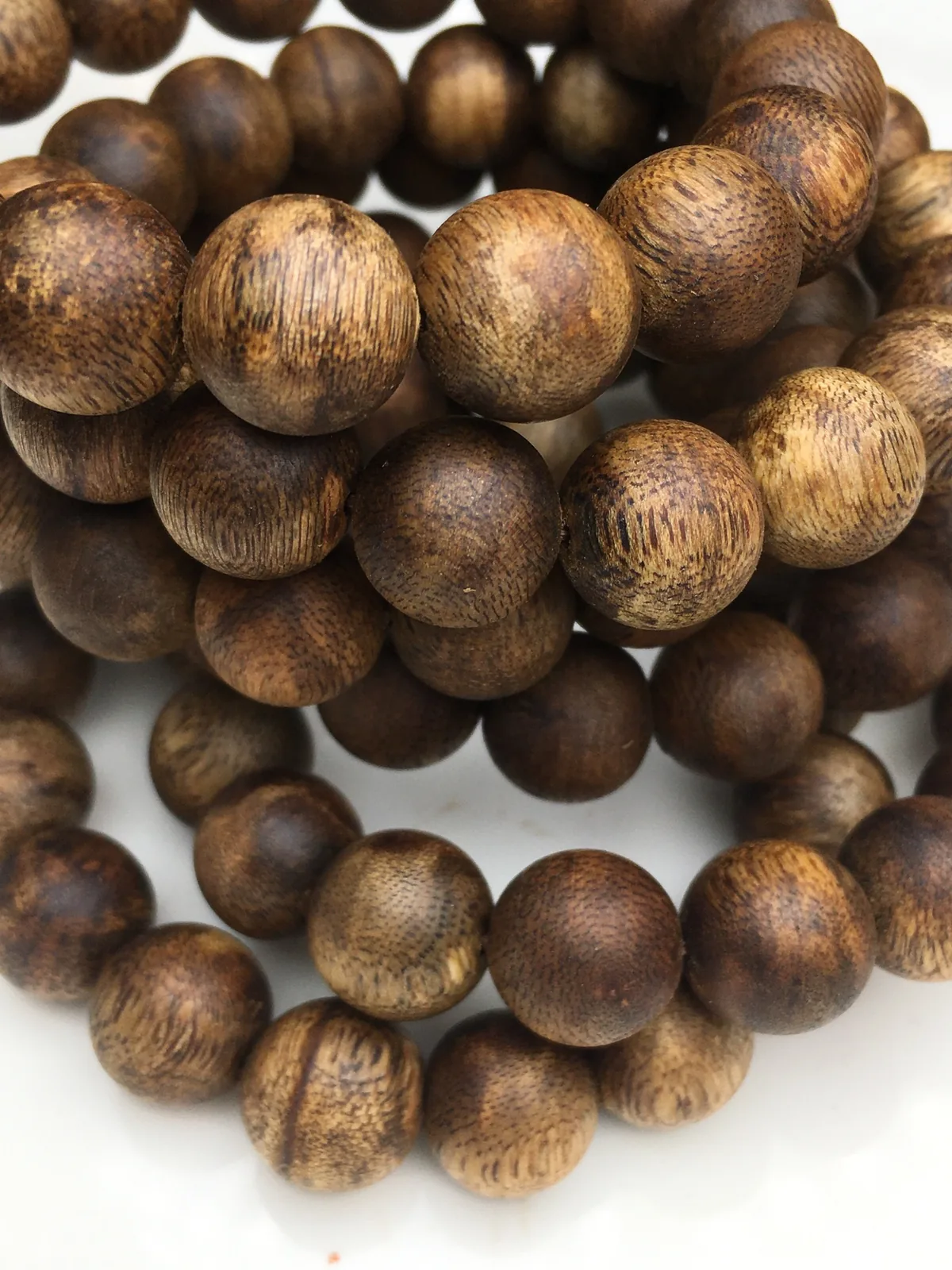
Same wood, same cut. On the right, however, each bead holds several times the wood of one on the left. That is exactly what the scale reports.
Part 3 — How do your wrist and fit change the agarwood bracelet price?
The bead count is the second lever on weight, after bead size. Once you choose the bead size, the bead count follows from your wrist and how loose you like the fit. The count moves in whole beads, so the weight moves in steps. For example, one more 12 mm bead adds about 0.87 cm³ of wood. Two neighbouring wrist sizes can even share the same count, because the next bead would make the strand too loose for one of them.
Fit matters for an agarwood bracelet too. On a 16 cm wrist with 12 mm beads, a snug fit takes 17 beads, a standard fit 17, and a relaxed fit 18. We ask for your wrist size first, because wrist size sets the count and so the agarwood bracelet price. If you are not sure of the number, our guide to how to measure your wrist takes two minutes.
12 mm round beads: count and estimated weight by wrist size
This table is a 6-row summary. First read the wrist column, then compare the beads (standard fit), inside length, estimated strand weight across each row. For example, the first row covers “14 cm”.
| Wrist | Beads (standard fit) | Inside length | Estimated strand weight |
|---|---|---|---|
| 14 cm | 16 | 15.6 cm | 8.3–13 g |
| 15 cm | 16 | 15.6 cm | 8.3–13 g |
| 16 cm | 17 | 16.7 cm | 8.8–14 g |
| 17 cm | 18 | 17.9 cm | 9.4–15 g |
| 18 cm | 19 | 19.1 cm | 9.9–16 g |
| 19 cm | 20 | 20.3 cm | 10–16 g |
Worked out with the same geometry as our wrist fitter: a standard fit of about 1 cm of room, a 2 mm hole and density 0.60–0.95 g/cm³. The wide range in each row is the resin spread to expect between strands of the same count.
A larger wrist adds beads, and each 12 mm bead adds about 0.87 cm³ of wood. For example, the 16 cm row needs 17 beads for a standard fit. Additionally, the gap between the low and high weight in one row is often larger than the gap between two wrist sizes, because resin varies more than wrists do.
Part 4 — Why can the same bead size carry a different agarwood bracelet price?
The answer is resin, measured as density. Look again at the 16 cm row above for an agarwood bracelet. Two strands of 17 beads at 12 mm hold exactly the same volume of wood, about 14.7 cm³. Yet one can weigh around 8.8 g and the other around 14 g. Nothing about the beads’ size or number explains that gap. Resin does, and so the agarwood bracelet price differs too.
The link is density: weight divided by volume. Most woods are lighter than water, according to USDA data in the Wood Handbook,(USDA 2010) and as resin fills agarwood, the density climbs. With the weight from your quote and the bead size and count, our density check gives you that figure in seconds.
A strand at the lighter end of our working band carries less resin. One near the top, however, carries a good deal more. It is the same property that sorts sinking wood from floating wood. Our guide to sinking agarwood explains that line.
Part 5 — Why can one fixed agarwood bracelet price not be fair?
A fixed price is a single figure for strands which never weigh the same. Suppose a shop sets one fixed agarwood bracelet price for a 12 mm round strand. Every strand the shop sends is either heavier or lighter than the strand in mind. So either the lighter strands are overpriced, or the heavier strands sell at a loss. Also, a shop selling at a loss soon stops sending the heavy strands.
As a result, a fixed price quietly pulls the seller towards the lightest wood which still passes as agarwood. Weighing, however, removes the pressure. The heavier strand costs more, the lighter strand less, and neither side has to guess. For example, our 16 cm table shows a spread from about 8.8 g to 14 g for 17 beads of 12 mm. Resin forms unevenly in every wounded tree, according to Tan and colleagues, so the spread never goes away.(Tan 2019)
Weighed agarwood bracelet price vs fixed price
This comparison is a 6-point check of Weighed quote against Fixed-price listing. For example, the first row compares what sets the price. Finally, pick the column that matches what you need.
| Feature | Weighed quote | Fixed-price listing |
|---|---|---|
| What sets the price | The weight of the strand you receive | A figure chosen before your strand was picked |
| What you see first | A video of your own strand on the scale | A photo of a similar strand |
| Weight stated | Always, read off the scale on camera | Rarely |
| Density check | Possible from weight, size and count | Not possible without the weight |
| What the seller gains | Nothing by sending lighter wood | Something by sending the lightest strand that passes |
| Your choice | Approve it, or ask for another strand | Buy it as listed |
A weighed quote is a price for one real strand, while a fixed-price listing is a price for an imagined average. In practice, the weighed quote also hands you the numbers for a density check. For example, the weight, bead size and bead count together give the density of your strand in seconds.
Four ways to steer your agarwood bracelet price
This section is a set of 4 short notes, from “Choose a smaller bead” to “Mind the accents”. First scan the 4 titles under “Four ways to steer your agarwood bracelet price”, then read the note that matches your case.
Choose a smaller bead
The cube law works in your favour here. One size down is the largest single cut in weight. Also, round beads come in a wide spread of sizes.
Give an exact wrist size
A measured wrist lets us set the right count first time. However, guessing high adds a bead you did not need, and a strand that slides around.
Ask for more resin
If resin is the point for you, say so. Then we look for the densest strand in your size and film it. Expect it to weigh more, and cost more, for the same beads.
Mind the accents
Stone is much denser than the wood of an agarwood bracelet, and metal more so. So a strand with jade or a gold fitting weighs more than the wood alone. Your quote also lists what is included.
Part 6 — How do you read an agarwood bracelet price quote?
A quote from us is a short message with five parts, and every line has a reason. First, the video shows the strand. Second, the numbers let you check the strand yourself:
- The video. The strand you would receive, up close, then on the scale with the display in view.
- The weight in grams. As read on camera; this is what the agarwood bracelet price rests on.
- Bead size and bead count. So you can check the fit against your wrist, and work out the density yourself.
- What is included. Cord, stones and any fittings weighed with the strand.
- The price for that strand alone, with shipping options and any paperwork for your country.
We charge nothing at this stage. For example, if the strand looks too pale, just ask, and we will film another strand. Finally, the quote covers CITES paperwork, since every Aquilaria species sits in Appendix II.(CITES)
From request to agarwood bracelet price in four steps
This process is a 4-step sequence, from “You choose” to “Invoice and shipping”. First follow step 1, then work down the 4 steps of “From request to agarwood bracelet price in four steps” in order.
- 1
Step 1: You choose
On the product page, set style, bead size and wrist; the page then writes your request, style code included.
- 2
Step 2: We weigh and film
We pick a strand in that style and size, film it close up, and put it on the scale with the display in shot.
- 3
Step 3: You approve, or ask again
You get the video, the weight, the bead count and the agarwood bracelet price. So approve it, or ask us to film a different strand.
- 4
Step 4: Invoice and shipping
After you approve, we send a PayPal invoice. Then we ship the exact strand from the video once you pay.
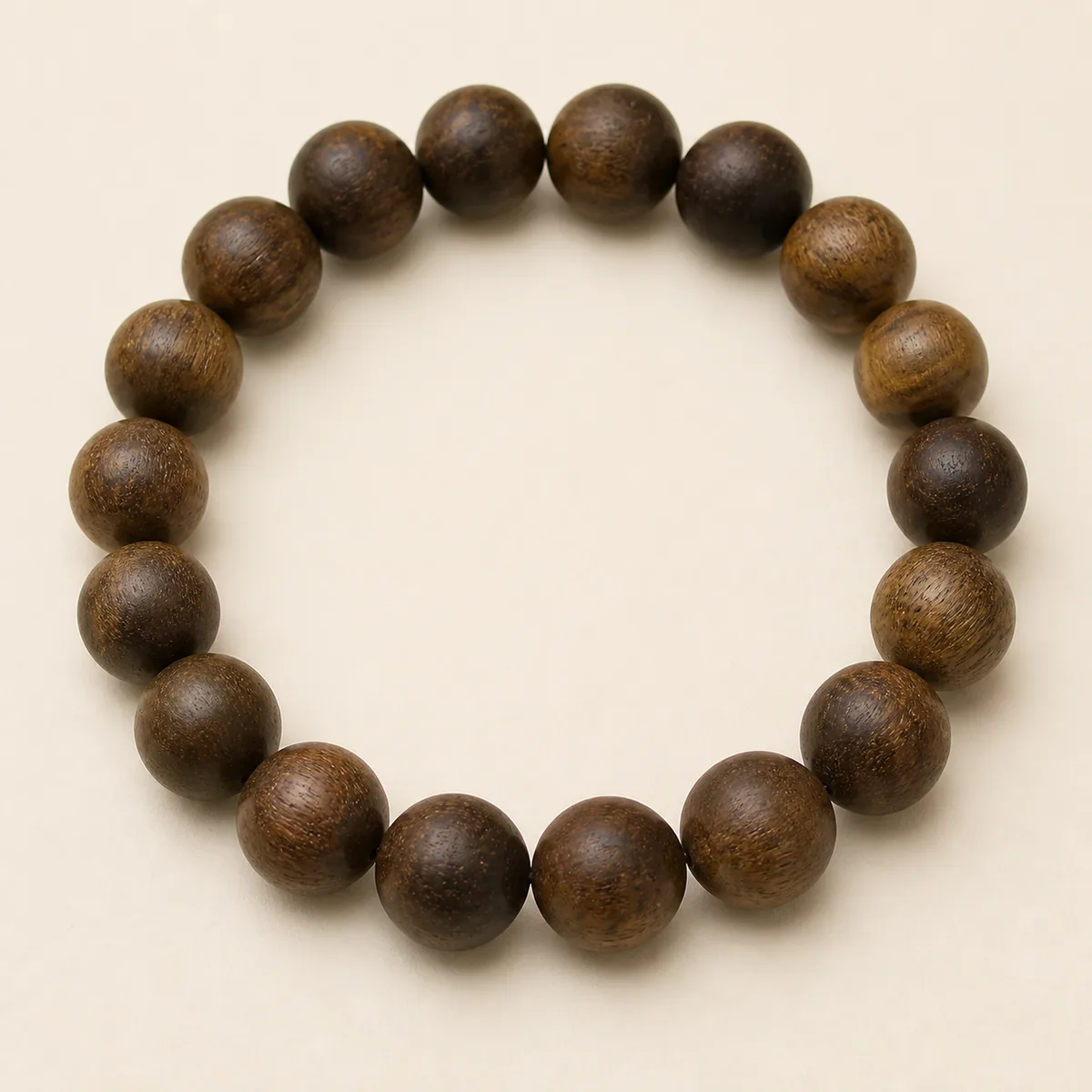 The style
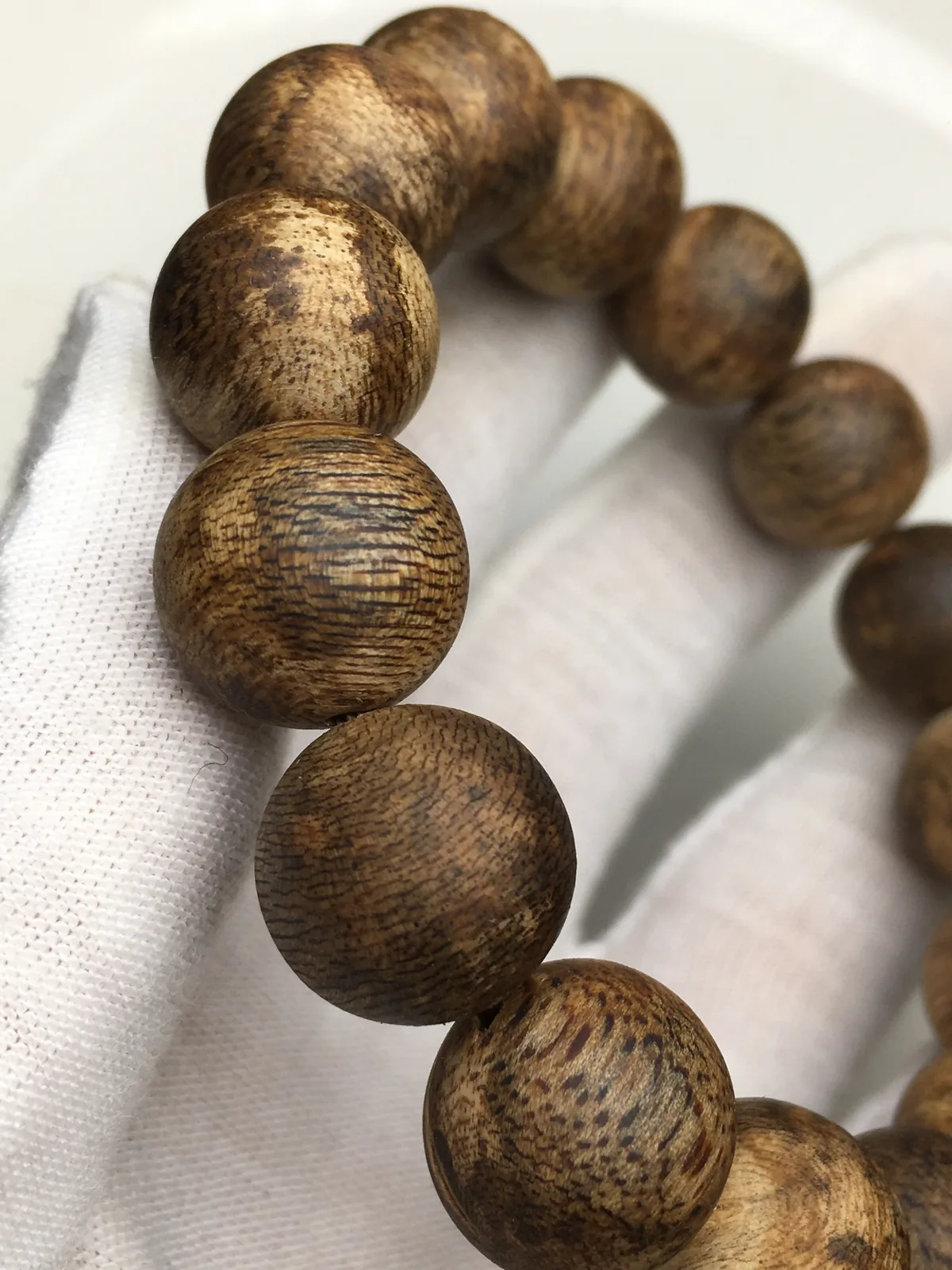 Your strand
The style page shows the look. The quote, however, shows the strand, and its weight is the only one that counts.
The kind of close-up you get
Why are sales final once a strand ships?
Your agarwood bracelet video is the other half of the arrangement. You approve the exact strand, at the exact weight and agarwood bracelet price, before you pay. So sales are final once the strand ships. In practice, the video is your chance to look closely and say no at no cost. However, if a strand arrives damaged, or the strand is not the one in your video, we replace the piece at our cost. Finally, you can always ask for a second strand before approving, and the second video costs nothing. The details are in our final sale policy and shipping policy.
Part 7 — From tree to scale to agarwood bracelet price
This timeline is a 5-stage sequence, from “Resin forms” to “On the scale”. First read “Part 7 — From tree to scale to agarwood bracelet price” from top to bottom, since each stage follows the one before.
- YearsResin formsGrowers wound a cultivated Aquilaria tree on purpose. Then it slowly lays down resin around the damage, unevenly, over years.
- HarvestWood is sortedWorkers separate resinous wood from pale wood by eye and by feel. So this is the first time weight in the hand matters.
- DryingWater leaves the woodFreshly cut wood holds water, and its weight falls as it dries. So weighing wet wood would say little about resin.
- WorkshopTurned and drilledWe turn blocks into beads of a set size, drill each with a 2 mm hole for the cord, and then polish them.
- Your quoteOn the scaleWe weigh the finished, strung strand on camera. That number, not the style name, sets your agarwood bracelet price.
Plantation growers start resin on purpose with methods such as drilling, chemical treatment and fungal inoculation, according to a 2019 review by Tan and colleagues.(Tan 2019) Even so, the amount of resin in any one log still varies, so the scale stays the last step.
Finally: is a weighed agarwood bracelet price fairer?
A weighed price is the fairer way to sell a material whose value hides inside the wood. Pricing an agarwood bracelet by weight can look old-fashioned next to a tidy shop with one number per item. Still, the tree decided how much resin went into your strand, and the scale is how both buyer and seller find out.
Whichever shop you buy from, ask for three numbers. First, the weight. Second, the bead size. Finally, the bead count. For example, two quotes for 12 mm strands become comparable the moment both list a weight. With all three you can compare an agarwood bracelet price on equal terms, check the density at home, and choose a strand rather than a style name. If you would like to see one on our scale, pick a style, and we will film it for you.
Frequently asked questions
This FAQ is a set of 10 short answers about agarwood bracelet price. First find your question below. For example, many facts in these answers about agarwood bracelet price come from the 4 published sources in References, which we checked in September 2026.
Why do you set the agarwood bracelet price by weight?
Because the value sits in the resin, and resin spreads unevenly through the wood. So two strands of the same style, size and count can carry very different amounts. Resin adds weight, so weight is the fairest measure both buyer and seller can check. A fixed agarwood bracelet price, however, can only describe an average strand.
What exactly is in a weighed quote?
You get a close-up video of the strand you would receive, then the same strand on the scale with the display in view. With it come the weight in grams, the bead size and the bead count. The quote also lists what is included, the price for that strand alone, and the shipping options for your country.
Can I ask for a different strand after seeing the video?
Yes. We charge nothing until you approve a strand. So if the grain, colour or weight is not what you hoped for, tell us what you would prefer, perhaps darker wood or a lighter strand. Then we pick another and film it, and the invoice only follows once you are happy.
Is a heavier strand always the better buy?
Not necessarily. For the same bead size and count, heavier usually means more resin, which many buyers want. However, grain, colour, scent and how the strand sits on your wrist matter as much. So weight tells you how much wood and resin you get, and whether you like the strand is yours to judge.
Is agarwood more expensive than sandalwood?
Usually, yes. Sandalwood is sold much like timber, and its quality is fairly even. Agarwood, however, is priced by its resin, which forms only in wounded trees. So if you ask which is more expensive, agarwood or sandalwood, the answer for a strand of the same size is agarwood. That agarwood vs sandalwood price gap is also why we weigh every strand.
What is the agarwood price per kg?
There is no single agarwood price per kg. Plantation wood with little resin sells for a small fraction of resin-rich or sinking wood. Prices also differ between chips, beads and oil. That is why we do not quote by the kilo. Instead, we weigh your own strand in grams and quote that strand.
Why does going up one bead size raise the agarwood bracelet price so much?
A bead’s volume grows with the cube of its diameter. So moving from 12 mm to 14 mm is a modest step to the eye, yet each bead holds about 1.6 times the wood. Fewer beads fit around the wrist, but not enough fewer to make up the difference. As a result, the strand is clearly heavier.
Does a larger wrist always mean a heavier strand?
Usually, but in steps rather than smoothly. The bead count changes one whole bead at a time, so two neighbouring wrist sizes can share the same count and roughly the same weight. A relaxed fit may also add a bead. Still, bead size matters far more than wrist size for the final weight.
Are stones and metal fittings counted in the weight?
Yes. We weigh the strand as we will ship it, so any jade, agate, amber or metal fitting goes on the scale with the wood. Stone is much denser than agarwood, so accents can add noticeably to a bracelet price. Your quote also lists exactly what is included, so you know what the number covers.
Can the weight of agarwood be faked?
It can. Some sellers weight or inject wood to make it heavier, so weight alone is evidence rather than proof. Use it alongside the grain, the scent and a close-up video. We sell plantation agarwood as it comes from the tree, and we film every agarwood bracelet before you decide.
References
This reference list is the source record for “Agarwood Bracelet Price: Why It Is Set by Weight, and How to Read a Weighed Quote”, with 4 published sources. According to the citations in “Agarwood Bracelet Price: Why It Is Set by Weight, and How to Read a Weighed Quote”, such as (Tan 2019), each one links to one entry below. Finally, we checked all 4 links behind “Agarwood Bracelet Price: Why It Is Set by Weight, and How to Read a Weighed Quote” in September 2026.
- 1Tan C.S., Isa N.M., Ismail I., Zainal Z.. Agarwood induction: current developments and future perspectives. Frontiers in Plant Science 10: 122, 2019.doi:10.3389/fpls.2019.00122
- 2Liu Y., Chen H., Yang Y., et al.. Whole-tree agarwood-inducing technique: an efficient novel technique for producing high-quality agarwood in cultivated Aquilaria sinensis trees. Molecules 18(3): 3086–3106, 2013.doi:10.3390/molecules18033086
- 3CITES Secretariat. Appendices I, II and III. Convention on International Trade in Endangered Species of Wild Fauna and Flora, current.View source
- 4Forest Products Laboratory. Wood Handbook — Wood as an Engineering Material (General Technical Report FPL-GTR-190). USDA Forest Service, 2010.View source
References are listed for transparency. We summarise them for general reading; nothing here is medical advice, and no health effect is claimed.
In this article
Styles mentioned

Browse more: Agarwood Bracelets · Agarwood Loose Beads
Related articles
Weighed before you pay
Choose a style, get your strand weighed
Pick a bead and size, send your request, and we reply with a video of your piece on the scale — its exact weight and price. Nothing is charged until you approve.