Agarwood Bracelet Meaning: What the Wood, the Count and the Charms Stand For
Agarwood bracelet meaning works on three levels. There is the wood, valued as incense for centuries, and the count, borrowed from Buddhist beads. Then there are the charms and cuts, most of them Chinese puns for a good wish. So this guide explains what each traditionally stands for, and why a meaning, however old, is not a benefit anyone can promise you.

Written by
Founder & Chief Sourcing Officer, AgarwoodTown
Wang Jianyu is the founder of AgarwoodTown, the agarwood business behind Oudbracelet, trading since 2014. 15+ years grading plantation agarwood and advising buyers on grade selection and CITES paperwork. These guides draw on the same bead geometry our wrist fitter uses and on the questions buyers ask before they approve a weighing video.
In this article
- What is the agarwood bracelet meaning?
- What are the benefits of an agarwood bracelet?
- Agarwood bracelet meaning at a glance
- Agarwood bracelet meaning in two questions
- Part 1 — Why does the wood give an agarwood bracelet meaning?
- Part 2 — What do the counts 108, 54, 27 and 18 mean?
- Part 3 — What do carved charms add to agarwood bracelet meaning?
- What do Guanyin, the Laughing Buddha and the pixiu stand for?
- Part 4 — What do cuts and shapes add to agarwood bracelet meaning?
- Part 5 — Is agarwood bracelet meaning a reading or a sales claim?
- Reading an agarwood bracelet product description
- Part 6 — Why give an agarwood bracelet for its meaning?
- Which agarwood bracelet meaning suits each occasion?
- Part 7 — How do you respect the traditions behind agarwood bracelet meaning?
- How do you choose an agarwood bracelet for its meaning?
- The wood behind the meaning
- What is agarwood bracelet meaning, in short?
- Frequently asked questions
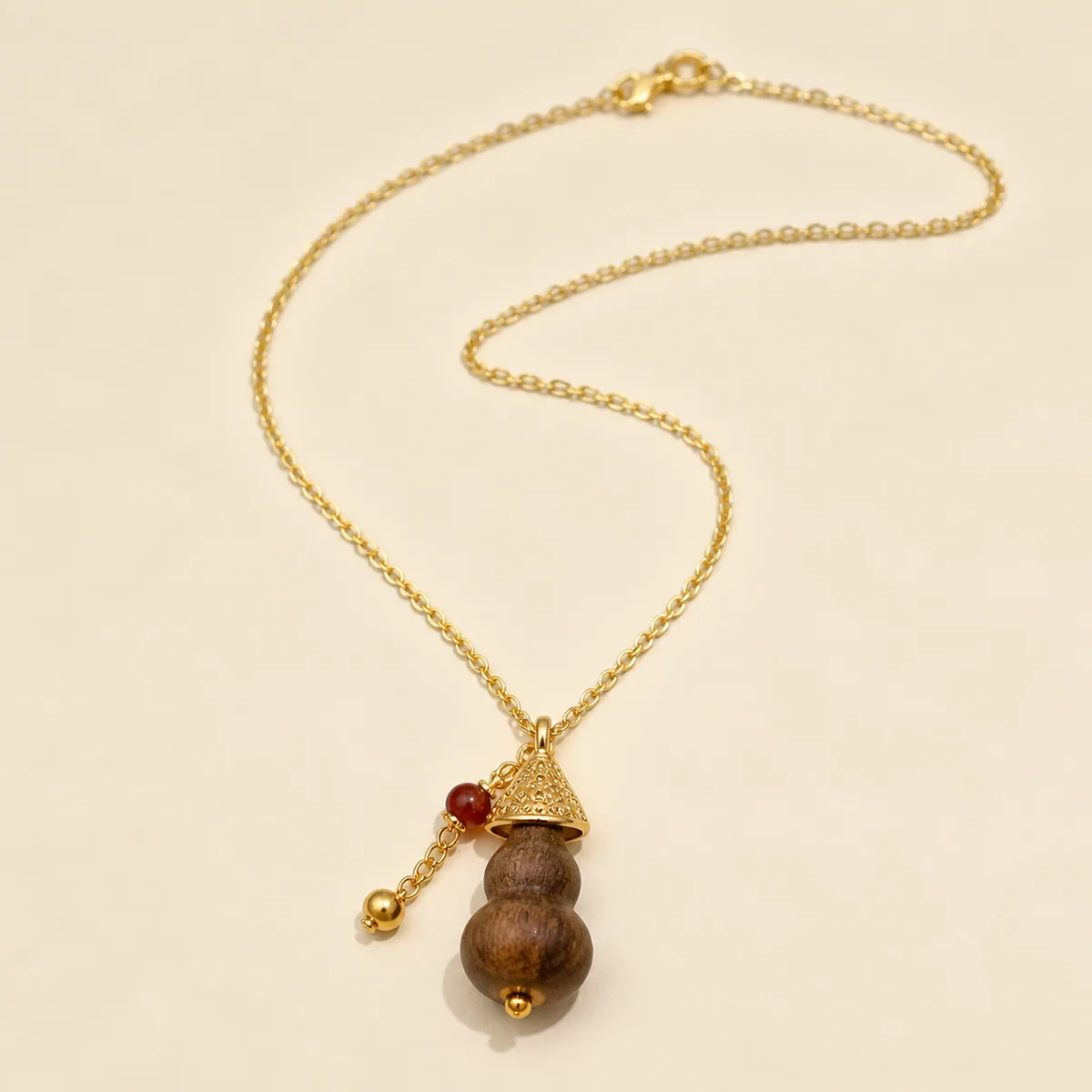 A gourd
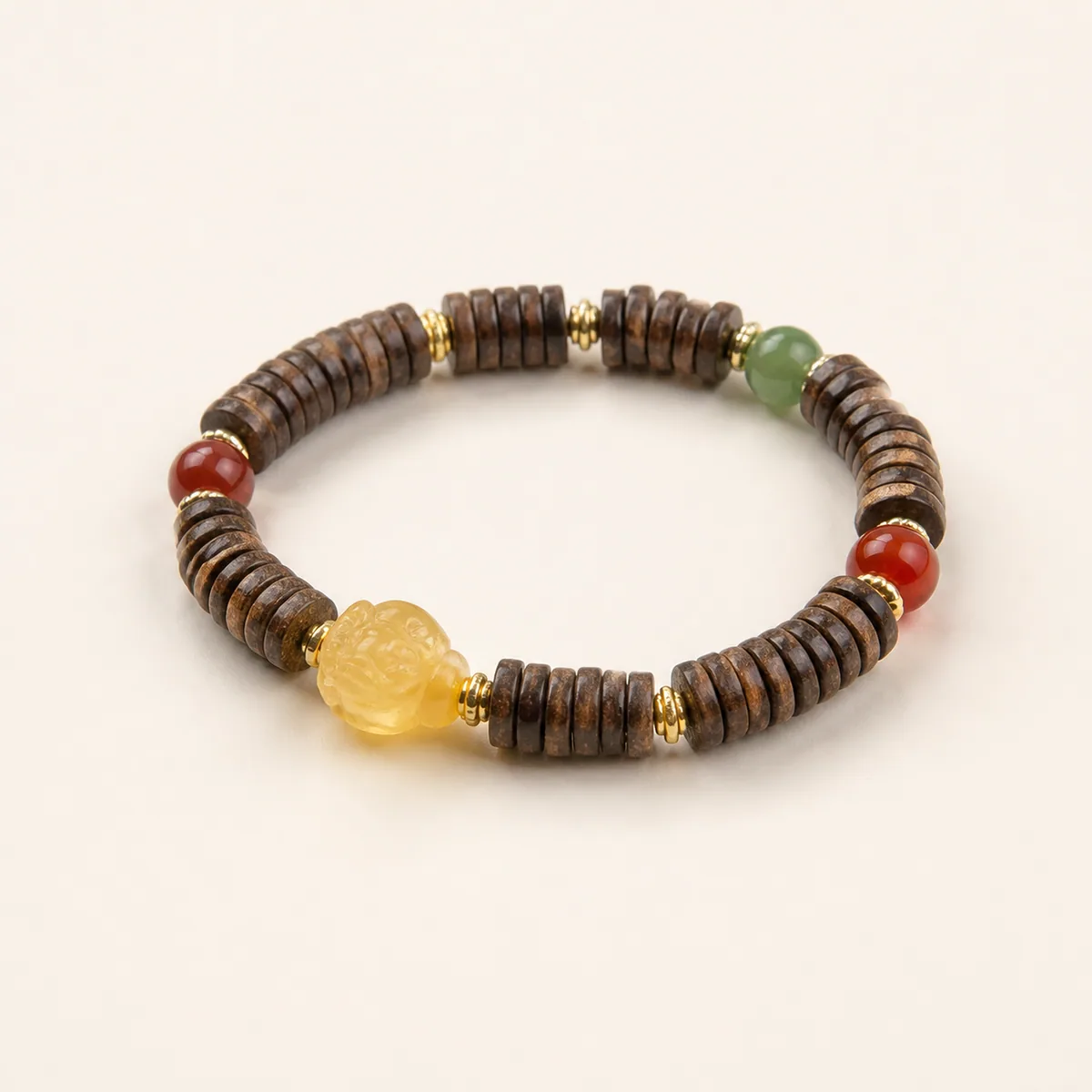 A pixiu
Two carved charms from our workshop: a double gourd in agarwood, and a small pixiu on an agarwood and amber strand. Each carries a traditional reading that goes back centuries. So the useful question is which part is culture, worth knowing and respecting, and which part is a sales promise dressed up as culture.
What is the agarwood bracelet meaning?
Agarwood bracelet meaning is the set of traditional readings an agarwood bracelet carries, and the readings work on three levels at once. First, there is the wood itself. People across Asia and the Arabian Peninsula have burned agarwood as incense and given the wood as a precious gift for well over a thousand years.
Second, there is the count: 108, 54, 27 or 18, borrowed from Buddhist counting beads. Third, there are the charms and cuts: gourds, peace discs, plain plaques, apple beads and bamboo nodes. Most charms are Chinese puns, where the name of an object sounds like a good wish.
However, no agarwood bracelet meaning is a mechanism. A gourd does not bring fortune. Instead, the Chinese name of a gourd sounds like fortune, so people have given gourds for centuries. The difference between a reading and a result runs through the whole guide.
What are the benefits of an agarwood bracelet?
The honest answer to anyone searching for the benefits of an agarwood bracelet is short. Agarwood is a beautiful, light, naturally scented wood with a long history. Anything beyond the wood is belief, and belief is the wearer’s to hold, not the seller’s to promise.
Agarwood has served incense, perfume and traditional purposes across many Asian cultures, as a 2021 review by Wang and colleagues describes.(Wang 2021) First, centuries of use gave the wood cultural weight. Then bead culture added readings of its own. Finally, agarwood bracelet meaning today rests on history, not on any promised effect.
Behind Oudbracelet stands AgarwoodTown, which began trading agarwood in 2014. We sell plantation-grown wood only, and we weigh every piece on camera before we quote. For example, a carved gourd on a strand appears in the weighing video before you decide. So what follows is agarwood bracelet meaning, written down as culture, with nothing added.
Agarwood bracelet meaning at a glance
This table is a 9-row summary. First read the element column, then compare the where the reading comes from, the traditional reading, how we describe it across each row. For example, the first row covers “Agarwood itself”.
| Element | Where the reading comes from | The traditional reading | How we describe it |
|---|---|---|---|
| Agarwood itself | Incense culture across Asia and the Arabian Peninsula | Rarity, refinement, a fragrance offered in temples and to guests | A resin-rich wood with a long history — no promised effect |
| 108 beads | Buddhist counting beads | One bead per recitation, a full round of 108 | A count, with the strand length |
| 18 or 27 beads | Buddhist wrist strands | Shorter counting loops derived from 108 | A count for the wrist; we also size to your wrist instead |
| Gourd (húlu) | Chinese homophone | Sounds like fú lù, fortune and rank | A traditional pun, passed on as culture |
| Peace disc (píng’ān kòu) | Chinese name of the object | A wish for a safe, uneventful life | A traditional wish, not an assurance |
| Plain plaque (wú shì pái) | Chinese wordplay | “Nothing happening” — a life without trouble | A traditional wish, not an assurance |
| Pixiu | Chinese mythical beast | Traditionally associated with gathering and keeping wealth | Folklore, described as folklore |
| Guanyin and the Laughing Buddha | Chinese Buddhist figures | Compassion; contentment and good humour | Religious figures, described with respect |
| Apple bead, bamboo node | Chinese homophone and image | Peace (píng); steady progress, node by node | Traditional readings of a cut |
Readings vary by region, family and teacher. Many readings also have more than one version. The table records common readings as cultural context, with Chinese names in brackets. Row 1 follows the 2021 review by Wang and colleagues on incense history. Nothing here is advice on religious practice. No row claims that a piece does anything for the wearer.
Agarwood bracelet meaning in two questions
This chooser is a 2-question guide with 8 possible answers. First answer “Why do you want a piece with meaning?”, then pick the option that fits, such as “To give it”.
The chooser is a shortcut for the two most common reasons to read about agarwood bracelet meaning. For example, a gift often works best as a pendant, earrings or a charm, because none of those pieces needs a wrist size. A count suits someone who prays or meditates with beads: a mala of 108, a tasbih of 33 or 99, or a rosary. The second question sends you to the guide that answers it. Our prayer beads guide lists the counts, and the wearing guide covers which wrist. Additionally, the real-agarwood guide gives five checks, and the scent guide explains why agarwood smells of resin, not perfume.
Part 1 — Why does the wood give an agarwood bracelet meaning?
Agarwood is one of the few bead materials that arrived with a meaning of its own. For centuries agarwood has ranked among the most valued aromatic materials in the world. People burned agarwood as incense in Buddhist temples, used the wood in perfumery, offered agarwood to guests, and carved and kept pieces as treasures. Reviews describe a long record of use across many cultures, alongside the chemistry behind the scent.(Wang 2021)
The reason is the scent, and the scent is resin. Agarwood forms only when an Aquilaria tree takes a wound. Then the tree lays down dark, aromatic resin in the heartwood over years. Without resin, the wood is pale and nearly odourless, as a 2019 review by Tan and colleagues explains.(Tan 2019)
The slow, uncertain process made agarwood rare. So the wood went to temples, courts and guests rather than into everyday use. In Japan, the appreciation of fragrant woods became a formal art, kōdō. Across the Arabian Peninsula, hosts burn oud to welcome visitors.
An agarwood bracelet carries a small part of the same history on the wrist. Today, reputable retail wood comes from cultivated trees that growers wound so resin forms. Also, international rules govern the trade in every Aquilaria species.(CITES) Neither fact changes agarwood bracelet meaning, but both facts change how you should buy one.
Part 2 — What do the counts 108, 54, 27 and 18 mean?
A count is the second layer of agarwood bracelet meaning, and the most common numbers come from Buddhist counting beads. A full mala has 108 beads, one per recitation in a complete round. Different schools explain the number in different ways. The half and quarter counts, 54 and 27, are strands in their own right, and 18 is a common wrist loop. Some traditions also add a larger guru bead, marker beads or a tassel to close the round.
Other faiths count too. For example, the Islamic tasbih uses 33 or 99, and a Catholic rosary carries 59. Each count exists for use: the beads keep the place, so the mind does not have to. So for an agarwood bracelet, meaning through number is about use, not luck. Our guide to agarwood prayer beads gives the full set of counts, with the length each comes to.
Most of our agarwood bracelets, however, have no fixed count. We size each strand to the wrist, so the bead number follows the wrist, not a tradition. If a count matters to you, say so in your request, and we string to the count.
Part 3 — What do carved charms add to agarwood bracelet meaning?
Most charms on an agarwood bracelet or pendant work the same way: the name of the object sounds like a good wish in Chinese. For example, the gourd, húlu, sounds like fú lù, fortune and official rank. A gourd was also once a container, so people read the gourd as something that holds good things in.
Similarly, the round peace disc, píng’ān kòu, takes a name from safety, because píng’ān means safe and well. The plain plaque is wú shì pái, “the tablet of nothing happening”. A plain plaque is a wish for a life without trouble, and carvers often leave the plaque blank on purpose.
Additionally, smaller motifs follow the same pattern. A fan, shàn, sounds like the word for kindness, and a leaf links to a flourishing family line. We pass the readings on, because puns explain why the pieces look as they do. However, we never sell agarwood bracelet meaning as an outcome.
What do Guanyin, the Laughing Buddha and the pixiu stand for?
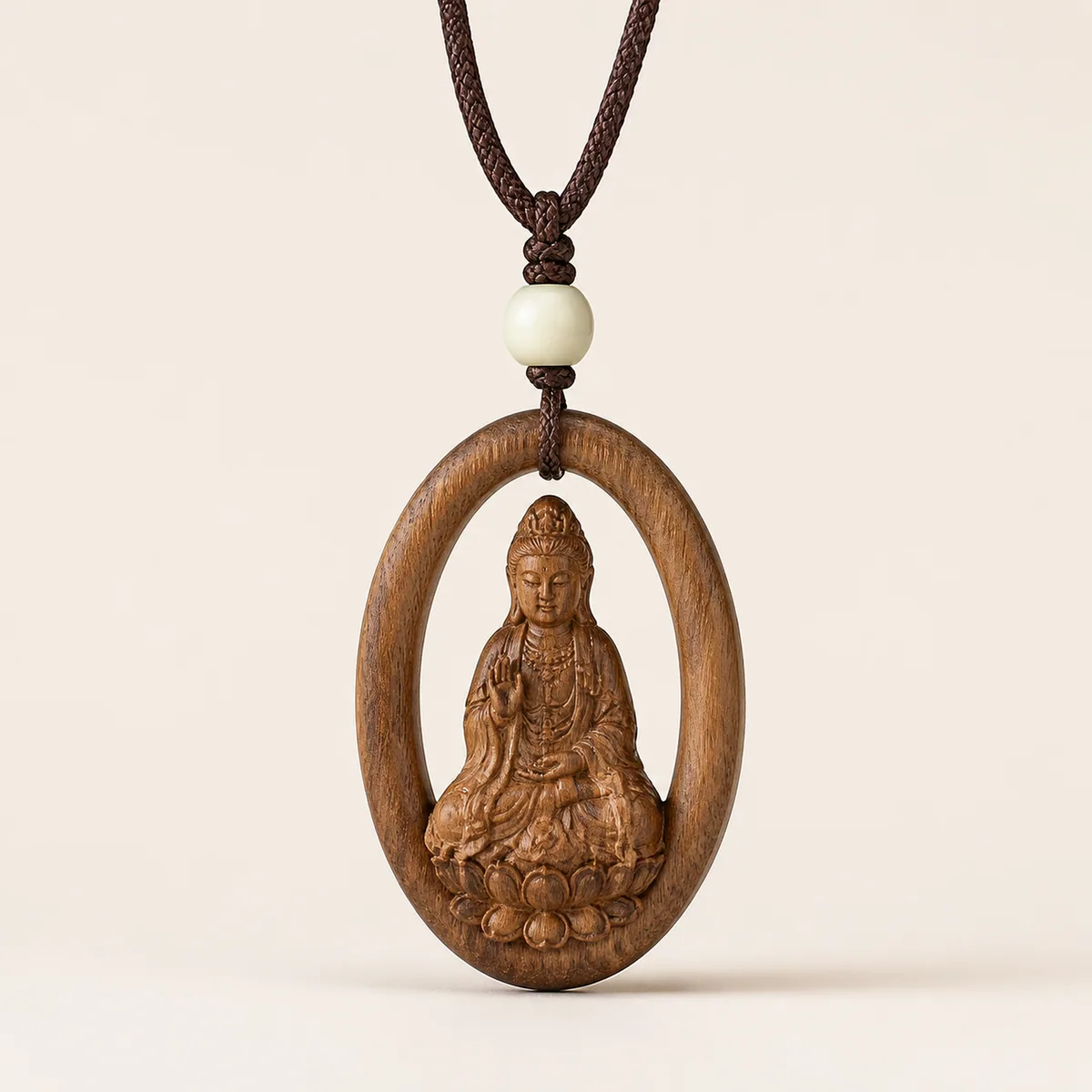
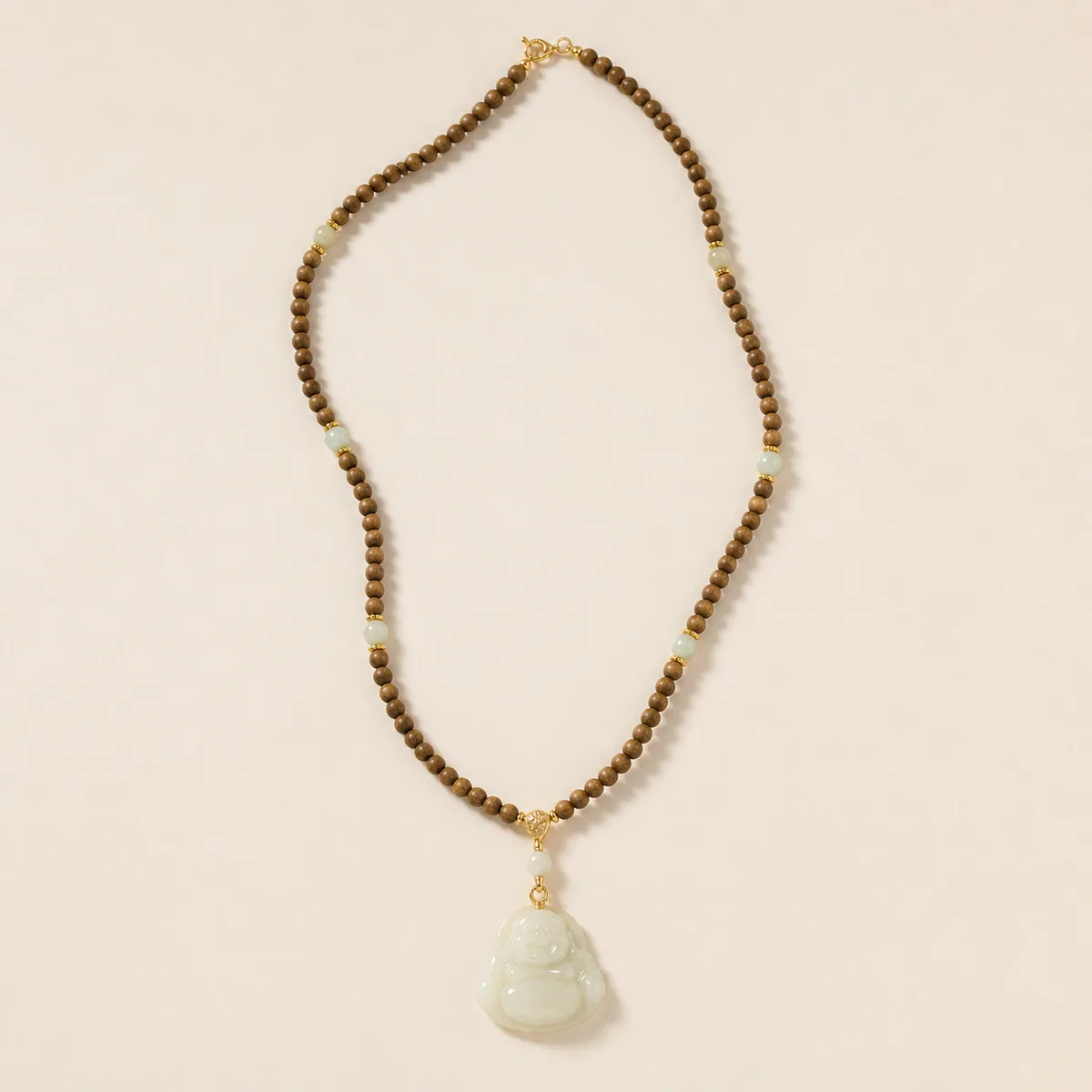
Figures are the oldest layer of charms, and the meanings of figures are religious rather than puns. Guanyin, the bodhisattva of compassion, and the Laughing Buddha, a figure of contentment and good humour, are both common as pendants. A well-known folk saying even holds that men should wear Guanyin and women the Buddha. Many families follow the saying; many others do not.
The pixiu is a winged, horned beast from Chinese folklore. Tradition associates the pixiu with gathering and keeping wealth. Moreover, the pixiu is one of the most heavily marketed charms, which is exactly why the beast deserves the plainest description. For example, our pixiu strand pairs agarwood with beeswax amber, and we describe the charm as folklore, nothing more. In practice, treat any rule about which hand or which direction a pixiu must face as sales copy, not tradition.
Part 4 — What do cuts and shapes add to agarwood bracelet meaning?
A bead cut is the lightest layer of agarwood bracelet meaning, though fewer people know the readings. The apple bead, with flattened poles, takes a meaning from sound: píngguǒ, apple, begins like píng’ān, safe and well. The bamboo-node bead, ridged like a bamboo stem, borrows the image of bamboo growing one node at a time, a picture of steady progress.
Likewise, the abacus bead, a sharp double cone, recalls the counting frame and so, loosely, good business. The plain round bead usually stands for completeness, and a round bead is also the most practical shape for counting.
In practice, most buyers choose the cut of an agarwood bracelet for the grain, not the name. Round beads show the resin lines as shifting rings. Cubes and barrels, however, show resin lines as flat sections and long streaks. Finally, our guide to agarwood bead shapes covers each cut, and the rare cuts collection has the apple, bamboo-node and abacus beads.
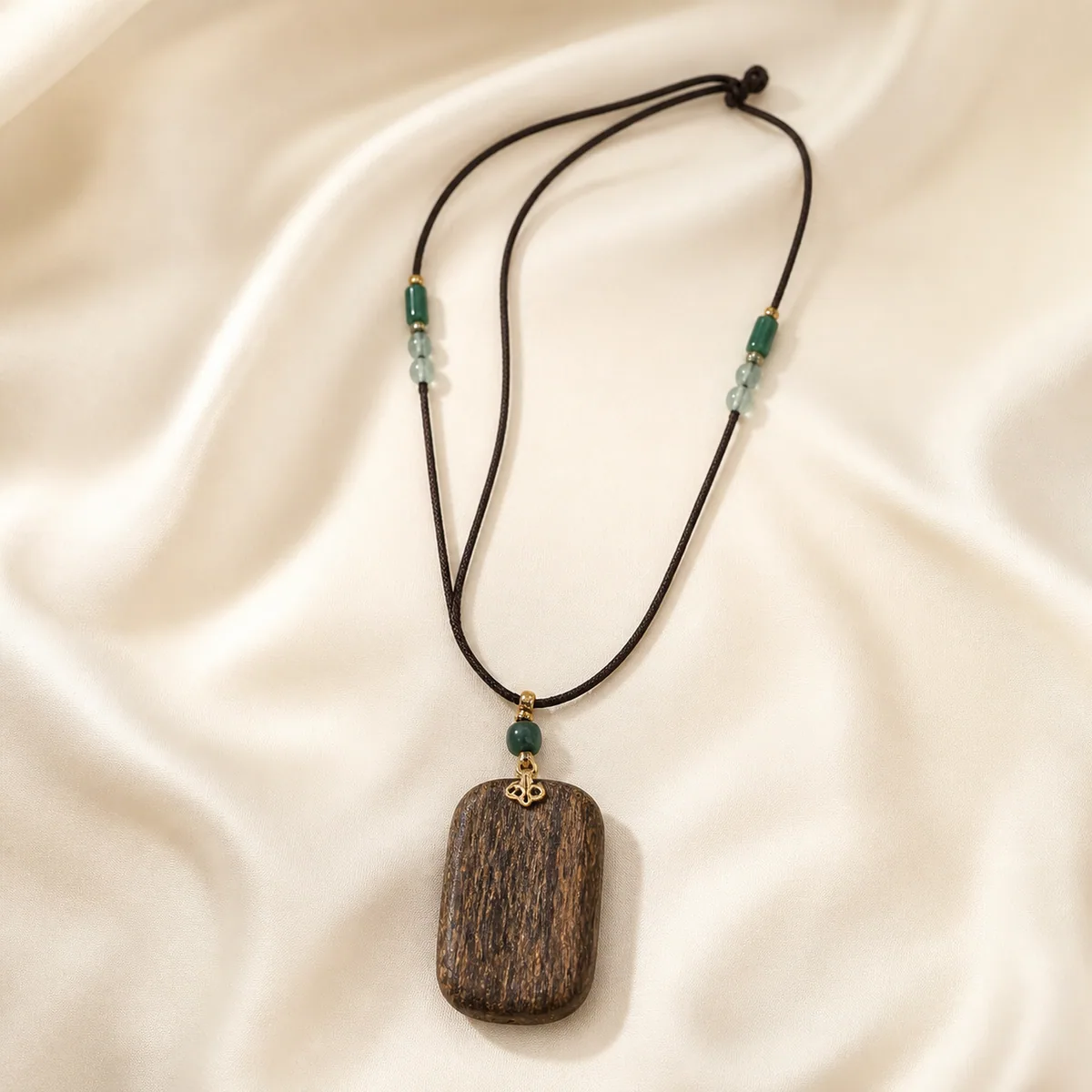 Plain plaque
 Peace disc
A plain plaque and a peace disc: two of the quietest charms, and two of the most often given. Neither charm needs a size, so both are common as gifts.
Part 5 — Is agarwood bracelet meaning a reading or a sales claim?
A cultural reading is a statement about what a thing is called, or what the thing has traditionally stood for. A claim, however, says what a piece will do: to your health, your mood, your luck or your bank balance. The first is history, and the second is marketing. Also, in many countries, advertising rules take unsupported health claims seriously. So when you read about agarwood bracelet meaning, check which kind of sentence you are reading.
The same wood, carved into the same gourd, can appear either way. For example, “a gourd, whose name sounds like fortune and rank in Chinese” is a reading. A listing that says a gourd or a pixiu will bring you money is a claim. Moreover, the more precise a rule gets, the less the rule has to do with the tradition behind the charm. Which wrist, which day, which direction to face: none of those details comes from the tradition. Traditions around counting beads and charms deserve respect, and respect includes not turning a tradition into a warranty.
Reading an agarwood bracelet product description
This comparison is a 6-point check of A cultural reading against A claim to be wary of. For example, the first row compares what it says. Finally, pick the column that matches what you need.
| Feature | A cultural reading | A claim to be wary of |
|---|---|---|
| What it says | What a thing is called or has stood for | What a thing will do for you |
| Typical wording | “Traditionally read as…”, “sounds like…” | “Brings…”, “ensures…”, “will attract…” |
| Where it comes from | Language, religion, folklore | The seller’s copy |
| Can it be checked? | Yes — in dictionaries and histories | No, and rarely offered for checking |
| Price logic | The piece is priced as material and work | The promise is priced in |
| What we do | Describe it, and say it is culture | Never write it |
The table works as a checklist for any product listing. First, look at the verbs: “sounds like” and “traditionally read as” describe a reading, while “brings” and “ensures” promise a result. Second, ask whether a dictionary or a history book could confirm the sentence. Finally, ask what you pay for: the wood and the carving, or a promise. For example, a gourd pendant described as a pun on fú lù passes all three checks.
Part 6 — Why give an agarwood bracelet for its meaning?
Meaning is most often the reason people give an agarwood bracelet rather than buy one for themselves. For example, a peace disc suits someone setting out on a journey. A plain plaque suits a parent who deserves a quiet year. A gourd suits a new home or a new job, and a strand of 108 suits someone who counts.
The gift works because the recipient knows the reading. Also, unlike a card, the wood is still there years later. So agarwood bracelet meaning is at its strongest in a gift.
The practical rules are simple. First, pendants, charms and earrings need no size, so they are easier to give than an agarwood bracelet. An agarwood bracelet, however, needs a wrist measurement, or a bracelet the person already wears. Our agarwood gifts collection gathers the pieces that need no sizing and the ones with a carved motif. If you are giving across a border, tell us where it is going. CITES lists agarwood, so we confirm what applies with your quote.
Which agarwood bracelet meaning suits each occasion?
This section is a set of 4 short notes, from “A journey or a new start” to “Someone who counts”. First scan the 4 titles under “Which agarwood bracelet meaning suits each occasion?”, then read the note that matches your case.
A journey or a new start
Give a peace disc pendant or earrings, named for safety. Peace discs are easy to give and need no size. Also, almost everyone who knows the reading will recognise a peace disc.
A new home, job or business
Give a gourd, read as fortune and rank and as a vessel that holds good things. A gourd comes as a pendant, or as a charm on an agarwood bracelet or multi-wrap strand.
A parent or an elder
Give a plain plaque, “nothing happening”: a wish for a quiet, untroubled year. A plain plaque is understated enough to wear every day, so people often choose a blank plaque on purpose for an agarwood bracelet or pendant.
Someone who counts
Give a 108-bead mala or a wrist strand of 18. Ask for a fixed count in your request, and we string to the count. Then the weighing video lets you count the beads before you pay.
Part 7 — How do you respect the traditions behind agarwood bracelet meaning?
Wearing an agarwood bracelet with religious or cultural meaning is common and usually welcome. Still, a little care goes a long way. Treat counting beads the way practitioners do. For example, many practitioners take a strand off before bathrooms or meals, and keep a strand off the floor.
Similarly, people often wear figures such as Guanyin and the Buddha above the waist and handle the figures with some care. Nobody requires any of the customs of you. However, the customs cost nothing, and people widely appreciate the care.
What we will not do is claim that anyone has blessed, consecrated or approved a strand. We also never say you must wear a piece a certain way for the piece to work. We string and carve wood, so blessing is a matter for the wearer and the wearer’s own tradition. Finally, if you want a piece blessed, take the piece to a temple, church or teacher you trust.
How do you choose an agarwood bracelet for its meaning?
This process is a 4-step sequence, from “Decide on the reading” to “Check it on video”. First follow step 1, then work down the 4 steps of “How do you choose an agarwood bracelet for its meaning?” in order.
- 1
Step 1: Decide on the reading
Pick the reading first: safety, fortune, a quiet life or a count. Then pick the object that carries the reading: a peace disc, a gourd, a plain plaque or a 108-bead strand.
- 2
Step 2: Choose how to wear the piece
Choose a pendant, earrings, a bracelet or a hand-held strand. Pendants and earrings need no size. For an agarwood bracelet, however, measure the wrist or a bracelet the person already wears.
- 3
Step 3: Write it in your request
Say the count or the charm you want. Then we confirm the count or charm with the quote, and we tell you plainly if a motif or count is out of stock.
- 4
Step 4: Check it on video
We weigh and film the exact piece. So count the beads, look at the carving close up, and approve only when the piece is right. We charge nothing before approval.
The wood behind the meaning
What is agarwood bracelet meaning, in short?
Agarwood bracelet meaning is mostly the meaning of agarwood itself. Agarwood is a rare, fragrant wood that people have valued, burned, carved and given for centuries. Today, growers raise agarwood in plantations, and people wear the wood on the wrist. The counts and charms add a second layer: Buddhist numbers, Chinese puns and old figures. Additionally, the readings explain why the pieces look as they do.
So hold the readings the way the traditions do: as language, as history and, for some, as faith. However, never pay for readings as promises. For example, a gourd is a pun on fortune, not a source of fortune. If you want to start simply, our gifts gather the charms that need no size. Finally, we weigh and film every piece on the site before you decide, so you see the exact wood and carving first.
Frequently asked questions
This FAQ is a set of 8 short answers about agarwood bracelet meaning. First find your question below. For example, many facts in these answers about agarwood bracelet meaning come from the 3 published sources in References, which we checked in September 2026.
What does an agarwood bracelet mean?
The first meaning of an agarwood bracelet is the wood itself. People have treasured agarwood for centuries as incense and perfume, so an agarwood bracelet carries that history. Many strands also add a layer from Buddhist counting beads, such as 108 or 18 beads. Some carry a carved charm whose Chinese name sounds like a good wish.
What are the benefits of wearing an agarwood bracelet?
The real ones are ordinary. Agarwood is light, warm to the touch, naturally scented by its own resin, and different on every bead. However, we make no claims about health, mood, sleep or fortune, and we suggest caution with any seller who does. Traditional readings are culture, not a mechanism anyone can promise.
Why do mala bracelets have 108 beads?
In Buddhist practice, a full round of recitation runs on 108 beads, one per repetition, and schools explain the number in different ways. Half and quarter counts of 54 and 27 are common too, and so are wrist loops of 18. Our prayer beads guide lists the counts and the length each comes to.
What does a gourd charm mean on agarwood?
The gourd is húlu in Chinese, which sounds like fú lù, fortune and official rank. People also once used gourds as containers, so the gourd reads as something that holds good things in. We pass that on as a traditional reading and cultural context. It is not a promise of any outcome.
What is a pixiu, and what is it supposed to do?
A pixiu is a winged, horned beast from Chinese folklore, and tradition associates it with gathering and keeping wealth. It is also one of the most heavily marketed charms, often with detailed rules for wearing it. So we describe it as folklore, and we make no claim that it does anything for the wearer.
What does a plain plaque or peace disc pendant mean?
The plain plaque is wú shì pái, the tablet of nothing happening: a wish for a life without trouble. Carvers often leave it blank on purpose. The peace disc, píng’ān kòu, takes its name from being safe and well. Both are quiet, traditional wishes, and both are among the pieces people give most.
Does it matter which wrist I wear an agarwood bracelet on?
Only as a matter of custom and comfort. In several Buddhist traditions, people hold or wear counting beads on the left. Many others simply wear a strand opposite their watch. However, we make no claim that one wrist does anything the other does not. Our wearing guide covers the practical side in detail.
Is it respectful to wear religious beads if I am not religious?
Generally yes, and many people do. Still, a little care goes a long way. Keep counting beads and figures off the floor, and take a strand off where practitioners would, such as in bathrooms. We never claim that anyone has blessed a piece, so take it to a temple, church or teacher you trust.
References
This reference list is the source record for “Agarwood Bracelet Meaning: What the Wood, the Count and the Charms Stand For”, with 3 published sources. According to the citations in “Agarwood Bracelet Meaning: What the Wood, the Count and the Charms Stand For”, such as (Wang 2021), each one links to one entry below. Finally, we checked all 3 links behind “Agarwood Bracelet Meaning: What the Wood, the Count and the Charms Stand For” in September 2026.
- 1Wang Y., Hussain M., Jiang Z., et al.. Aquilaria species (Thymelaeaceae) distribution, volatile and non-volatile phytochemicals, pharmacological uses, agarwood grading system, and induction methods. Molecules 26(24): 7708, 2021.doi:10.3390/molecules26247708
- 2Tan C.S., Isa N.M., Ismail I., Zainal Z.. Agarwood induction: current developments and future perspectives. Frontiers in Plant Science 10: 122, 2019.doi:10.3389/fpls.2019.00122
- 3CITES Secretariat. Appendices I, II and III. Convention on International Trade in Endangered Species of Wild Fauna and Flora, current.View source
References are listed for transparency. We summarise them for general reading; nothing here is medical advice, and no health effect is claimed.
In this article
Styles mentioned
Browse more: Agarwood Necklaces & Pendants · Agarwood Bracelets
Related articles
Weighed before you pay
Choose a style, get your strand weighed
Pick a bead and size, send your request, and we reply with a video of your piece on the scale — its exact weight and price. Nothing is charged until you approve.