Agarwood Bead Shapes Explained: How 13 Cuts Show the Grain, Wear and Pack
The same agarwood can look completely different once you cut it into different bead shapes. Here are all thirteen agarwood bead shapes we string. For each one, we show what it reveals of the grain and how it wears. We also show how much wood it packs into a strand, and how Chinese bead culture reads it.

Written by
Founder & Chief Sourcing Officer, AgarwoodTown
Wang Jianyu is the founder of AgarwoodTown, the agarwood business behind Oudbracelet, trading since 2014. 15+ years grading plantation agarwood and advising buyers on grade selection and CITES paperwork. These guides draw on the same bead geometry our wrist fitter uses and on the questions buyers ask before they approve a weighing video.
In this article
- What do agarwood bead shapes change?
- All 13 agarwood bead shapes at a glance
- Choosing between agarwood bead shapes in two questions
- Part 1 — Grain first: what do agarwood bead shapes do to the wood?
- Part 2 — The classic agarwood bead shapes: round, cube and disc
- Part 3 — Barrel and drum agarwood bead shapes
- Drum or long barrel?
- Part 4 — How does each agarwood bead shape wear over the years?
- What to watch for, cut by cut
- Part 5 — How much wood do agarwood bead shapes pack into a strand?
- Wood per 10 cm of strand, by cut (worked out)
- Part 6 — What are natural form and the rare agarwood bead shapes?
- Four rare agarwood bead shapes, one style each
- Part 7 — Choosing your agarwood bead shape in four questions
- Watch a round agarwood bead shape turn
- Why see the agarwood bead cut before you choose?
- Finally: which agarwood bead shape is right for you?
- Frequently asked questions
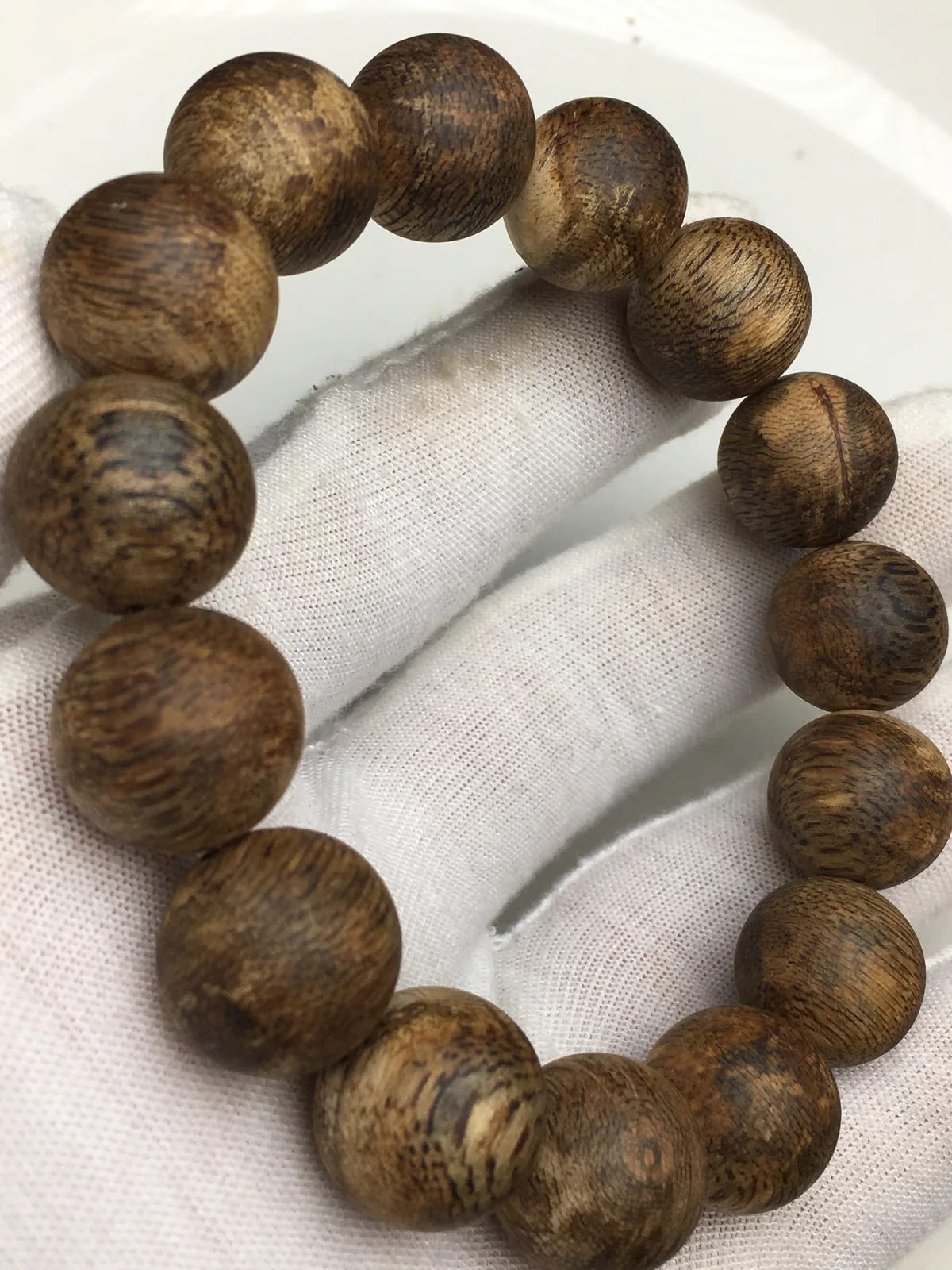 Round
 Cube
Two plantation agarwood strands, photographed alike. One reads as soft, shifting spots; the other reads as clean lines. Which shows the grain better? Both do. They simply look at it from different directions.
What do agarwood bead shapes change?
Agarwood’s resin runs through the wood in lines and patches. The tree lays it down around old wounds.(Tan 2019) In plantation wood, growers start that process on purpose. Even so, the resin still follows the tree’s own structure, not a pattern anyone chose.(Liu 2013)
So the cutter cannot move those lines. Instead, the cutter decides which way you look at them. That one choice changes a strand more than almost anything else. In short, agarwood bead shapes are different windows onto the same grain.
For example, a round bead shows the grain as rings and flecks that change as it turns. A flat face shows a clean section, like a slice through the trunk. Meanwhile, a long barrel shows the longest unbroken run. The bead shape also changes how a strand feels, wears and packs. As a result, it changes the weight too.
We are Oudbracelet, the retail arm of AgarwoodTown, and agarwood has been our trade since 2014. Today we string thirteen agarwood bead shapes, from the classic round bead to rare carved cuts. Here they are side by side.
According to the USDA Wood Handbook, wood grain shows differently depending on how a piece is cut.(USDA 2010) First, a round bead shows the grain as rings. Then a cube shows it as flat panels. Finally, a disc shows it along one edge, so the same wood can look like 3 different materials.
All 13 agarwood bead shapes at a glance
This table is a 13-row summary. First read the cut column, then compare the chinese name, shows the grain as, grain view, for counting, styles across each row. For example, the first row covers “Round”.
| Cut | Chinese name | Shows the grain as | Grain view | For counting | Styles |
|---|---|---|---|---|---|
| Round | yuán zhū | Rings and flecks that change as it turns | ★★★★★ | ★★★★★ | 29 |
| Cube | fāng zhū | Flat sections on every face | ★★★★★ | ★★★★★ | 23 |
| Square | fāng zhū | Flat sections, crisper edges | ★★★★★ | ★★★★★ | 1 |
| Disc | piàn zhū | A cross-section in every disc | ★★★★★ | ★★★★★ | 9 |
| Drum | gǔ zhū | Lines on the sides, rings on the ends | ★★★★★ | ★★★★★ | 4 |
| Barrel | tǒng zhū | Lines along the length | ★★★★★ | ★★★★★ | 3 |
| Long barrel | cháng tǒng zhū | The longest unbroken lines | ★★★★★ | ★★★★★ | 4 |
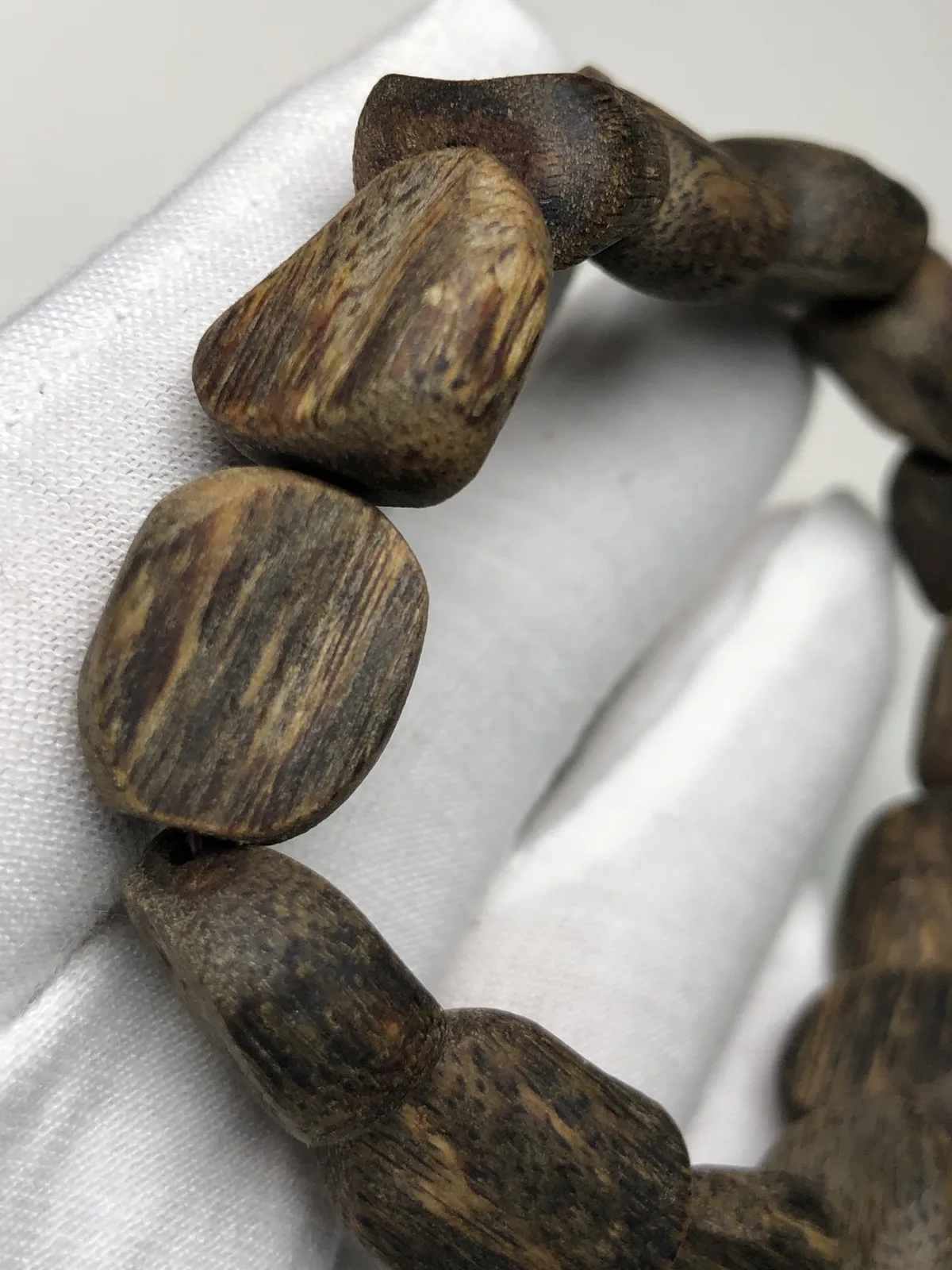
| Natural form | suí xíng | Whatever the piece gave | ★★★★★ | ★★★★★ | 4 |
| Heartwood | suí xíng | Irregular pieces, as found | ★★★★★ | ★★★★★ | 1 |
| Abacus | suàn pán zhū | Lines meeting at a sharp waist | ★★★★★ | ★★★★★ | 1 |
| Apple | píngguǒ zhū | Like round, slightly flattened | ★★★★★ | ★★★★★ | 1 |
| Bamboo-node | zhú jié | Carved ridges over the grain | ★★★★★ | ★★★★★ | 1 |
| Antique-cut | lǎo xíng zhū | Soft-edged lines along the length | ★★★★★ | ★★★★★ | 1 |
The star ratings are our working judgement from handling these strands. Use them for comparison only; they are not a standard. For example, the cube gets five stars for grain view because every face is flat, while the round bead gets five for counting. The style counts show pure-agarwood styles in our catalogue today, and they update on their own when we add styles.
Choosing between agarwood bead shapes in two questions
This chooser is a 2-question guide with 8 possible answers. First answer “What do you want to see?”, then pick the option that fits, such as “Clear grain lines”.
The chooser is a shortcut, not a rule. First, decide what you want to see: grain lines, a soft sheen, one band or an irregular outline. Second, decide how the strand will be used. For example, someone who counts prayers but loves grain might pick round beads for a mala and a barrel strand for daily wear. Part 7 asks the same questions in more detail, in four steps instead of two.
Part 1 — Grain first: what do agarwood bead shapes do to the wood?
Grain is the direction of the wood fibres, and agarwood resin follows the tree’s own structure. Cut a log straight across and you see rings. Split a log lengthwise, however, and you see long lines. Every agarwood bead shape picks one of those two views, or a mix of both. The USDA Wood Handbook describes the same effect in sawn timber.(USDA 2010)
Across the grain, the resin shows as spots, rings and small islands of dark wood. You see this view on the ends of a drum and the faces of a disc. Along the grain, by contrast, the resin shows as streaks. Streaks can run the whole length of a barrel or across two faces of a cube. A round bead shows both at once: lines at the “equator” blend into spots at the poles.
So figured wood, with bold streaks, rewards the long-line cuts. On the other hand, speckled resin often looks best as round beads. There, no single face has to carry the whole pattern. For example, pale wood with scattered dark flecks usually suits round beads better than cubes.
Part 2 — The classic agarwood bead shapes: round, cube and disc
What is a round agarwood bead (yuán zhū)?
A round agarwood bead is a sphere drilled through the centre, and the round cut is the default for bracelets and malas. A sphere rolls easily between the fingers, so round beads became the traditional counting bead. For example, the beads on a 108-bead mala are usually round. A round bead also shows both grain views at once: lines at the equator and spots at the poles.
In Chinese bead culture, people read the full circle as yuánmǎn, or completeness. Round agarwood beads suit every size, from small mala beads to 20 mm statement strands. Additionally, neighbouring spheres touch at a single point, so the cord takes little strain. In total, we string 29 pure-agarwood round styles.
What is a cube agarwood bead (fāng zhū)?
A cube agarwood bead is a square-sided bead with softened edges. We saw the blanks square first and then soften the edges, so the beads sit comfortably. Flat faces show resin lines more clearly than any other agarwood bead shape. Each face is a clean window onto the grain, much like a plank sawn from a log. Traditionally, the square also stands for fāngzhèng: being upright and plain-dealing.
Cube strands pack tightly, so a cube bracelet reads as a band rather than a row of dots. In idealised geometry, a sharp-edged cube holds about 2.0 times the wood of a round bead of the same width. Real cubes have softened corners, so the true figure is lower. Together, cube and square make up 24 styles.
What is a disc agarwood bead (piàn zhū)?
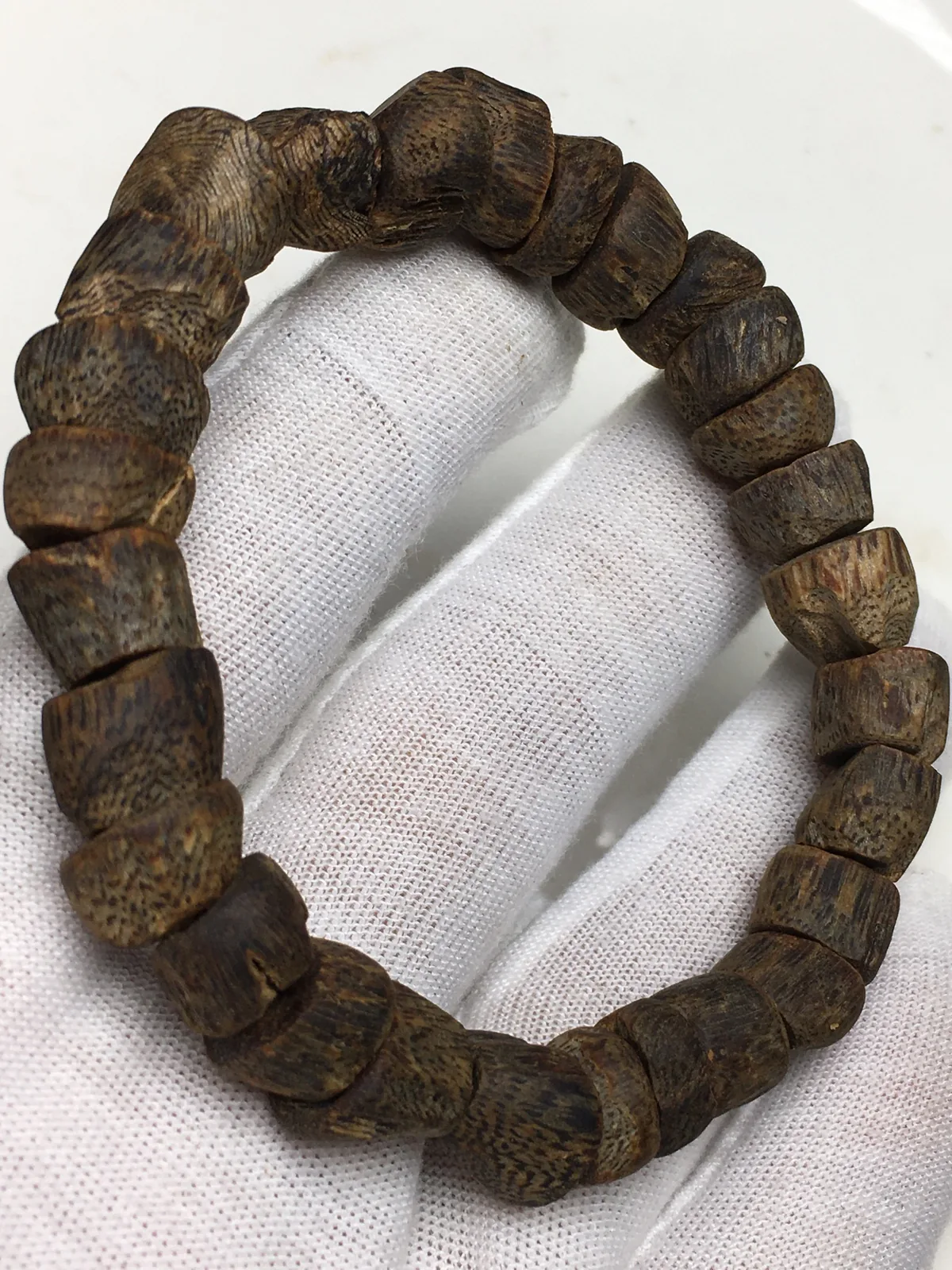
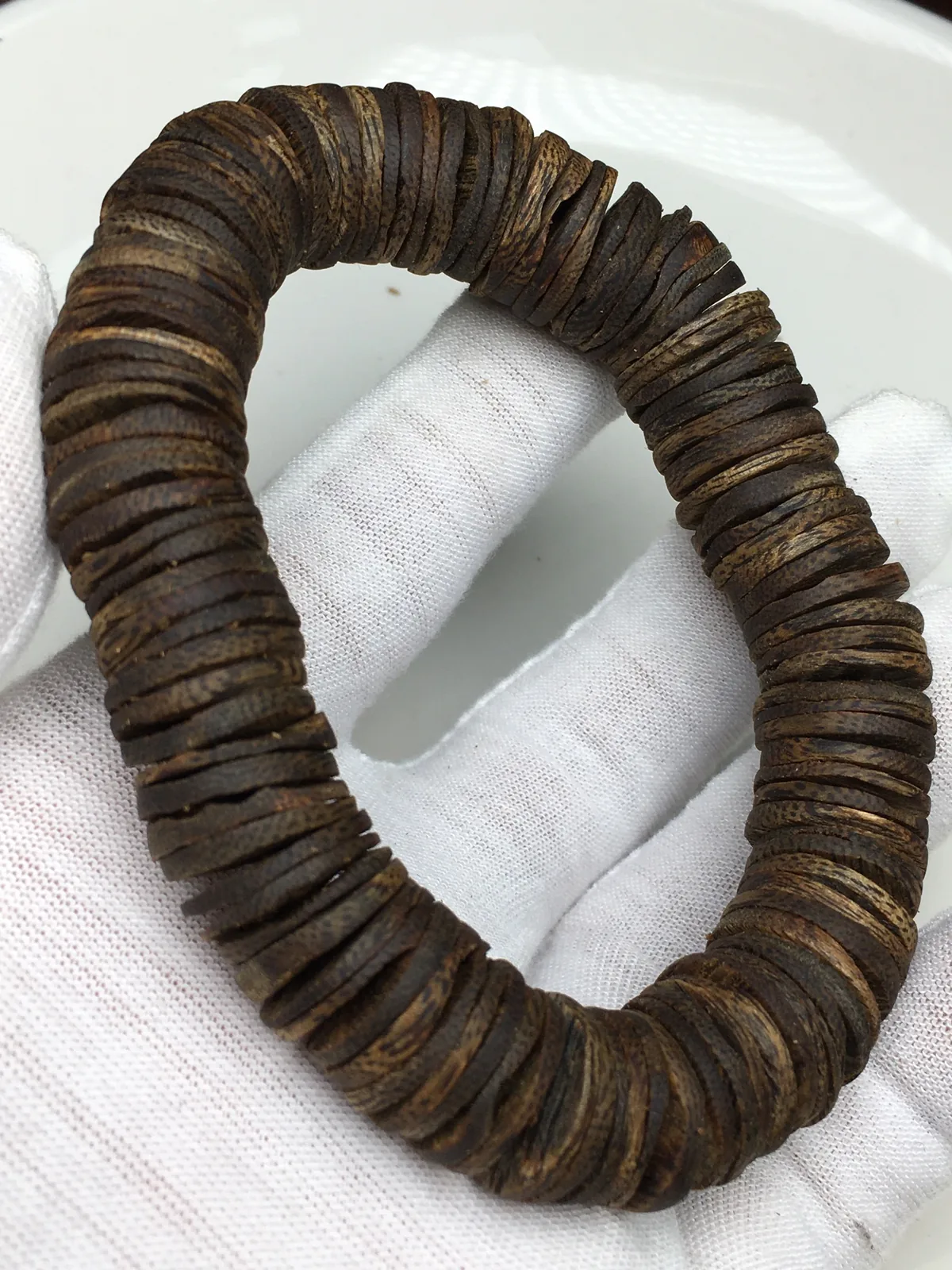
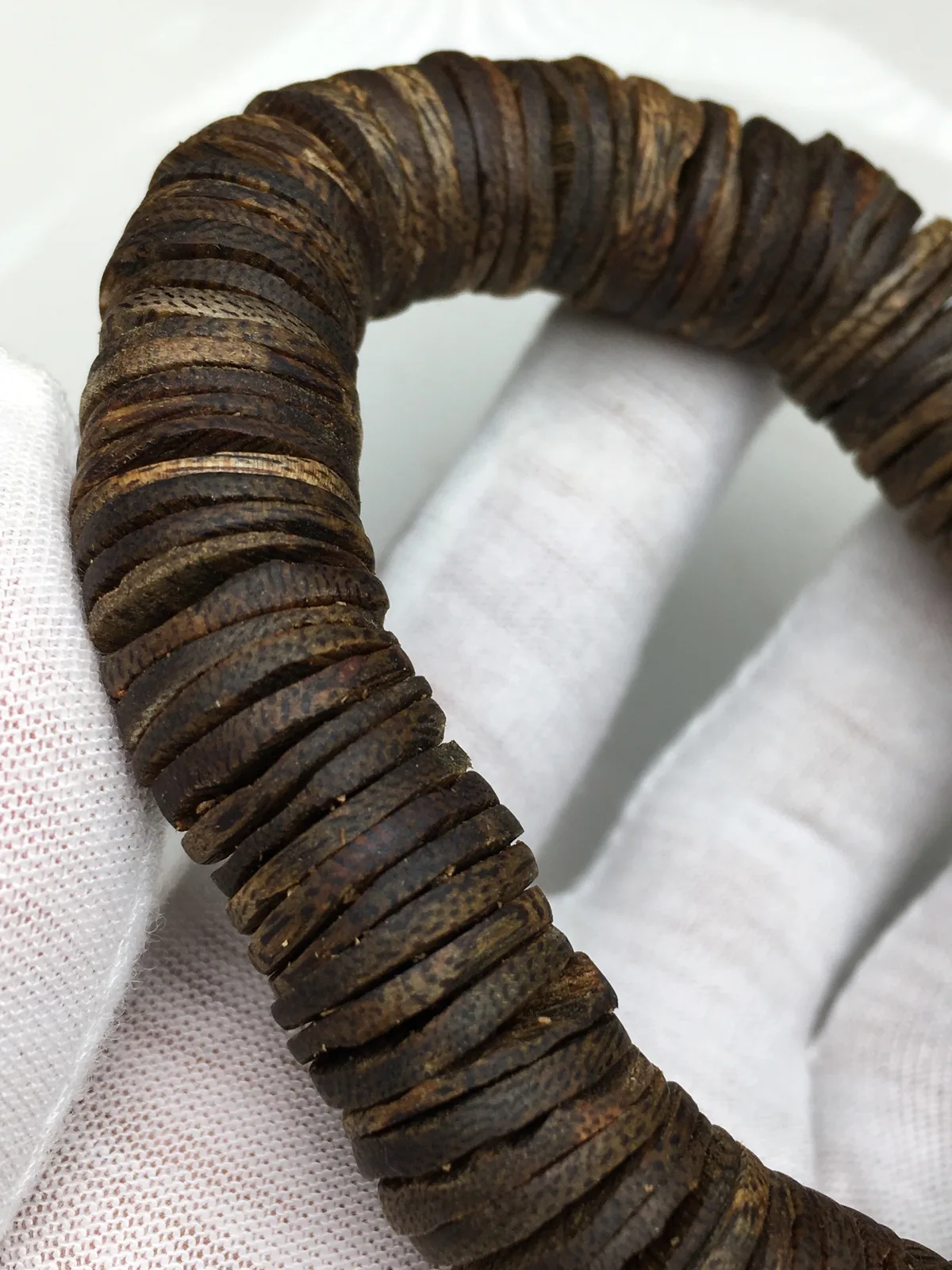
A disc agarwood bead is a thin slice cut across the grain and stacked edge to edge with its neighbours. As a result, the strand looks like one continuous ring, with a line of pattern in every disc. Each disc is a small cross-section of the trunk, so the resin shows as rings and spots. Disc strands use many pieces and flex smoothly. For example, multi-wrap strands often use discs for exactly that reason.
However, discs carry the most end grain of any cut. According to the USDA Wood Handbook, end grain takes up and loses moisture faster than side grain.(USDA 2010) So a disc strand needs the most care around water and heat. We offer 9 disc styles.
Part 3 — Barrel and drum agarwood bead shapes
What is a drum agarwood bead (gǔ zhū)?
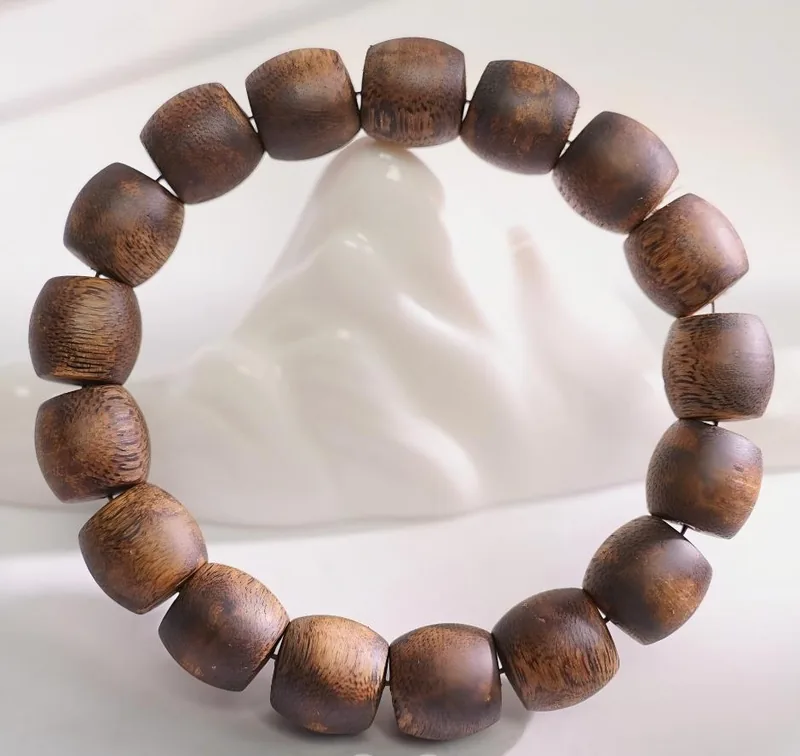
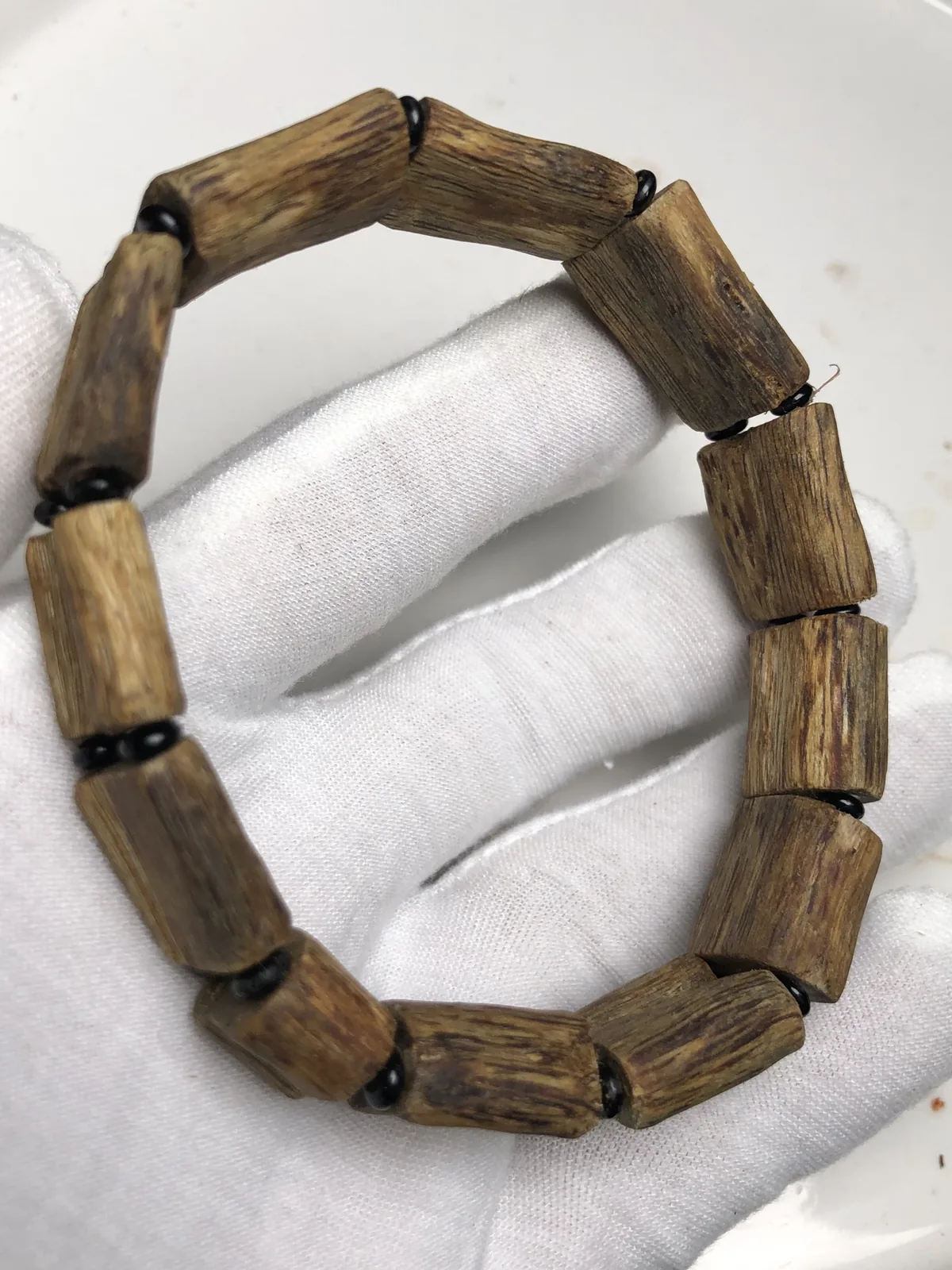
A drum agarwood bead is a short cylinder with rounded sides and flat ends. The name comes from a Chinese drum. Thanks to the flat ends, drum beads sit close without gaps. So a drum strand looks full and even. The sides show short lines along the grain, while the ends show rings.
Drums also size in fine steps, since one extra bead changes the fit only a little. Additionally, drums are forgiving of patchy resin, as the comparison below shows. In idealised geometry, a cylinder holds about 1.5 times the wood of a round bead per length of cord. For example, a drum strand and a round strand of the same width can differ clearly on the scale. We string 4 drum styles.
What is a barrel agarwood bead (tǒng zhū)?
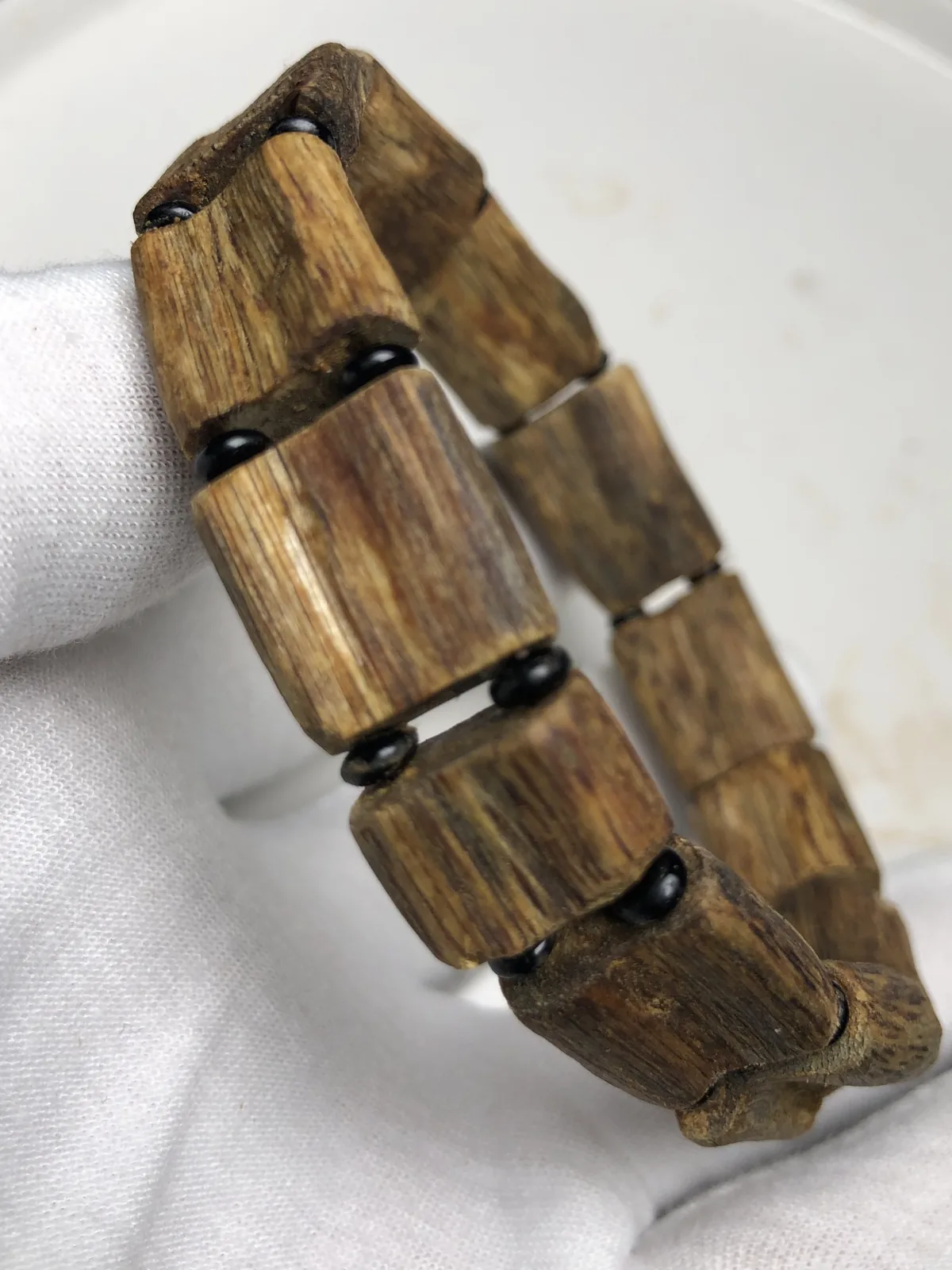
A barrel agarwood bead is a short cylinder cut along the grain. The resin lines therefore run the length of each agarwood bead. Barrels suit people who like grain but want something softer than cube. Barrel beads also feel less formal than round beads. In the chooser above, barrel and drum are the picks for everyday wear.
For example, style R36 shows barrels as a middle ground between round and cube. Like drums, barrels hold about 1.5 times the wood of round beads per length of cord, in idealised terms. Finally, the flat ends meet face to face, so check the cord at the joints now and then. There are 3 barrel styles.
What is a long barrel agarwood bead (cháng tǒng zhū)?
A long barrel is a cylinder longer than it is wide, and this agarwood bead shape gives the longest unbroken run of grain. A long-barrel strand also has the fewest beads. No other bead shape shows off figured wood better. Still, a long agarwood bead has nowhere to hide a pale patch. For that reason, long barrels want even, figured wood along the whole length.
Additionally, sizing comes in coarse steps, since one bead changes the fit a lot. On the wrist, a long-barrel strand sits as a chain of flat-ish segments rather than a smooth curve. For example, style R44 holds the most grain per bead of the two styles pictured below. We offer 4 long-barrel styles.
 Drum
 Long barrel
Both are cylinders drilled end to end. The short drum reads as a dense, even band. By contrast, the long barrel stretches out, so each bead becomes a small panel of grain.
Drum or long barrel?
This comparison is a 4-point check of Drum against Long barrel. For example, the first row compares grain. Finally, pick the column that matches what you need.
| Feature | Drum | Long barrel |
|---|---|---|
| Grain | Short lines on the sides, rings at the ends | Long unbroken lines along each bead |
| On the wrist | Many beads; bends evenly around the wrist | Few beads; sits as a chain of flat-ish segments |
| Sizing | Fine steps — one bead changes the fit a little | Coarse steps — one bead changes the fit a lot |
| Best wood | Forgiving of patchy resin | Wants even, figured wood the whole length |
Drum and long barrel are both cylinders drilled end to end, so the real difference is length. A short drum gives many beads and an even curve. A long barrel gives few beads and long panels of grain. In practice, patchy resin suits the drum, while evenly figured wood deserves the long barrel. Sizing follows the same logic: one drum bead changes the fit a little, and one long barrel changes the fit a lot.
Part 4 — How does each agarwood bead shape wear over the years?
Wood is not equally stable in every direction. Along the grain, wood barely moves. Across the grain, however, wood swells and shrinks as moisture comes and goes. According to the USDA Wood Handbook, end grain also takes up and loses moisture faster than side grain.(USDA 2010) So agarwood bead shapes with a lot of end grain need the most care. First come discs, followed by the flat ends of drums. Keep both away from water and sudden heat.
Bead shape also decides where a strand rubs. Round agarwood beads touch neighbouring beads at a single point. As a result, round beads roll freely and the cord takes little strain. Flat-ended cuts, by contrast, meet face to face. Flat faces sit steady, yet the cord bends sharply at each joint whenever the strand flexes. The joint is usually where the cord thins first. Meanwhile, cube corners slowly round over with wear.
None of this makes any bead shape fragile. Our care guide covers the routine. Below, you can see what changes from cut to cut.
What to watch for, cut by cut
This timeline is a 5-stage sequence, from “The easiest to live with” to “Mind the high points”. First read “What to watch for, cut by cut” from top to bottom, since each stage follows the one before.
- RoundThe easiest to live withIt rolls freely and wears evenly all over. Just wipe it and check the cord now and then.
- CubeCorners soften firstIts edges round over slowly with wear. Take it off before you knock your wrist on desks and door frames.
- DiscKeep it dryIt has the most end grain of any cut. Avoid water and quick drying, and restring before the cord frays.
- Drum · barrelWatch the jointsFlat ends meet face to face. The cord bends hardest there, so look there first.
- Natural formMind the high pointsRaised points take wear and knocks first. Store it in its own pouch.
Part 5 — How much wood do agarwood bead shapes pack into a strand?
A strand of round beads is part wood and part air, because round agarwood beads leave gaps. Two spheres touch at one point, with gaps above and below. In contrast, flat-sided cuts such as cube, drum and disc sit flush and fill those gaps with wood. So at the same bead width, each agarwood bead shape puts a different amount of wood into a strand. We sell agarwood by weight, so the cut changes the quote as well.
The geometry is simple to work out. Take idealised 10 mm beads with a 2 mm hole. For the same length of cord, a sharp-edged cube holds about 2.0 times the wood of a round bead. A cylinder holds about 1.5 times; that covers drum, barrel, long barrel and a stack of discs. Real cubes have softened edges, and real strands curve. So the true gap is smaller, and you should read these figures as upper limits. For scale, a 10 mm round strand for a 16 cm wrist takes 20 beads with standard room.
Wood per 10 cm of strand, by cut (worked out)
This table is a 5-row summary. First read the cut column, then compare the idealised shape, wood per bead (cm³), beads per 10 cm, wood per 10 cm (cm³), estimated weight, vs round across each row. For example, the first row covers “Round”.
| Cut | Idealised shape | Wood per bead (cm³) | Beads per 10 cm | Wood per 10 cm (cm³) | Estimated weight | vs round |
|---|---|---|---|---|---|---|
| Round | sphere, 10 mm | 0.49 | 10 | 4.9 | 3.0–4.7 g | ×1.0 |
| Cube | 10 mm cube, sharp edges | 0.97 | 10 | 9.7 | 5.8–9.2 g | ×2.0 |
| Drum / barrel | cylinder 10 × 10 mm | 0.75 | 10 | 7.5 | 4.5–7.2 g | ×1.5 |
| Long barrel | cylinder 10 wide × 20 mm long | 1.51 | 5 | 7.5 | 4.5–7.2 g | ×1.5 |
| Disc | 10 mm wide × 5 mm thick | 0.38 | 20 | 7.5 | 4.5–7.2 g | ×1.5 |
We worked these out; we did not measure them. They assume perfect shapes 10 mm wide, drilled end to end with a 2 mm hole, touching in a straight line. The weight range uses our working density band of 0.6–0.95 g/cm³. Real agarwood beads have softened edges, so real flat-cut strands weigh less than shown. Your quote uses the scale.
Part 6 — What are natural form and the rare agarwood bead shapes?
Natural form is the cut that keeps the outline of the raw piece. Suí xíng means “following the form”. Here the carver removes as little wood as possible and keeps the outline the piece had. No two agarwood beads match, and no two strands match either. So the strand you receive will not look like the photo bead for bead. We shape heartwood pieces the same way. Between them, these two cuts make up 5 styles.
Four more agarwood bead shapes take extra work per bead: abacus, apple, bamboo-node and antique-cut. For that reason, we offer each in one design. Just ask if you want another size. For example, natural-form and heartwood strands suit a buyer who wants a piece nobody else has. Finally, raised points on irregular beads take wear first, so store these strands in their own pouch.

Four rare agarwood bead shapes, one style each
This section is a set of 4 short notes, from “Abacus — suàn pán zhū” to “Antique-cut — lǎo xíng zhū”. First scan the 4 titles under “Four rare agarwood bead shapes, one style each”, then read the note that matches your case.
Abacus — suàn pán zhū
A double cone with a sharp waist, like a counting-frame bead. Its edge catches light along the grain. See style S010.
Apple — píngguǒ zhū
A round bead, flattened slightly at the poles. Píng (apple) sounds like píng (peace). So people traditionally give it as a wish for a calm, safe life.
Bamboo-node — zhú jié
Ridges on the bead copy a bamboo stem. Bamboo grows node by node, so it is a traditional image of steady progress.
Antique-cut — lǎo xíng zhū
An older, slightly longer form with softer edges than a modern barrel. It shows lines along its length, yet it feels gentler in the hand.
Part 7 — Choosing your agarwood bead shape in four questions
This process is a 4-step sequence, from “Grain or sheen?” to “Matching or one-off?”. First follow step 1, then work down the 4 steps of “Part 7 — Choosing your agarwood bead shape in four questions” in order.

- 1
Step 1: Grain or sheen?
For clear resin lines, choose cube, barrel or long barrel. If you want a soft, even sheen, choose round.
- 2
Step 2: Counting or wearing?
For counting breaths or prayers, round beads roll most easily. Otherwise, any cut works for daily wear.
- 3
Step 3: Dots or band?
Round beads read as a row of dots. Cube, drum and disc strands, instead, read as one band around the wrist.
- 4
Step 4: Matching or one-off?
Natural-form and heartwood strands vary the most. Finally, choose one of these cuts for a strand nobody else has.
Watch a round agarwood bead shape turn
Why see the agarwood bead cut before you choose?
A still photo is a poor guide to bead shape, because photos flatten depth. For instance, a cube strand can look round from above. Likewise, a long barrel’s grain only shows when it catches the light. That is why we weigh and film your actual strand before you pay, whatever the cut. In practice, a short film shows depth, edges and light far better than a still image. Additionally, the film shows the scale reading, so the weight behind your quote is on record. Once you approve, we send a PayPal invoice and ship. Sales are final after approval; see the final sale policy. For wood, resin and stones, start with the buying guide.
Finally: which agarwood bead shape is right for you?
Every agarwood bead shape is a different view of the same resin. An Aquilaria tree laid the resin down slowly, after injury, in lines nobody chose.(Tan 2019) First, the round bead shows the grain softly. Second, the cube shows the grain frankly. Third, the disc shows a cross-section, and the long barrel shows the full length. Finally, the natural form shows the wood just as the piece came.
This guide mentions some cultural readings: completeness, uprightness, peace and steady progress. Each reading is a tradition of Chinese bead culture. We pass the readings on as context, not as a promise of any effect. So choose the cut you like on your own wrist, and see the strand on film before you pay.
Frequently asked questions
This FAQ is a set of 8 short answers about agarwood bead shapes explained. First find your question below. For example, many facts in these answers about agarwood bead shapes explained come from the 4 published sources in References, which we checked in September 2026.
Which agarwood bead shape shows the grain best?
Flat-faced cuts, cube and square, show resin lines most clearly. Every face is a flat section through the wood. Long barrels, meanwhile, show the longest continuous lines. Round beads show the grain as shifting rings and flecks instead. That look is softer, and it changes as the bead turns on the wrist.
Do cube beads feel sharp on the wrist?
No. We saw our cube and square beads square and then soften the edges. So they sit comfortably and do not dig in. They do feel firmer than round beads, because flat faces rest on the skin instead of rolling. The corners also round over slowly with wear. As a result, a cube strand grows gentler the longer you have it.
Why are natural-form strands all different?
The carver shapes natural-form pieces as little as possible. So each bead keeps the outline the wood gave it. That means no standard size and no two matching beads. Your strand will look different from the photo. However, your weighing video shows exactly which pieces you get before you pay, so there are no surprises.
Does the agarwood bead shape affect the price?
Indirectly, yes. We price by weight, and different agarwood bead shapes pack different amounts of wood into a strand. For example, cube, drum and disc strands usually hold more wood than round strands of the same bead size. Their flat faces leave no gaps. Your quote gives the exact weight of your strand, so you can compare cuts fairly.
What do the bead shapes mean in Chinese culture?
Some shapes carry traditional readings. The round bead suggests completeness, and the square suggests uprightness. The apple bead carries a wish for peace through a sound-alike word. Bamboo-node beads stand for steady progress. We pass these on as cultural context only. We make no claim that any shape has an effect on the wearer, so feel free to choose by look.
Which cut is best for a mala?
Traditionally, round beads. They roll easily between the fingers when counting, and they have no edges to catch. Many malas also use small beads, so a 108-bead strand stays light and comfortable. Apple beads roll almost as well. Our bead size guide shows how long each bead size makes a mala, and how it wraps.
Can I mix cuts in one strand?
Yes. Some of our designs already do, and we can discuss a custom mix in your quote request. Mixing bead shapes changes how the strand sits. Flat-ended beads and round beads touch differently, and they bend in different places. So tell us what you have in mind. We will say honestly whether it will wear well over time.
Are disc beads more fragile than other cuts?
Not in normal wear. Still, they are the cut to keep driest. Each disc is a thin slice across the grain, and wood moves most across the grain as moisture changes. So keep a disc strand away from water. If it does get wet, let it air-dry slowly at room temperature rather than near heat.
References
This reference list is the source record for “Agarwood Bead Shapes Explained: How 13 Cuts Show the Grain, Wear and Pack”, with 4 published sources. According to the citations in “Agarwood Bead Shapes Explained: How 13 Cuts Show the Grain, Wear and Pack”, such as (Tan 2019), each one links to one entry below. Finally, we checked all 4 links behind “Agarwood Bead Shapes Explained: How 13 Cuts Show the Grain, Wear and Pack” in September 2026.
- 1Tan C.S., Isa N.M., Ismail I., Zainal Z.. Agarwood induction: current developments and future perspectives. Frontiers in Plant Science 10: 122, 2019.doi:10.3389/fpls.2019.00122
- 2Liu Y., Chen H., Yang Y., et al.. Whole-tree agarwood-inducing technique: an efficient novel technique for producing high-quality agarwood in cultivated Aquilaria sinensis trees. Molecules 18(3): 3086–3106, 2013.doi:10.3390/molecules18033086
- 3CITES Secretariat. Appendices I, II and III. Convention on International Trade in Endangered Species of Wild Fauna and Flora, current.View source
- 4Forest Products Laboratory. Wood Handbook — Wood as an Engineering Material (General Technical Report FPL-GTR-190). USDA Forest Service, 2010.View source
References are listed for transparency. We summarise them for general reading; nothing here is medical advice, and no health effect is claimed.
In this article
Styles mentioned
Related articles
Weighed before you pay
Choose a style, get your strand weighed
Pick a bead and size, send your request, and we reply with a video of your piece on the scale — its exact weight and price. Nothing is charged until you approve.