Mala Beads: Why 108, How to Choose and How to Wear Them
Mala beads are a string of beads for counting mantras, usually 108 of them. This guide explains why 108, what the guru bead does, and how long a mala is at each bead size, then how to choose mala beads to hold or to wear.

Written by
Founder & Chief Sourcing Officer, AgarwoodTown
Wang Jianyu is the founder of AgarwoodTown, the agarwood business behind Oudbracelet, trading since 2014. 15+ years grading plantation agarwood and advising buyers on grade selection and CITES paperwork. These guides draw on the same bead geometry our wrist fitter uses and on the questions buyers ask before they approve a weighing video.
In this article
- What are mala beads?
- Mala beads by size: length of 108 beads
- Part 1 — Why do mala beads have 108 beads?
- Part 2 — Choosing mala beads by bead and wood
- A full mala or a wrist mala?
- Ordering agarwood mala beads
- Mala beads, on film
- Multi-wrap strands, on film
- Finally: mala beads you will use
- Frequently asked questions
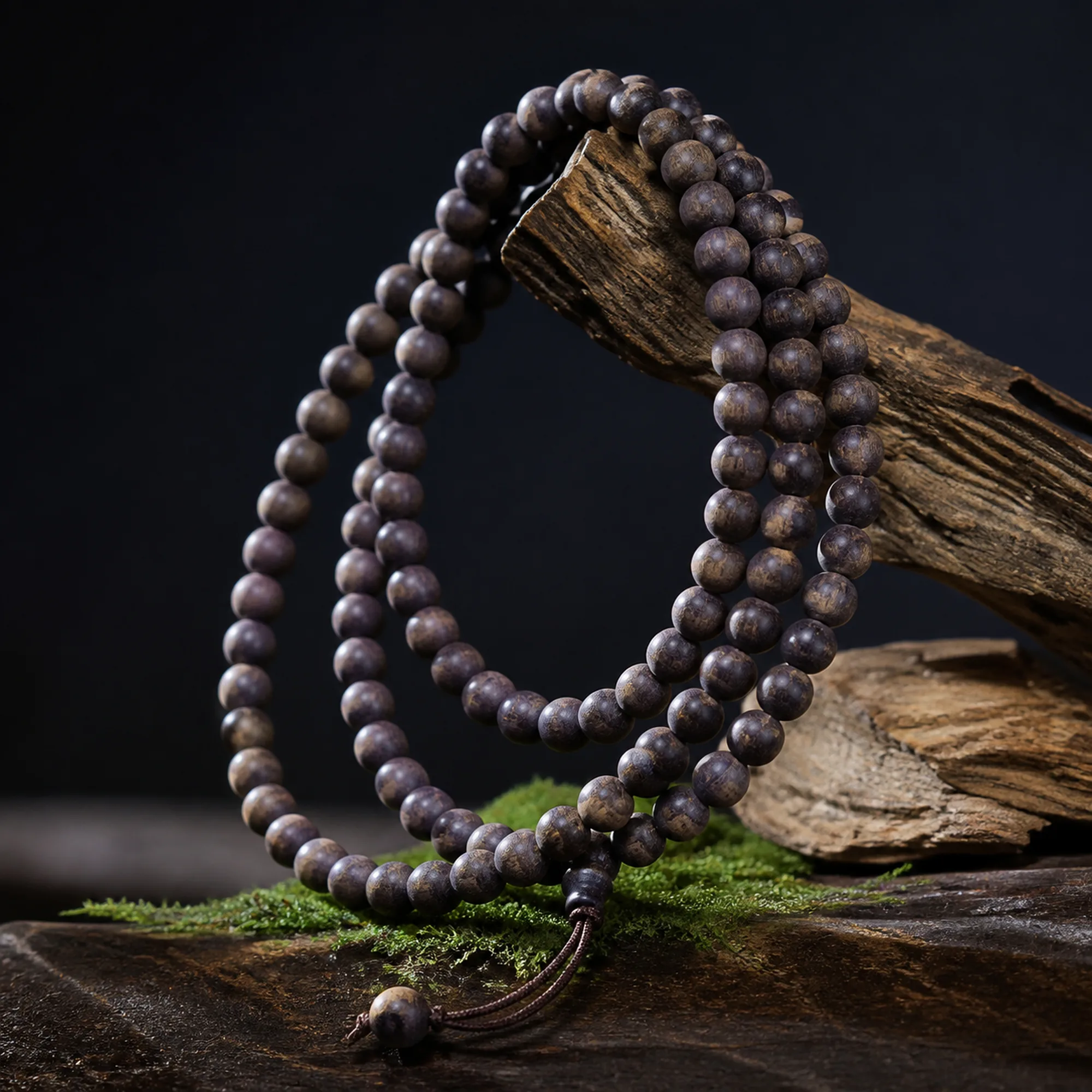
 108 beads
 Worn wrapped
The same 108 beads can be held for counting or wrapped round the wrist several times.
What are mala beads?
Mala beads are a string of beads used to count mantras or breaths during meditation. A full mala usually has 108 beads, with one larger bead, often called the guru bead, that marks where the count starts and ends.(Britannica 2026)
So mala beads are a counting tool first. Hindu and Buddhist practice both use them, and each tradition has its own customs. Also, many people now wear them round the neck or the wrist as a quiet reminder, even outside formal practice.
According to Britannica, a japa mala typically has 108 beads, with a larger guru or bindu bead marking the start and end. First you move one bead per mantra. Then you stop at the guru bead. Finally, a wrist mala of 27 beads reaches 108 in exactly 4 rounds.
Mala beads by size: length of 108 beads
This table is a 3-row summary. First read the bead size column, then compare the 108 beads, loop length, worn as, wraps round a 16 cm wrist across each row. For example, the first row covers “6 mm”.
| Bead size | 108 beads, loop length | Worn as | Wraps round a 16 cm wrist |
|---|---|---|---|
| 6 mm | about 65 cm | wrist wrap or short necklace | about 3.8× |
| 8 mm | about 86 cm | necklace or long wrap | about 5.1× |
| 10 mm | about 108 cm | long necklace | about 6.4× |
Loop length is roughly bead count times bead size, before the guru bead and tassel. Wraps assume about 17 cm per turn on a 16 cm wrist.
A full mala is a long strand, so bead size decides how the 108 beads are worn. For example, 108 beads of 6 mm make a loop of about 65 cm, which wraps round a 16 cm wrist almost 4 times. Beads of 10 mm make a loop of about 108 cm, long enough to hang low as a necklace. Additionally, the guru bead and any tassel add a few centimetres. On a japa mala, that larger guru bead marks the start and end of each round, according to Britannica.(Britannica 2026)
Part 1 — Why do mala beads have 108 beads?
The number 108 is a meaningful count in several Indian traditions, and a full set of mala beads keeps to it. The meaning, according to Britannica, links 108 to the cycle of life.(Britannica 2026) In practice, one round of 108 mantras also takes a few minutes, which suits a seated session.
However, shorter malas are common too. For example, wrist malas of 27, 21 or 18 beads are easy to find. A 27-bead wrist mala reaches 108 in exactly 4 rounds, and an 18-bead mala reaches 108 in 6.
Other faiths count with different numbers. A Catholic rosary has 59 beads, arranged as five decades of ten Hail Marys plus the opening beads.(USCCB) A Muslim tasbih often has 99 or 33 beads, which recall the names of God.(Britannica) Finally, the count always follows the practice, not the material, so a Buddhist mala in agarwood still has 108 beads.
Part 2 — Choosing mala beads by bead and wood
The best mala beads for most people are 6 to 8 mm beads in a material that feels right in the hand. First, pick a bead size you like to hold. Beads of 6 to 8 mm are the most common, because they move smoothly between the fingers. Second, choose the material. Seeds, stones and woods are all traditional, and each one feels different in the hand.
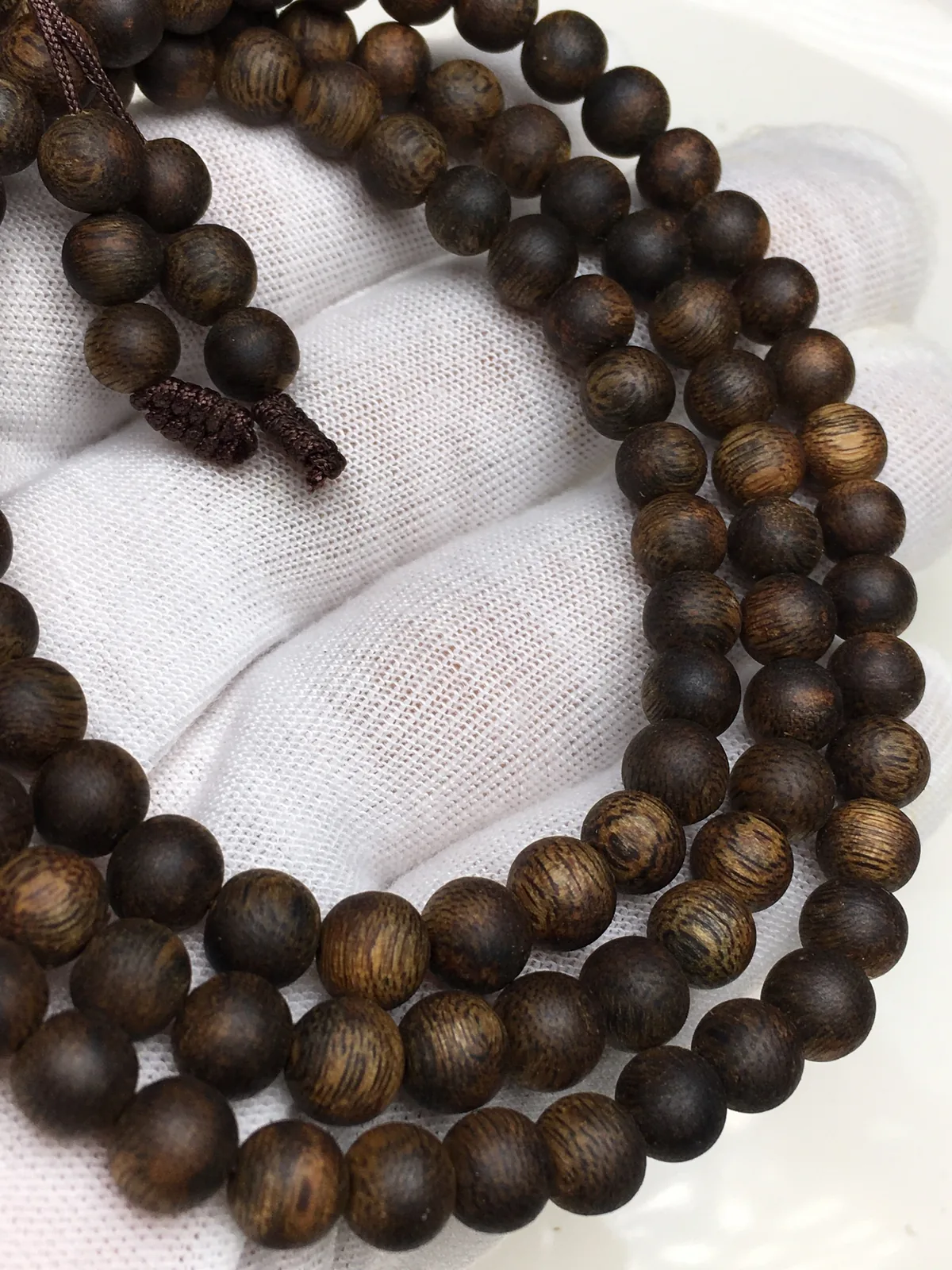
Wood is light and quiet. Agarwood is the resin-filled heartwood of Aquilaria trees, and the dark lines in each bead are that resin. The soft, warm scent comes from compounds in the resin, according to a 2011 review by Naef.(Naef 2011) For example, a wooden mala feels warm against the skin, while a stone mala starts cool. Agarwood has long been valued for prayer beads across Asia for both reasons. Finally, keep the strand dry, and wipe the beads with a soft cloth.
A full mala or a wrist mala?
This comparison is a 4-point check of Full mala (108) against Wrist mala (18–27). For example, the first row compares counting. Finally, pick the column that matches what you need.
| Feature | Full mala (108) | Wrist mala (18–27) |
|---|---|---|
| Counting | One round = 108 | Several rounds to reach 108 |
| Worn as | Necklace or multi-wrap | Single bracelet |
| Bead size | Usually 6–8 mm | Usually 8–12 mm |
| Best for | Seated practice | Carrying through the day |
A full mala is the better choice for seated counting, because one round of 108 beads is one complete count. A wrist mala is the easier strand to carry, since a 27-bead loop sits on the wrist like any bracelet. For example, many people keep a full strand at home for morning practice and wear a wrist mala through the day. On a full japa mala, the larger guru bead marks where each round starts and ends, according to Britannica.(Britannica 2026)
Ordering agarwood mala beads
This process is a 4-step sequence, from “Choose the count” to “Approve, then pay”. First follow step 1, then work down the 4 steps of “Ordering agarwood mala beads” in order.

- 1
Step 1: Choose the count
108 beads, or a shorter wrist mala.
- 2
Step 2: Choose the bead size
Usually 6 to 8 mm for a full mala.
- 3
Step 3: We string and film
We string the beads and weigh the mala on camera.
- 4
Step 4: Approve, then pay
Check the video, then approve before paying.
Ordering agarwood mala beads is a short exchange with no payment until you approve the strand. In practice, most questions come at step 2, because bead size sets both the loop length and the weight. Additionally, every strand goes on the scale on camera, so you see the real beads with Aquilaria resin lines before you pay.
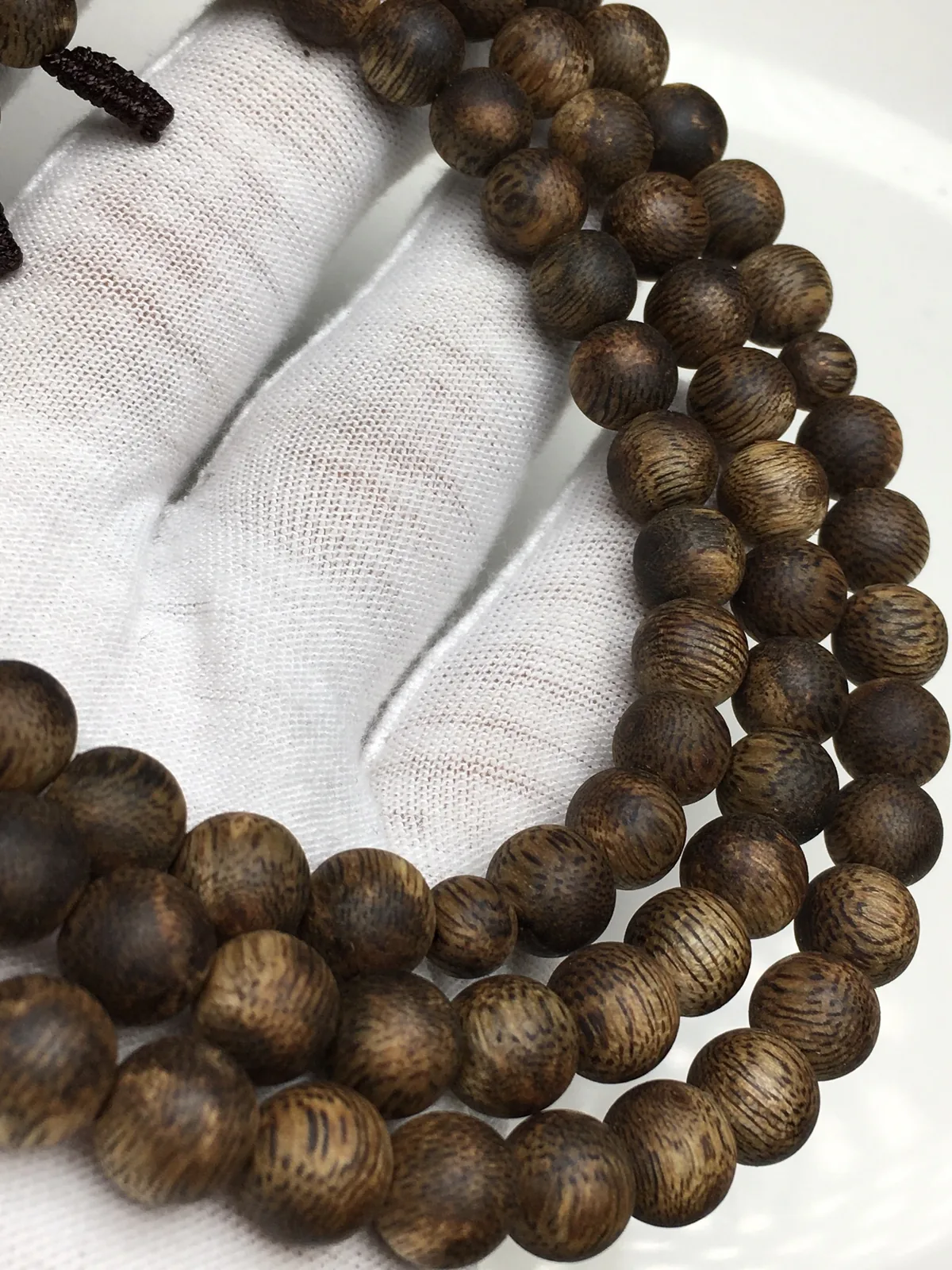
Mala beads, on film
Multi-wrap strands, on film
Finally: mala beads you will use
Good mala beads are simply the ones you pick up every day. A mala is a counting tool first, so the right strand is the one that suits your practice. First, choose a count: 108 beads for seated practice, or a wrist mala of 27, 21 or 18 beads for the day. Second, choose a bead size you like to hold, usually 6 to 8 mm for a full mala. Finally, choose a material that feels right, and let the strand wear in with use.
Our agarwood is plantation-grown, and every strand ships under the rules for Aquilaria set out in the CITES appendices. All Aquilaria species sit in Appendix II, according to CITES, so international trade needs permits.(CITES) Browse our agarwood malas, and we film your strand on the scale before you pay.
Frequently asked questions
This FAQ is a set of 8 short answers about mala beads. First find your question below. For example, many facts in these answers about mala beads come from the 5 published sources in References, which we checked in September 2026.
How many beads are in a mala?
A full mala usually has 108 beads, plus one larger guru bead that marks where the count starts and ends. Shorter wrist malas of 27, 21 or 18 beads are also common; you simply count round them several times to reach 108.
Why do mala beads have 108 beads?
The number 108 carries meaning in several Indian traditions, and Britannica links it to the cycle of life. In practice, 108 also gives a round of counting that takes a few minutes, which suits a seated practice. Each tradition has its own explanation.
What is the guru bead on a mala?
It is the larger bead, often with a tassel, that marks the start and end of the count. Many people turn the mala round when they reach it rather than crossing over it. Customs differ between traditions, so follow the practice you were taught.
Can I wear mala beads every day?
Yes. Many people wear mala beads as a necklace or wrap them round the wrist. Keep them away from water, perfume and sweat where you can, because these wear the cord first. Wooden malas warm against the skin and stay light for daily wear.
What bead size is best for mala beads?
Beads of 6 to 8 mm are the most common for a full 108-bead mala, because they move smoothly between the fingers and keep the strand a comfortable length. Wrist malas often use larger beads of 8 to 12 mm, since there are fewer of them.
Are wooden mala beads a good choice?
Yes. Wood is light, quiet and warm in the hand, and it has been used for prayer beads for centuries. Agarwood adds dark resin lines and a soft scent. Keep wooden mala beads dry and wipe them with a soft cloth, and they last for years.
How long is a 108-bead mala?
Roughly the bead count times the bead size. So 108 beads of 6 mm make a loop of about 65 cm, and 108 beads of 8 mm about 86 cm, before the guru bead and tassel. That is long enough to wear as a necklace or wrap several times.
Do you add a guru bead and tassel?
We string the round agarwood beads to 108 on request. Tell us whether you would like a guru bead or tassel, and we say plainly what we can add before we quote. We weigh and film the finished strand, and you approve it before paying.
References
This reference list is the source record for “Mala Beads: Why 108, How to Choose and How to Wear Them”, with 5 published sources. According to the citations in “Mala Beads: Why 108, How to Choose and How to Wear Them”, such as (Britannica 2026), each one links to one entry below. Finally, we checked all 5 links behind “Mala Beads: Why 108, How to Choose and How to Wear Them” in September 2026.
- 1Encyclopaedia Britannica. Japa mala. Britannica, 2026.View source
- 2United States Conference of Catholic Bishops. How to Pray the Rosary. USCCB, current.View source
- 3Encyclopaedia Britannica. Subḥah. Britannica, current.View source
- 4Naef R.. The volatile and semi-volatile constituents of agarwood, the infected heartwood of Aquilaria species: a review. Flavour and Fragrance Journal 26(2): 73–87, 2011.doi:10.1002/ffj.2034
- 5CITES Secretariat. Appendices I, II and III. Convention on International Trade in Endangered Species of Wild Fauna and Flora, current.View source
References are listed for transparency. We summarise them for general reading; nothing here is medical advice, and no health effect is claimed.
In this article
Styles mentioned


Related articles
Weighed before you pay
Choose a style, get your strand weighed
Pick a bead and size, send your request, and we reply with a video of your piece on the scale — its exact weight and price. Nothing is charged until you approve.